
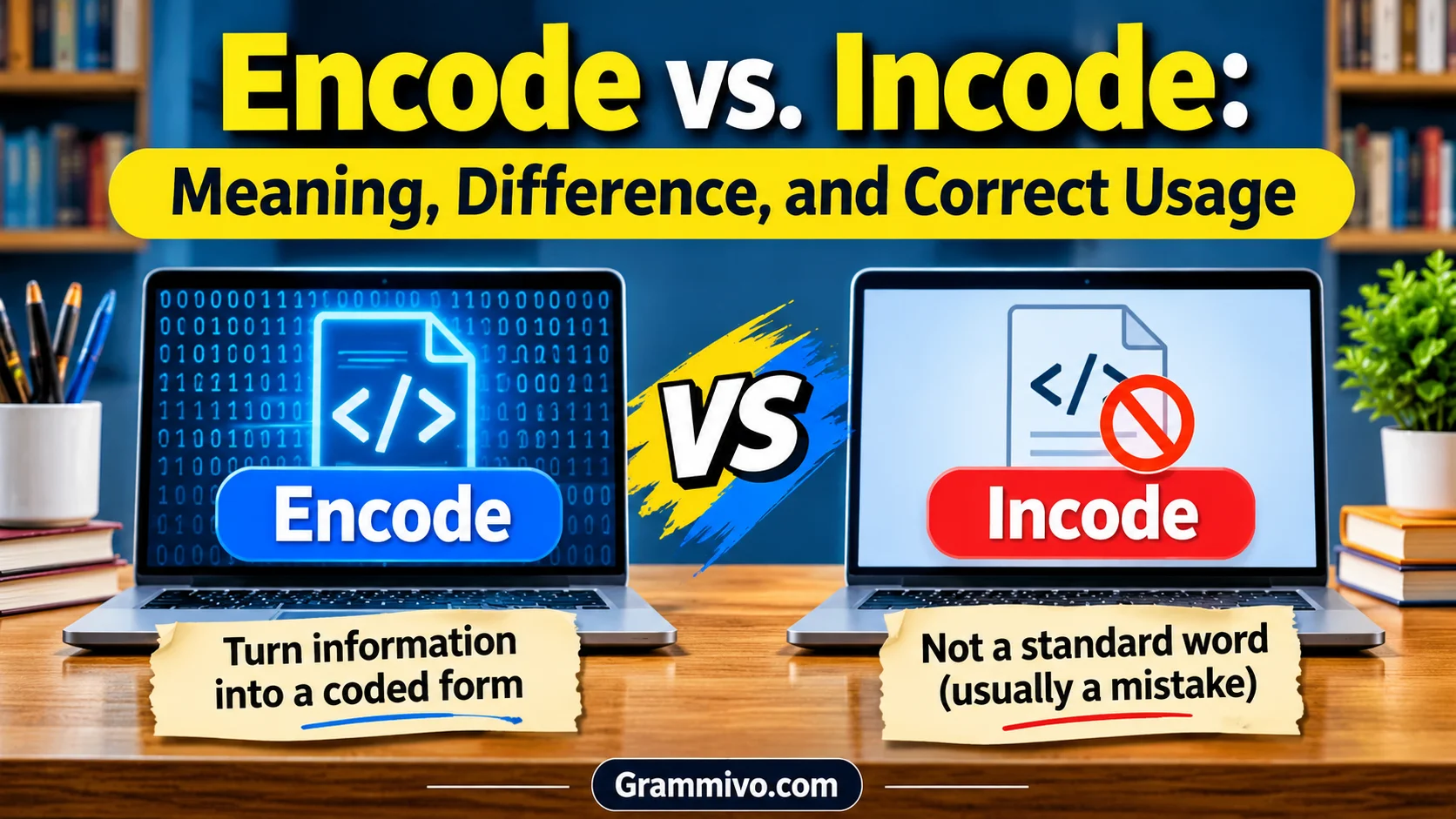
Have you ever wondered whether the correct spelling is encode or incode? These two forms look similar at first glance. However, only one is a standard English word with an established meaning.
The confusion often appears in writing about computers, digital information, data processing, and communication. You might see someone write incode when they actually mean encode. Although the difference involves just one letter, choosing the wrong spelling can make your sentence confusing or technically inaccurate.
The word encode has several important uses. It describes converting information into a particular format, representing messages through symbols, and preparing digital data for storage or transmission. You’ll encounter it in programming, computing, telecommunications, and everyday communication.
Quick Answer:
Encode is the correct standard English word when you mean converting information into a particular code, format, or representation. Incode is not generally recognized as a standard English word and is usually a misspelling of encode in this context.
For example:
- Correct: The software can encode the video into a smaller file.
- Incorrect: The software can incode the video into a smaller file.
Encode is commonly used in technology, computing, communication, and data processing. If you’re describing the process of converting information into a different representation, choose encode, not incode.
Comparison Overview
The easiest way to understand encode vs. incode is to compare their spelling, meaning, grammatical function, and everyday usage.
| Feature | Encode | Incode |
| Standard spelling | Correct | Generally incorrect |
| Part of speech | Verb | Not a standard English verb |
| Meaning | Convert information into a code or format | No established general English meaning |
| Pronunciation | /ɪnˈkoʊd/ | No standard pronunciation |
| Common usage | Computing, communication, and data processing | Usually a spelling mistake |
| Dictionary recognition | Established English word | Not generally recognized as a standard word |
| Example | Encode the information before sending it. | Usually replace with encode. |
The central difference is straightforward: encode is an established English word, whereas incode is not a standard alternative.
However, understanding how encode works will help you recognize when and why this spelling matters.
Main Differences Between Encode and Incode
Although these terms look almost identical, they don’t have equal standing in standard English. Their differences become clearer when you examine their meanings, spelling patterns, pronunciation, and grammatical roles.
What Does Encode Mean?
Encode is a verb that means to convert information into a particular code, format, or system of representation.
The process changes how information appears or is organized without necessarily changing the underlying message or information itself.
For example, a computer cannot process every type of information in the same way humans understand it. It uses specific formats and encoding systems to represent text, images, sounds, and other data.
Consider a simple example. When you type a message on your computer, the characters need to be represented using a system that the computer can store and process. Character encoding systems such as UTF-8 make this possible.
Here are several common uses of encode:
- Computing: Converting information into a format computers can process.
- Communication: Representing messages through symbols or signals.
- Data processing: Transforming information into a structured representation.
- Digital media: Converting audio or video into a particular digital format.
- Information security: Representing information using a defined encoding scheme.
Example sentences:
- The application can encode text using UTF-8.
- Engineers encode digital signals before transmitting them.
- The video editor will encode the finished project into MP4 format.
- Researchers encode survey responses into numerical categories.
- The device uses a special system to encode audio signals.
In each example, encode describes converting information into another representation.
What Does Incode Mean?
Incode is not generally recognized as a standard English word with an established dictionary meaning.
Most people who write incode when discussing data conversion, programming, or communication actually intend to write encode.
For example:
- Incorrect: Please incode the message before sending it.
- Correct: Please encode the message before sending it.
The confusion probably comes from the familiar prefix in- and the pronunciation of encode. However, spelling similarities don’t automatically make two words interchangeable.
There are situations where the exact string incode might appear as a software identifier, product name, username, or specialized label. Such uses don’t establish it as a standard English vocabulary word.
You might also encounter the expression in code, written as two separate words. This is different from the one-word spelling incode.
For example:
- The instructions were written in code.
- The developer entered the information directly into the code.
Here, in code means using or appearing within a code. It doesn’t mean the same thing as the verb encode.
Encode vs. Incode: Spelling Differences
The spelling difference between encode and incode involves their first letters.
- Encode: E-N-C-O-D-E
- Incode: I-N-C-O-D-E
The correct standard spelling is encode when referring to the process of converting information into a coded representation.
A common mistake is adding an extra initial letter because the word begins with a sound that resembles the short vowel in in. However, pronunciation doesn’t determine the spelling.
Remember these examples:
| Incorrect spelling | Correct spelling |
| Incode the file | Encode the file |
| Incode the message | Encode the message |
| Incode the data | Encode the data |
| Incode the video | Encode the video |
| Incode the information | Encode the information |
A simple way to remember the spelling is to associate encode with encoding and encoder. These related forms all use the same enco- spelling.
Encode vs. Incode: Pronunciation
Pronunciation can also contribute to confusion between these forms.
The standard pronunciation of encode is:
- IPA: /ɪnˈkoʊd/
- Simple pronunciation: in-KOHD
The first syllable sounds like the word in, while the second syllable rhymes with code.
This explains why some writers mistakenly spell it as incode. They hear the initial sound and assume the word begins with the letters in.
However, the correct spelling remains encode.
Because incode isn’t a standard English word, it doesn’t have an established dictionary pronunciation. Someone might pronounce it as in-code, but that doesn’t make it an accepted alternative.
Encode vs. Incode: Grammatical Usage
Understanding grammatical forms makes it easier to use encode correctly in different sentences.
Encode functions as a regular verb. It changes according to the tense and grammatical structure of a sentence.
Here are its main forms:
| Word form | Grammatical function | Example |
| Encode | Base form | We encode the information. |
| Encodes | Third-person singular | This application encodes text. |
| Encoded | Past tense or past participle | The system encoded the file. |
| Encoding | Present participle or gerund | Encoding the data takes time. |
Let’s examine these forms more closely.
Encode: Use the base form after modal verbs or with plural subjects.
Example: The program can encode several file types.
Encodes: Use this form with singular third-person subjects in the simple present tense.
Example: This device encodes audio automatically.
Encoded: Use this form when describing a completed action or the resulting state.
Example: The information was encoded before transmission.
Encoding: Use this form when discussing the ongoing process or treating the activity as a noun.
Example: Encoding digital information requires an appropriate format.
The word incode doesn’t have these established grammatical forms in standard English. Therefore, don’t use incodes, incoded, or incoding as replacements for the corresponding forms of encode.
How to Use Encode in Sentences
Knowing the definition is useful, but seeing encode in different situations makes its meaning much easier to understand.
The word appears in several fields. Its basic meaning remains similar, although the type of information and encoding method can change.
Encode in Technology and Computing
Computers use encoding to represent information in formats they can store, process, and exchange.
For example, text characters need a consistent representation so different devices and applications can interpret them correctly.
One widely used character encoding standard is UTF-8. It represents Unicode characters using one to four bytes and supports characters from many writing systems.
Without compatible character encoding, text can appear incorrectly when transferred between applications or devices.
Consider these examples:
- A website uses UTF-8 to display text correctly.
- A developer encodes user input before storing it.
- The software encodes images into a supported file format.
- A computer encodes information before sending it across a network.
Encoding also plays an important role in digital media.
For instance, video applications encode raw video and audio data into compressed formats. This process helps create files that are easier to store, stream, and share.
Practical example:
Imagine recording a video on your smartphone. The camera captures visual information, but the resulting file needs a suitable digital representation.
A video encoder processes the footage and produces a compressed video stream. Depending on the selected settings, it may use a codec such as H.264 or H.265.
This is an example of encoding in everyday technology.
Encode in Data Security and Communication
Encoding also helps represent information during communication between different systems.
Devices often need to convert information into formats that match a communication standard. Both the sending and receiving systems must understand the relevant format.
For example, a communication system might encode digital information into signals suitable for transmission through a particular medium.
This process helps devices exchange information accurately.
However, there’s an important distinction between encoding and encryption.
Encoding changes the representation of information. Encryption protects information by making it unreadable without the appropriate key.
These processes serve different purposes.
| Feature | Encoding | Encryption |
| Main purpose | Change information representation | Protect information |
| Uses a key | Not necessarily | Typically requires cryptographic keys |
| Primary goal | Compatibility or data representation | Confidentiality |
| Reversible | Usually, with the appropriate decoding method | With the correct decryption key |
| Example | UTF-8 encoding | AES encryption |
For example, converting text into Base64 is an encoding process. It doesn’t provide meaningful confidentiality because anyone can decode it without a secret key.
By contrast, properly implemented encryption protects sensitive information from unauthorized access.
Understanding this difference helps you use encode accurately in technical writing.
Encode in Everyday English
Although encode frequently appears in technology, it also has broader uses.
People can encode messages, instructions, information, and signals using symbols or established systems.
For example, a teacher might ask students to encode information into a chart. A researcher might encode interview responses into categories for analysis.
Here are some natural examples:
- The students learned how to encode messages using simple symbols.
- The researcher will encode each response into a separate category.
- The organization uses a standard format to encode its records.
- The transmitter can encode information into electronic signals.
- The puzzle requires you to encode each letter using a number.
In these situations, encode doesn’t necessarily involve computers. It simply describes representing information through another system.
Common Mistakes When Using Encode and Incode
Spelling mistakes aren’t the only problems that can occur when using encode. Some writers also confuse it with related technical terms.
Understanding these differences helps you choose words that accurately describe the intended action.
Writing Incode Instead of Encode
This is the most direct mistake associated with the topic.
Because encode begins with a sound similar to in, writers sometimes assume that incode is an acceptable spelling.
However, standard English uses encode for this meaning.
Consider these corrections:
- Incorrect: The developer needs to incode the data.
- Correct: The developer needs to encode the data.
- Incorrect: This application can incode audio files.
- Correct: This application can encode audio files.
- Incorrect: We should incode the information before sharing it.
- Correct: We should encode the information before sharing it.
The correction is simple. Replace incode with the appropriate form of encode.
Confusing Encode With Encrypt
Encode and encrypt are related to information processing, but they don’t mean the same thing.
Encoding changes the representation of information, while encryption protects its confidentiality.
For example, Base64 converts binary information into a text-based representation. Anyone who understands the format can reverse the conversion.
Encryption works differently. It transforms readable information into ciphertext using a cryptographic algorithm and key.
Consider these sentences:
- Correct: The application encodes the image into JPEG format.
- Correct: The application encrypts the confidential document before transmission.
Using encrypt when you mean encode can create technical confusion. The reverse mistake can also misrepresent an important security feature.
Frequently Asked Questions
Is Encode or Incode Correct?
Encode is the correct standard English spelling when describing the process of converting information into a code or format. Incode isn’t generally accepted as a standard English alternative.
For example, write “encode the message” rather than “incode the message.”
Is Incode a Real English Word?
Incode isn’t generally recognized as a standard English word with an established dictionary meaning. It may appear as a proper name, identifier, or specialized label in certain contexts. However, it shouldn’t replace encode in ordinary writing.
What Does Encode Mean in Simple Words?
Encode means changing information into another format or system so it can be stored, processed, or communicated.
For example, a computer encodes text into a character format that allows software to interpret it correctly.
What Is the Difference Between Encode and Encrypt?
Encode means converting information into a particular representation. Encrypt means transforming information to protect it from unauthorized access.
Encoding doesn’t automatically provide security. Encryption specifically serves a security purpose and typically relies on cryptographic keys.
What Is the Opposite of Encode?
Decode is the usual opposite of encode.
Encoding converts information into a particular representation. Decoding interprets or reverses that representation to recover usable information.
For example, a device may encode a message before sending it. The receiving device then decodes the message.
Conclusion:
When comparing encode vs. incode, the correct choice is clear. Encode is the established English word for converting information into a particular code, format, or representation. You can use it when discussing computers, digital media, communication, information processing, and other situations involving coded information. On the other hand, incode isn’t a standard English alternative. If you’re using it to describe converting information into another format, replace it with encode.
