
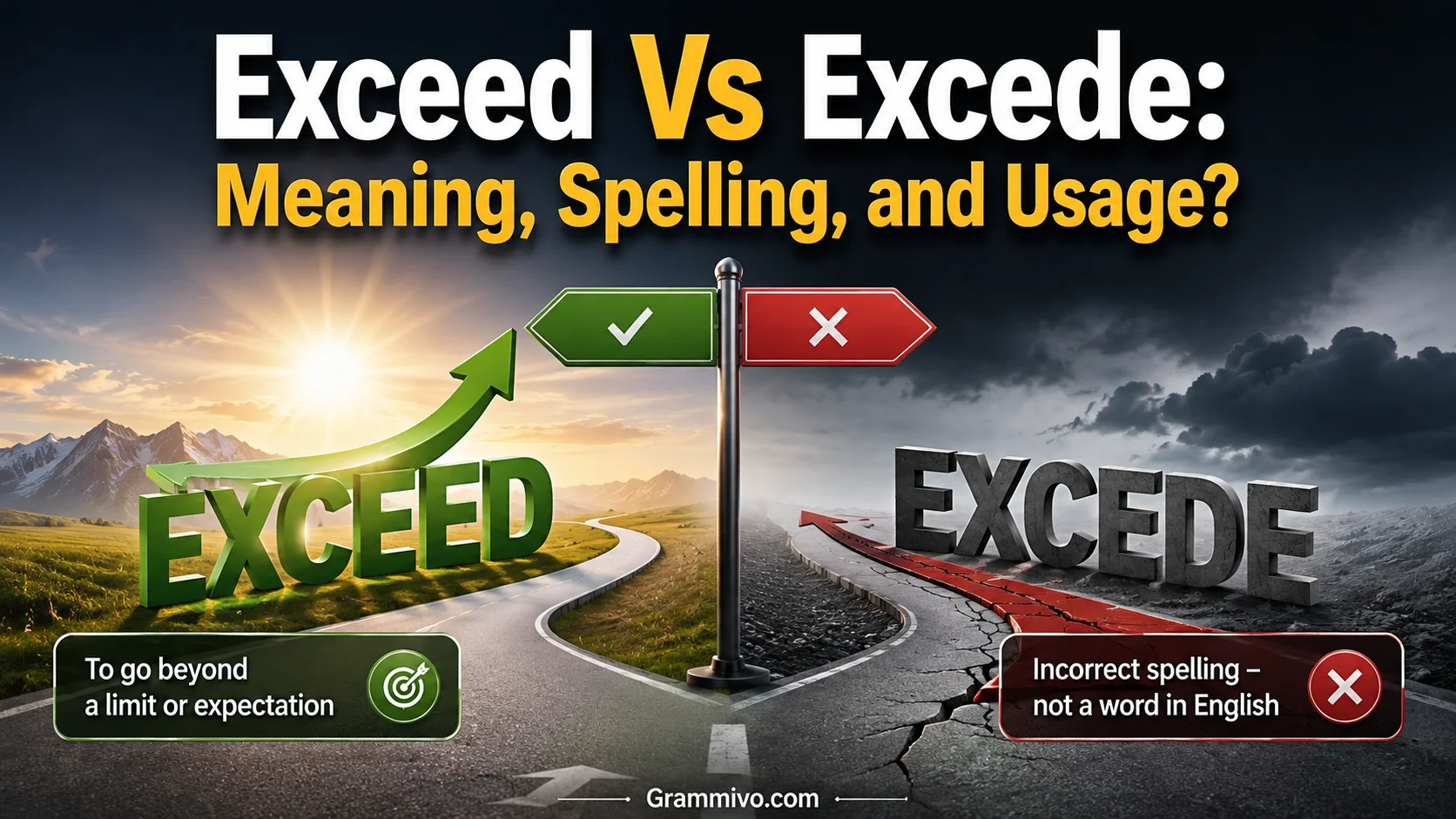
If you’ve ever hesitated between “exceed” and “excede,” you’re not alone. Both spellings look plausible at first glance, especially because English contains several common words ending in -cede, such as precede, recede, and concede. That makes excede seem like it should be a real English spelling.
However, when you’re writing standard modern US English, the correct word is exceed. It means to go beyond a limit, amount, expectation, requirement, or standard. For example, you can exceed a speed limit, exceed a budget, or exceed expectations.
The confusion becomes easier to understand when you look at how the word is spelled, pronounced, and used in different forms. There’s also a small linguistic wrinkle worth knowing: excede can appear in historical English and in other languages, so calling it universally meaningless would be inaccurate.
Quick Answer
The correct spelling in standard modern English is exceed, not excede. Exceed is a verb meaning “to go beyond,” “surpass,” or “be greater than” something. For instance, “The project costs may exceed the original budget” uses the word correctly.
| Word | Standard US English? | Meaning | Example |
| exceed | Yes | To go beyond or surpass | “Costs may exceed the budget.” |
| excede | Generally no | Usually an incorrect spelling of exceed in English | “Costs may excede the budget.” |
So, if you’re writing an email, school assignment, business report, article, resume, or everyday message in English, choose exceed.
The easiest spelling reminder is simple:
Exceed = ex + ceed
Notice the double e at the end: exceed.
What Does Exceed Mean?
Exceed means to go beyond a particular amount, limit, level, expectation, requirement, or standard. It can describe something that becomes greater than a stated boundary or something that performs better than an expected level.
Consider these examples:
- The driver exceeded the speed limit.
- The restaurant’s sales exceeded its monthly target.
- The repairs exceeded the original estimate.
- Her performance exceeded expectations.
- The crowd exceeded the venue’s capacity.
- The package cannot exceed the stated weight limit.
The word works with both measurable quantities and abstract standards.
You can exceed something concrete, such as a weight limit. You can also exceed something less tangible, such as an expectation.
That flexibility makes exceed a common word in business, education, finance, transportation, sports, technology, and everyday conversation.
What Does Excede Mean?
In standard modern English, excede is generally not the correct spelling of the verb meaning “to go beyond.” If you intend that English meaning, write exceed.
For example:
- Incorrect in standard English: “The expenses may excede the budget.”
- Correct: “The expenses may exceed the budget.”
There is an important distinction, though. The sequence excede isn’t simply a meaningless collection of letters. It can appear in historical English sources as an obsolete spelling related to exceed. It also occurs in other languages, including Spanish.
That distinction matters because language depends on context.
If you encounter excede in an old text or a Spanish sentence, it doesn’t automatically mean someone made a spelling mistake. But if you’re writing an ordinary sentence in modern US English, exceed is the form you want.
Exceed Vs Excede: Why Do People Get Them Confused?
The spelling confusion has a logical explanation. English contains several words that use the -cede pattern.
Think about these familiar verbs:
- precede
- recede
- concede
- intercede
- accede
After seeing those words, a writer might naturally assume that exceed should follow the same pattern and become excede.
There’s another problem: pronunciation doesn’t clearly reveal the spelling.
Exceed is commonly pronounced approximately:
ik-SEED
The final sound resembles “seed.” When you hear the word rather than see it written, you don’t get much information about whether the spelling should contain -ceed or -cede.
That’s where the mistake often begins.
The spelling difference at a glance
| Spelling | Letters after “ex” | Standard English verb? |
| exceed | ceed | Yes |
| excede | cede | No, not for the standard English verb |
The difference looks tiny. Its effect on correctness is significant.
How to Spell Exceed Correctly
The correct spelling is:
E-X-C-E-E-D
Break it visually into:
EX + CEED
The easiest part to forget is the second e.
A useful memory trick is to connect the spelling with the pronunciation:
exceed → ex-SEED
The final -ceed sounds like “seed,” which can help you remember that the word contains ee before the final d.
Don’t turn this into a rigid spelling rule for every English word. English spelling has too many historical exceptions for that. Instead, treat exceed as a word whose spelling is worth memorizing.
Another useful approach is to remember its common grammatical forms:
- exceed
- exceeds
- exceeded
- exceeding
Once you recognize the base spelling, the other forms become much easier.
Exceed Meaning: The Main Ways to Use It
The meaning of exceed changes slightly depending on what follows it. The central idea remains the same: something goes beyond a particular point.
Exceed a Limit
This is one of the most common uses.
When something becomes greater than an allowed maximum, it exceeds the limit.
Examples:
- The driver exceeded the speed limit.
- The suitcase exceeded the airline’s weight limit.
- The download exceeded the allowed data limit.
- The vehicle must not exceed the posted speed.
Here, the boundary is clear. If the limit is 65 mph and a vehicle travels at 70 mph, the vehicle has exceeded the limit.
The same construction works with many other restrictions.
Exceed an Amount
You can use exceed when one quantity becomes greater than another.
For example:
- The final cost exceeded $5,000.
- Attendance exceeded 10,000 people.
- The company’s expenses exceeded its forecast.
- Temperatures exceeded 100 degrees.
This usage often appears in reports and factual writing because it communicates a measurable difference without unnecessary wording.
Exceed Expectations
Exceed expectations is one of the most familiar expressions involving the word.
It means to perform better than someone expected.
For example:
“The new product exceeded our expectations.”
The sentence doesn’t necessarily mean the product broke a physical limit. Instead, its performance went beyond the level people anticipated.
You might say:
- The candidate exceeded expectations during the interview.
- The restaurant exceeded my expectations.
- Her first novel exceeded readers’ expectations.
- The team’s results exceeded expectations.
This expression works especially well when discussing performance, quality, service, or results.
Exceed Requirements
You can also exceed requirements by doing more than a rule, specification, or standard demands.
For example:
“The new safety system exceeds federal requirements.”
The sentence means the system does more than the minimum required level.
That’s different from simply meeting requirements.
Meet requirements = satisfy the stated standard.
Exceed requirements = go beyond the stated standard.
That distinction often matters in professional and technical writing.
Exceed in a Sentence: Correct Examples
Seeing the word in different contexts makes its usage much easier to recognize.
| Context | Example |
| Budget | “The renovation may exceed the original budget.” |
| Speed | “The driver exceeded the posted speed limit.” |
| Weight | “The box exceeds the maximum permitted weight.” |
| Expectations | “The final results exceeded expectations.” |
| Capacity | “The event exceeded the hall’s stated capacity.” |
| Sales | “Quarterly sales exceeded the company’s forecast.” |
| Cost | “The repair costs exceeded the initial estimate.” |
| Performance | “The athlete exceeded her previous record.” |
| Requirements | “The product exceeds the required safety standard.” |
| Target | “The campaign exceeded its fundraising target.” |
| Number | “Applications exceeded the available places.” |
| Time | “The meeting exceeded its scheduled length.” |
Notice how the word stays consistent while the thing being surpassed changes.
That’s the heart of exceed: the subject goes beyond a reference point.
Excede Vs Exceed: Common Spelling Mistakes
Many errors don’t involve the base word alone. Writers sometimes carry the incorrect spelling into other grammatical forms.
Here’s how the common mistakes compare:
| Incorrect Form | Correct Form |
| excede | exceed |
| exceded | exceeded |
| exceding | exceeding |
| exceds | exceeds |
| excede expectations | exceed expectations |
| exceded the limit | exceeded the limit |
| exceding the target | exceeding the target |
The pattern is worth remembering:
exceed → exceeded → exceeding → exceeds
The base -ceed spelling remains visible throughout the standard forms.
Example
Incorrect:
“The company’s revenue exceded its forecast.”
Correct:
“The company’s revenue exceeded its forecast.”
Incorrect:
“The vehicle is exceding the speed limit.”
Correct:
“The vehicle is exceeding the speed limit.”
These aren’t differences in meaning. They’re spelling errors caused by changing -ceed to -cede.
Exceed, Exceeds, Exceeded, and Exceeding
Knowing the different forms helps prevent mistakes when writing longer sentences.
Exceed
Use the base form after modal verbs and in certain constructions.
- We cannot exceed the limit.
- The costs may exceed the estimate.
- Try not to exceed the recommended amount.
Exceeds
Use exceeds with a singular third-person subject in the present tense.
- The price exceeds our budget.
- This model exceeds the required standard.
- Demand exceeds available supply.
Exceeded
Use exceeded for the past tense and past participle.
- Sales exceeded the forecast.
- The driver exceeded the limit.
- The final cost has exceeded our estimate.
Exceeding
Use exceeding as the present participle or gerund.
- The company is exceeding its sales target.
- Exceeding the limit may result in a penalty.
- The project is exceeding its original timeline.
The spelling stays anchored to exceed.
Exceed Vs Surpass Vs Go Beyond
These words overlap, but they don’t always sound equally natural.
Exceed often works best with limits, amounts, expectations, requirements, and measurable standards.
“The expenses exceeded the budget.”
Surpass often emphasizes achieving a higher level than another result, person, or standard.
“The athlete surpassed her previous record.”
Go beyond is more conversational and flexible.
“The service went beyond what customers expected.”
Here’s a practical comparison:
| Word or phrase | Common emphasis | Example |
| Exceed | Limits, amounts, expectations, requirements | “Costs exceeded the estimate.” |
| Surpass | Performance or achievement | “She surpassed the previous record.” |
| Go beyond | General or conversational meaning | “The team went beyond expectations.” |
| Outdo | Doing better than someone or something | “The sequel outdid the original.” |
You can sometimes substitute these words, but the tone changes slightly.
For business and technical writing, exceed is often the cleanest choice when you’re describing a measurable threshold.
Read More: Foreign vs. Foriegn: Which Spelling Is Correct?
Common Phrases With Exceed
Certain combinations appear frequently because the meaning fits naturally.
Exceed Expectations
Perform better than anticipated.
“The service exceeded expectations.”
Exceed the Limit
Go beyond an allowed maximum.
“Do not exceed the posted limit.”
Exceed Capacity
Become greater than the amount something can hold or support.
“The venue exceeded its recommended capacity.”
Exceed Requirements
Perform above the required standard.
“The equipment exceeds the minimum requirements.”
Exceed the Budget
Cost more than the planned amount.
“The project exceeded the budget.”
Exceed the Target
Achieve more than the intended goal.
“The campaign exceeded its target.”
Exceed Projections
Produce a result higher than an earlier estimate.
“Revenue exceeded projections.”
Exceed the Maximum
Go beyond the highest permitted value.
“The temperature exceeded the maximum recorded level.”
These phrases are useful because they show that exceed isn’t limited to one narrow situation.
Is Excede Ever Correct?
This question deserves a more careful answer than a simple “no.”
If the question is “Should I use exceed or excede in standard modern English?”, the answer is clear:
Use exceed.
However, excede does occur outside that ordinary modern-English usage.
Historical English texts can contain excede as an obsolete spelling associated with exceed. In addition, excede appears in Spanish. In Spanish, it comes from the verb exceder and can function as a present-tense form meaning “exceeds.”
For example, a Spanish sentence might contain:
“El costo excede el presupuesto.”
In English, that means roughly:
“The cost exceeds the budget.”
The important lesson is context.
If you’re proofreading an English article and see:
“The price will excede the budget.”
you should normally correct it to:
“The price will exceed the budget.”
If you’re reading a Spanish document, however, excede may be perfectly correct in that language.
So the most accurate rule is:
Excede isn’t the standard modern English spelling of the verb “to exceed,” but the form can legitimately appear in historical or non-English contexts.
Exceed Vs Excede in American English
For writers using American English, the practical choice is straightforward.
Use exceed in:
- School assignments
- College papers
- Business reports
- Emails
- Resumes
- Articles
- Websites
- Technical documentation
- Marketing copy
- Everyday messages
Examples:
“The expenses exceeded the approved budget.”
“The product exceeds the minimum specifications.”
“Customer demand exceeded the company’s forecast.”
Using excede in these sentences would make the writing look misspelled.
That doesn’t mean every reader will stop and analyze the error. Some may understand exactly what you mean. Correct spelling still matters because polished writing builds credibility.
A single spelling error rarely ruins a document. Repeated errors can make the writer appear careless, especially in formal or professional settings.
FAQs:
Is exceed or excede correct?
Exceed is correct in standard modern English when you mean “go beyond” or “be greater than.”
Is “excede” a word?
Excede can appear in historical English and in other languages. However, it isn’t the standard modern English spelling of the verb exceed.
What does exceed mean?
Exceed means to go beyond a limit, amount, expectation, requirement, standard, or other reference point.
What is the past tense of exceed?
The past tense is exceeded.
“The final cost exceeded the estimate.”
What is the present participle of exceed?
The present participle is exceeding.
“The company is exceeding its target.”
Conclusion:
The exceed vs excede question has a simple answer for modern English writing: exceed is the correct spelling. Use exceed when you mean to go beyond a limit, amount, expectation, requirement, or standard. Its common forms are exceed, exceeds, exceeded, and exceeding.
The spelling mistake happens because English contains many familiar -cede words, making excede look reasonable. Pronunciation doesn’t help much either because exceed sounds roughly like “ik-SEED.”
