
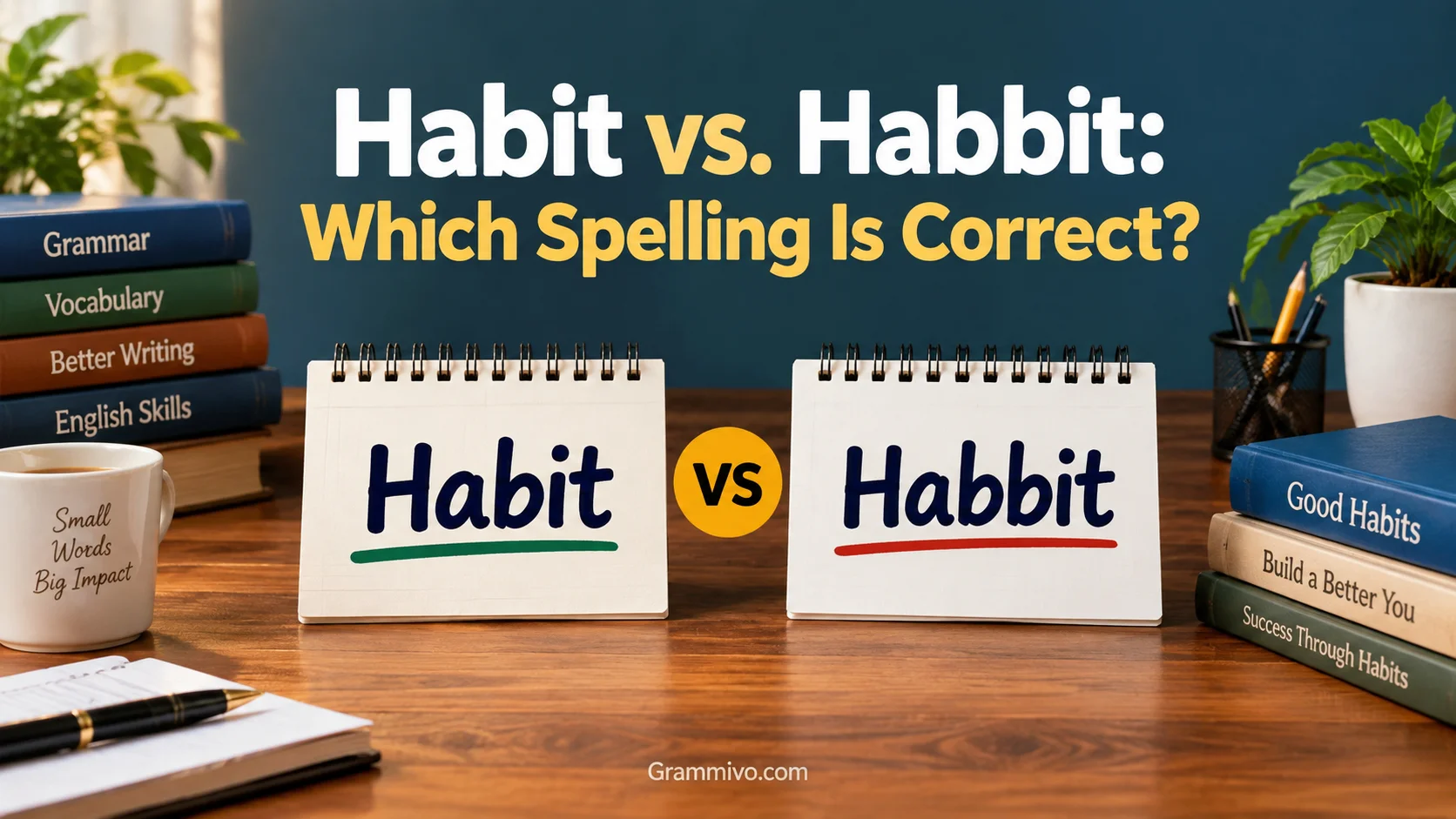
For Habit vs. Habbit, the correct spelling is habit, while habbit is a common misspelling that can affect clear writing. If you’ve typed the word and paused, you’re not alone in this confusion. The correct choice is habit, not Habbit, which is a common spelling mistake and common misspelling rather than a standard English word.
In standard US English, habit describes a regular action, routine, tendency, or custom. If you’re wondering about habbit or habit, the answer is simple: write habit with one b, not two b. These forms look similar, so English learners, students, and professionals can easily confuse them.
Using the wrong spelling may reduce readability and make your writing appear unprofessional.A useful guide to habbit or habit meaning also includes synonyms, Oxford Dictionary references, plural forms, examples, and pronunciation. The spelling of habit keeps a single b, even though English has words where a consonant doubles after certain suffixes or follows particular pronunciation patterns.
Quick Answer
Habit is the correct spelling. Habbit is incorrect in standard English.
The word habit usually means a behavior or action that someone repeats regularly. It can also refer to a customary way of behaving or, in older and specialized usage, a type of clothing.
Correct
- habit
- habits
- habitual
- habitually
Incorrect
- habbit
For example:
Reading for twenty minutes every evening is a good habit.
Not:
Reading for twenty minutes every evening is a good habbit.
The easiest thing to remember is simple: habit has one b.
Comparison Overview
| Word | Correct Spelling? | Meaning | Example |
| Habit | Yes | A repeated behavior, practice, or customary action | Walking every morning became a habit. |
| Habbit | No | Misspelling of habit | Habbit is not the standard spelling. |
There isn’t a meaning difference between habit and habbit because habbit isn’t an accepted standard spelling of the word.
Whether you’re writing an email, school assignment, article, report, or social media post, use habit.
Main Differences Between Habit vs. Habbit
The biggest difference between habit vs. habbit is spelling rather than meaning. Habit is the standard English word, while habbit is a spelling error.
Habit Is the Correct Spelling
Habit is a noun that commonly describes something you do repeatedly or regularly. The repeated behavior can be intentional at first, although it may eventually become automatic.
For example:
- Drinking water after waking up is a healthy habit.
- She has a habit of taking notes during meetings.
- His habit of staying up late affects his mornings.
- Reading before bed became part of her daily habit.
The word can describe positive, negative, neutral, personal, or social behaviors.
Habbit Is a Misspelling
Habbit adds an unnecessary second b.
You may encounter this spelling online, in informal writing, or in user-generated content. Its appearance doesn’t make it a legitimate alternative spelling.
For standard written English, change habbit to habit.
For example:
Incorrect:
Exercise is a healthy habbit.
Correct:
Exercise is a healthy habit.
This is an important distinction because spell-checking software may catch some instances of habbit, but you shouldn’t rely entirely on automated correction. Knowing the correct form makes proofreading much easier.
What Does Habit Mean?
The most common meaning of habit involves repeated behavior.
When you perform an action again and again, that action can become familiar and predictable. Over time, you may perform it with little conscious thought.
Think about what happens when you wake up and automatically reach for your phone. If you do that every morning, you might describe checking your phone as a habit.
Habit as a Repeated Behavior
A habit can involve almost any everyday action.
For example:
- Brushing your teeth before bed
- Drinking coffee in the morning
- Checking email after arriving at work
- Exercising several times a week
- Reading before sleeping
- Taking notes during lectures
- Locking the door before leaving home
Not every repeated action necessarily becomes a deeply ingrained habit. Context, frequency, personal routines, and repetition can all affect how automatic a behavior becomes.
The key idea is regular repetition.
Habit as a Regular Practice
Habit can also describe a person’s usual practice or tendency.
Consider this sentence:
He has a habit of arriving ten minutes early.
The sentence doesn’t necessarily mean arriving early happens at exactly the same time every day. Instead, it describes a recurring pattern of behavior.
Similarly:
She has a habit of asking thoughtful questions.
Here, habit describes a recurring tendency rather than a rigid daily routine.
Habit as Clothing
The word habit has another meaning that appears less often in modern everyday conversation.
Historically, habit could refer to clothing or dress. The word has been associated particularly with religious clothing and certain forms of riding attire.
For example, a religious habit can refer to the distinctive clothing worn by members of some religious orders.
A riding habit historically referred to clothing designed for horseback riding, particularly clothing worn by women.
This meaning can still appear in historical writing, literature, and specialized contexts.
Why Is Habit Spelled With One B?
The spelling habit comes from a long linguistic history rather than from a modern spelling shortcut.
English ultimately traces the word to Latin habitus, which is related to habere, meaning “to have” or “to hold.” The word entered English through French and developed into the form habit.
That history helps explain why English doesn’t spell it habbit.
The modern spelling contains only one b:
H-A-B-I-T
There is no spelling rule that requires a second b in the word.
Why the Extra B Seems Tempting
English contains plenty of words with doubled consonants:
- rabbit
- hobby
- address
- common
- different
- successful
Because habit sounds somewhat similar to words containing doubled consonants, writers may instinctively add another b.
The visual pattern can be misleading.
Compare:
- habit
- rabbit
Both contain the sound represented by b, but their spellings differ. You can’t reliably determine English spelling simply by copying the pattern of a similar-sounding word.
Why Is “Habbit” Incorrect?
The spelling habbit doesn’t create a new word with a different definition. It simply adds a letter that doesn’t belong.
This mistake can happen for several reasons.
Consonant Doubling Confusion
English spelling often doubles consonants in particular circumstances. For example, a final consonant can double before certain suffixes:
- run → running
- sit → sitting
- begin → beginning
However, those spelling patterns don’t mean that every word containing a consonant should have a doubled version.
Habit is already correctly spelled with one b.
Influence From Similar Words
A writer who knows words such as rabbit, hobby, or ribbon may unconsciously expect another b.
That’s a spelling association, not a rule.
The correct form remains:
habit
Pronunciation Doesn’t Add Another B
Another common problem involves trying to spell a word according to how it sounds.
The pronunciation of habit doesn’t provide a reason to insert an additional b. English spelling often preserves historical patterns that aren’t perfectly predictable from pronunciation alone.
That’s why visual familiarity with the correct spelling matters.
Habit vs. Habbit in American English
In American English, the standard spelling is habit.
British English also uses habit. This means there’s no US-versus-UK spelling distinction here.
Compare that with words such as:
- color / colour
- aluminum / aluminium
- favorite / favourite
Those words have recognized spelling differences between American and British English.
Habit doesn’t.
| Variety | Correct Form |
| American English | habit |
| British English | habit |
| Canadian English | habit |
| Australian English | habit |
| Incorrect form | habbit |
So if you’re wondering whether habbit might be a British spelling, the answer is no. The standard form remains habit.
Common Phrases With Habit
Knowing common expressions can make the correct spelling easier to remember. It also helps you use habit naturally in your own writing.
Break a Habit
The expression break a habit means to stop a repeated behavior.
For example:
She wants to break her habit of checking social media during work.
The phrase often appears when someone wants to replace an unwanted behavior.
Form a Habit
Form a habit means to develop a repeated behavior.
Try to exercise at the same time each morning to form a consistent habit.
You can also use develop a habit:
He developed a habit of reviewing his notes every evening.
Get Into the Habit of
Get into the habit of means to become accustomed to doing something regularly.
Get into the habit of backing up important files.
This expression is especially useful when discussing routines, productivity, study practices, and health.
Have a Habit of
The phrase have a habit of describes something someone regularly tends to do.
My brother has a habit of leaving his keys on the kitchen counter.
The behavior doesn’t have to be good or bad. Context determines the meaning.
Good Habit and Bad Habit
A good habit generally refers to a behavior that produces a useful result.
Examples include:
- Exercising regularly
- Reading consistently
- Keeping a schedule
- Getting enough sleep
- Reviewing work before submitting it
A bad habit usually refers to a behavior that causes problems or works against someone’s goals.
Examples might include:
- Procrastinating
- Constantly checking notifications
- Skipping important tasks
- Staying up unnecessarily late
The labels good and bad depend partly on context. A behavior that’s useful in one situation may be unhelpful in another.
Read More: Sneaked or Snuck: Which Past Tense Is Correct?
Habit vs. Habbit Examples
Examples make the spelling difference crystal clear.
Correct Examples With Habit
Here are natural examples using habit:
- Drinking water throughout the day is a healthy habit.
- Reading every night became one of his favorite habits.
- She has a habit of organizing her desk before starting work.
- He is trying to break the habit of checking his phone during meals.
- Daily practice helped her develop a strong study habit.
- Waking up early was difficult until it became a habit.
- Good writing habits can make editing much easier.
- His habit of interrupting people sometimes causes problems.
Notice that habit works in several different grammatical structures.
Incorrect Examples With Habbit
These sentences contain the common misspelling:
- Exercise is a healthy habbit.
- She developed a reading habbit.
- He wants to break this bad habbit.
- Checking your work should become a good habbit.
The corrections are straightforward:
- Exercise is a healthy habit.
- She developed a reading habit.
- He wants to break this bad habit.
- Checking your work should become a good habit.
Habit vs. Habbit: Easy Way to Remember the Spelling
Here’s a simple memory trick:
Habit has one B.
You can picture the word as:
HA + B + IT
Only one B sits in the middle.
Another useful trick is to connect the spelling with the phrase “one-b habit.”
A habit has one B.
It sounds almost like a tiny spelling rule, which makes it easier to recall when you’re writing quickly.
If you see habbit on the page, stop for a second. Ask yourself whether you’ve accidentally doubled the b.
The answer will usually be yes.
Habit vs. Habbit in a Sentence
The word habit can appear in many sentence patterns.
As the Subject
A good habit can save time.
Here, habit performs the grammatical role of the subject.
As the Object
She developed a useful habit.
Here, habit receives the action of the verb developed.
With “Of”
He has a habit of checking his calendar every morning.
This structure is especially common when describing recurring behavior.
In the Plural
The plural of habit is habits.
Healthy habits can support a consistent daily routine.
Notice that the plural simply adds s:
habit → habits
There is still only one b.
Related Words and Forms
Once you understand habit, several related words become easier to recognize.
Habit
A habit is a repeated behavior, practice, or customary tendency.
Reading is one of her favorite habits.
Habits
Habits is the plural form.
Small habits can shape your daily routine.
Habitual
Habitual is an adjective meaning usual, regular, or repeated.
His habitual morning walk helps him start the day.
The spelling still contains only one b.
Habitually
Habitually is an adverb.
She habitually checks her schedule before leaving home.
This word describes an action that someone performs regularly or as a customary pattern.
Habit-Forming
Habit-forming describes something that can lead to repeated use or behavior.
The app was designed to encourage habit-forming routines.
The spelling of the base word remains habit.
Habit vs. Habbit: A Simple Spelling Check
When you’re unsure about habit vs. habbit, run through this quick checklist:
- Is the word spelled H-A-B-I-T? Yes.
- Does standard English use habbit? No.
- Does American English use habit? Yes.
- Does British English use habit? Yes.
- Does the plural become habits? Yes.
- Does the related adjective contain one b? Yes: habitual.
This takes only a few seconds.
A Practical Case Study: Spotting the Mistake
Imagine you’re proofreading a workplace email:
I’ve developed a habbit of reviewing every report twice before sending it.
At first glance, the sentence looks perfectly normal. The meaning is clear. However, one letter creates the problem.
The corrected version is:
I’ve developed a habit of reviewing every report twice before sending it.
The sentence doesn’t need restructuring. You only need to remove the extra b.
This illustrates an important point about spelling errors: a misspelled word can still be understandable. Correct writing, however, requires the standard form.
In professional communication, that small correction can make your writing look more polished and deliberate.
Common Spelling Mistakes With Habit
Habbit is by far the main spelling confusion addressed here, but related words can also create uncertainty.
Habit vs. Habbit
Habit is correct.
Habbit is incorrect.
Habit vs. Habitual
These words are related but serve different grammatical roles.
- Habit = noun
- Habitual = adjective
- Habitually = adverb
For example:
Reading is a useful habit.
She is a habitual reader.
She habitually reads before bed.
Understanding the word family helps you choose the correct form rather than treating every variation as interchangeable.
FAQs:
Is habit or habbit correct?
Habit is the correct spelling in standard English. Habbit is a misspelling and should not be used in formal or everyday writing.
What does habit mean?
A habit is a regular action, behavior, routine, or tendency that you repeat over time. For example, exercising every morning can become a healthy habit.
Why do people spell habit as habbit?
The mistake usually happens because some English words double a consonant in certain spelling patterns. However, habit has only one b, so habbit is incorrect.
What is the plural of habit?
The plural form is habits. For example, you might say, “Good study habits can improve your learning.”
How can I remember the spelling of habit?
A simple memory trick is to remember that habit has one b in the middle. Think of it as: ha-bit, not hab-bit.
Conclusion:
Habit is the correct spelling, while habbit is a common spelling mistake. Use habit when referring to a regular action, routine, tendency, or custom. Remembering the single b makes Habit vs. Habbit easy to handle in everyday writing.
