
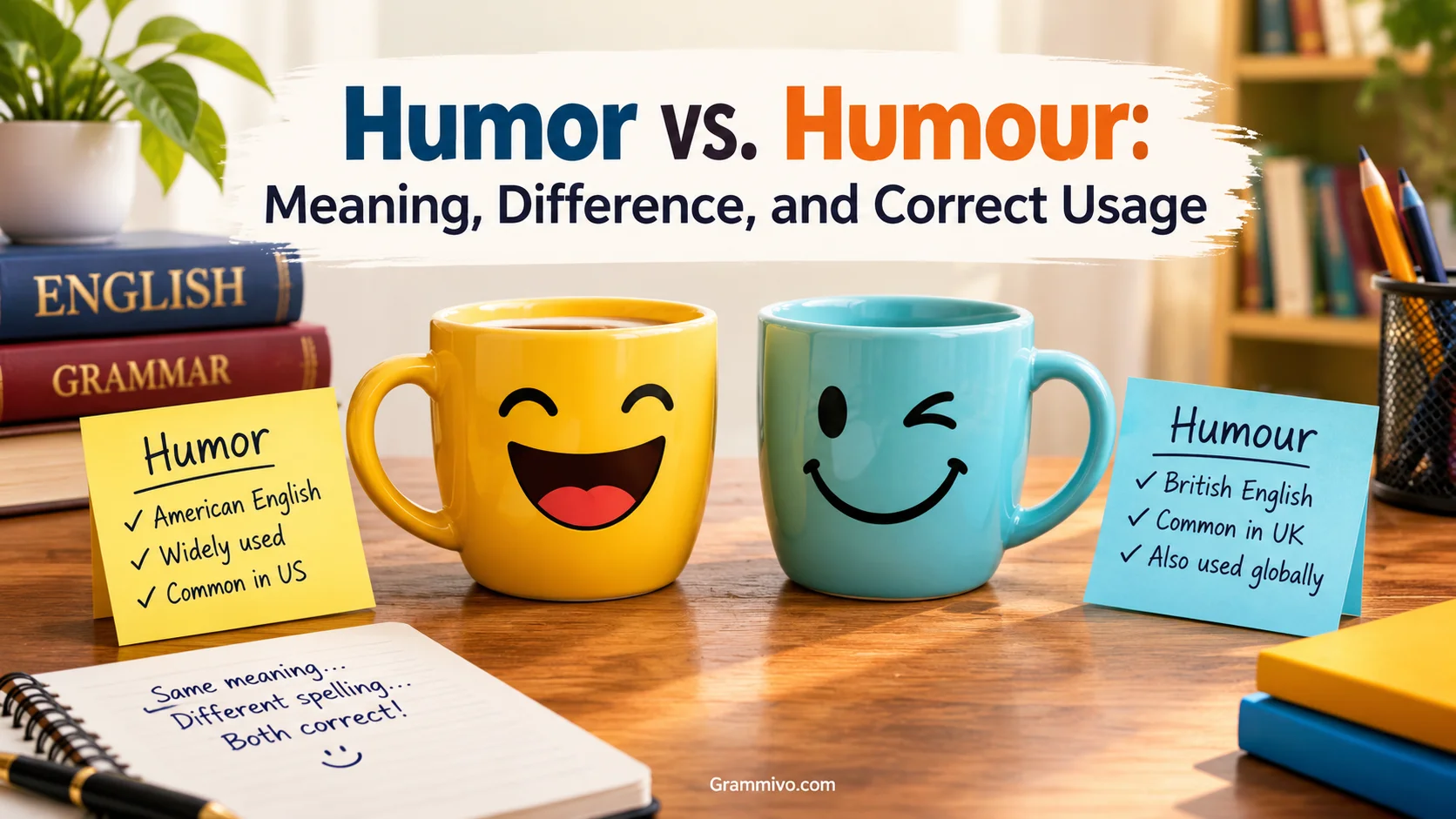
Have you ever wondered whether to write humor or humour? Both spellings appear in books, articles, conversations, and social media posts. Although they look slightly different, they share the same meaning and pronunciation in standard English.
The main difference comes down to regional spelling conventions. American English uses humor, while British English uses humour. Both forms describe the quality of being funny, the ability to appreciate jokes, or something that makes people laugh. The word can also function as a verb when someone accommodates another person’s wishes.
Choosing the right spelling becomes easier once you understand your audience. If you’re writing for an American publication, humor is usually the best choice. For a British, Australian, or Canadian audience, humour is generally preferred.
This guide explains the meanings, spelling differences, grammatical forms, regional preferences, and everyday expressions associated with both words. You’ll also find practical examples to help you choose the correct spelling confidently.
Quick Answer
Humor is the correct spelling in American English, while humour is the standard spelling in British English. Both words have the same meaning and pronunciation.
- Humor: Preferred in the United States.
- Humour: Preferred in the United Kingdom, Canada, and Australia.
- Meaning: The quality of being funny or the ability to recognize and appreciate what is amusing.
- Pronunciation: Generally the same in both spelling systems.
- Related forms: Humorous is standard in both American and British English, while humourous is generally considered a misspelling.
Example: An American writer might say, “She has a great sense of humor.” A British writer would typically write, “She has a great sense of humour.”
Neither spelling is universally better. The right choice depends on your audience and the spelling conventions you follow.
Comparison Overview
The following table highlights the essential differences between humor and humour.
| Feature | Humor | Humour |
| Correctness | Correct | Correct |
| Primary usage | American English | British English |
| Preferred in the United States | Yes | Generally no |
| Preferred in the United Kingdom | Generally no | Yes |
| Preferred in Canada | Less common | Generally yes |
| Preferred in Australia | Less common | Yes |
| Meaning | The quality of being funny | The quality of being funny |
| Pronunciation | Generally identical | Generally identical |
| Part of speech | Noun and verb | Noun and verb |
| Related adjective | Humorous | Humorous |
| Example | He appreciates my humor. | He appreciates my humour. |
The key distinction is spelling, not meaning. Both forms describe the same concept and work in the same grammatical contexts.
Canadian English deserves a small qualification. Canadian spelling often follows British conventions for words such as colour, favour, and humour, although Canadian usage also incorporates American influences. Individual publications may follow their own style guides.
Main Differences Between Humor vs. Humour
The Main Difference Is Regional Spelling
The most obvious difference is the letter u. American English drops that letter in humor, while British English retains it in humour.
This pattern appears in several other English words. For example, Americans write color, favor, and neighbor, whereas British writers typically use colour, favour, and neighbour.
These differences developed through the history of English spelling. They don’t indicate that one version is more intelligent, formal, or grammatically correct than the other.
Consider these examples:
- American English: “His humor makes difficult situations easier.”
- British English: “His humour makes difficult situations easier.”
Both sentences communicate the same idea. The spelling simply reflects the writer’s preferred English variety.
Humor and Humour Have the Same Meaning
Neither word carries a special meaning that the other lacks. Both can refer to jokes, comedy, a person’s ability to make others laugh, or the quality of finding something amusing.
For instance, a person with a good sense of humor can recognize funny situations and appreciate clever jokes. The same description applies to someone with a good sense of humour.
Both spellings also work when discussing different comedy styles, including dry humor, dark humor, observational humor, and self-deprecating humor.
The context determines the meaning of the word. The spelling tells readers which regional convention the writer follows.
Humor and Humour Have the Same Pronunciation
In standard English, humor and humour generally sound alike. Adding the letter u doesn’t create a separate syllable or change the word’s basic pronunciation.
Many American speakers pronounce the word approximately as HYOO-mer, although pronunciation varies by accent. British pronunciation also varies across regions, but the spelling difference doesn’t create a separate word.
The same principle applies when speaking about humor in conversation. You don’t need to pronounce the word differently just because you’re writing for a British audience.
Read More: Barbecue vs. Barbeque: Meaning, Difference, and Correct Usage
Humor and Humour Follow the Same Grammar Rules
Both spellings function as nouns and verbs. Their grammatical roles depend on how you use them in a sentence.
As a noun:
- American: “Her humor brightened the entire room.”
- British: “Her humour brightened the entire room.”
As a verb:
- American: “I’ll humor him for a few minutes.”
- British: “I’ll humour him for a few minutes.”
As a noun, the word often describes something abstract, such as a person’s comic sensibility. As a verb, it means accommodating someone, indulging their wishes, or going along with something to keep the peace.
For example, if your friend insists on explaining an unlikely theory, you might humor them by listening patiently. In British writing, you’d spell that verb humour.
What Does Humor Mean?
The word humor has several related meanings in American English. Most commonly, it describes the quality that makes something funny or a person’s ability to appreciate comedy.
However, humor isn’t limited to jokes or punchlines. It can appear in ordinary conversations, novels, films, advertisements, and even serious discussions. A clever observation, an unexpected comparison, or an awkward situation can all create humor.
Humor as a Noun
As a noun, humor can describe the quality of being amusing or the ability to recognize something funny. It can also refer to a particular style of comedy.
Here are some examples:
- “Her sense of humor makes every family gathering enjoyable.”
- “The movie combines humor with a serious message.”
- “His dry humor often catches people off guard.”
- “The writer uses humor to make a difficult subject easier to understand.”
In these examples, humor refers to something related to amusement or comedy.
The word is often uncountable when it describes a general quality. You might say, “I appreciate your humor,” rather than “I appreciate your humors.”
However, humor can have a plural form in specialized or historical contexts. For example, older medical theories referred to bodily humors, which were fluids once believed to influence health and temperament.
Humor as a Verb
As a verb, humor means to accommodate someone, indulge them, or temporarily go along with their wishes.
This meaning doesn’t necessarily involve laughter. Sometimes, you humor someone because you want to avoid an argument or allow them to express an idea.
Consider these examples:
- “I decided to humor my little brother and listen to his story.”
- “She humored her friend by pretending to consider the unusual suggestion.”
- “The manager humored the customer while looking for a practical solution.”
The verb often suggests patience, tolerance, or mild amusement. Depending on the situation, it can sound affectionate, neutral, or slightly dismissive.
For instance, saying “I’ll humor you” might mean you’re willing to hear someone out. However, it could also suggest that you don’t take their argument seriously.
Common Expressions With Humor
Several expressions use humor in American English. Understanding these phrases helps you use the word naturally.
- Sense of humor: The ability to recognize, enjoy, or create funny things.
- Dry humor: Comedy delivered with a straight face or little emotional expression.
- Dark humor: Comedy that deals with serious, disturbing, or uncomfortable subjects.
- Self-deprecating humor: Jokes in which someone makes fun of themselves.
- Good humor: A cheerful, pleasant, or agreeable mood.
- Humor me: A request asking someone to indulge you or hear you out.
- A touch of humor: A small amount of comedy added to something else.
For example, a teacher might use a touch of humor to make a difficult lesson more engaging. A novelist might use dark humor to explore a troubling subject without making every scene unbearably heavy.
What Does Humour Mean?
Humour is the standard British English spelling of the same word. It carries the same meanings, follows the same grammatical rules, and appears in the same kinds of expressions.
British writers use humour when discussing comedy, a person’s personality, or the ability to recognize amusing situations. They also use it as a verb when describing the act of indulging or accommodating someone.
Humour as a Noun
In British English, humour can describe the quality of being funny, a person’s comic sensibility, or a particular style of comedy.
Examples include:
- “Her sense of humour always lifts my spirits.”
- “The play combines sharp humour with social commentary.”
- “His dry humour makes even ordinary conversations entertaining.”
- “The author uses humour to explore difficult family relationships.”
These sentences mean exactly what their American equivalents mean. Only the regional spelling changes.
British publications commonly use expressions such as a sense of humour, a good sense of humour, and a wicked sense of humour. The last expression often describes someone whose jokes are mischievous, sharp, or slightly irreverent.
Humour as a Verb
The verb humour has the same meaning as the American verb humor. It can describe indulging someone, accommodating their wishes, or allowing them to continue an idea without challenging them immediately.
For example:
- “I’ll humour him while he explains his theory.”
- “She humoured her younger cousin by playing along.”
- “The teacher humoured the student’s imaginative explanation.”
In each example, the verb describes how someone responds to another person’s wishes or behavior.
The action might be kind, playful, or strategic. A parent might humour a child’s imaginative story, while a colleague might humour an overly enthusiastic suggestion during a meeting.
Common Expressions With Humour
British English uses many of the same expressions found in American English.
- Sense of humour: The ability to appreciate or produce comedy.
- Dry humour: Understated comedy delivered without obvious emotion.
- Dark humour: Comedy involving serious or uncomfortable subjects.
- Self-deprecating humour: Comedy based on making fun of yourself.
- Good humour: A pleasant or cheerful disposition.
- Humour me: An invitation to indulge someone or listen to an idea.
- A touch of humour: A small amount of comedy in a situation.
For example, a British reviewer might write, “The film balances emotional depth with gentle humour.” An American reviewer could express the same opinion using humor.
When to Use Humor vs. Humour
Choosing between these spellings becomes straightforward when you consider your audience. The goal isn’t to find one universally correct version. Instead, use the spelling that fits the English variety you’re writing.
Use Humor in American English
Choose humor when writing primarily for readers in the United States. American dictionaries and standard US editorial conventions use this spelling.
You’ll commonly encounter it in:
- American newspapers and magazines
- US school assignments and academic papers
- Business reports and professional emails
- American novels and screenplays
- Website articles aimed at US readers
- Social media posts written in American English
For example, an American entertainment journalist might write:
“The series relies on sharp humor to explore everyday workplace frustrations.”
An American teacher might also write:
“Humor can help students remember difficult concepts.”
Both sentences follow standard US spelling conventions.
If you’re writing an American English article, use humor, humorous, and humorously. Don’t switch to British spellings halfway through the article unless you’re discussing those forms directly.
Use Humour in British English
Choose humour when writing for a British audience. This spelling is standard in the United Kingdom and appears throughout British publications and professional writing.
Common contexts include:
- British newspapers and magazines
- UK school and university assignments
- British business correspondence
- Books published for British readers
- UK entertainment reviews
- Websites following British editorial conventions
For example:
“The comedian’s observational humour makes familiar situations unexpectedly funny.”
A British teacher might write:
“Appropriate humour can make classroom discussions more engaging.”
These sentences use the same vocabulary and grammar an American writer would use. The difference lies in the regional spelling convention.
Which Spelling Should You Use in Canada and Australia?
Canada and Australia generally favor humour, although local usage and editorial preferences can vary.
Canadian English often follows British conventions for words such as colour, favour, and humour. However, Canadian spelling isn’t simply British English copied word for word. It has its own conventions and sometimes reflects American influence.
Australian English generally retains the u in words such as humour, colour, and favour.
Consider these examples:
- Canadian English: “Her humour makes the presentation memorable.”
- Australian English: “The show combines music and humour.”
- American English: “The show combines music and humor.”
If you’re writing for a Canadian or Australian publication, check its style guide. A publication’s established preferences matter more than assumptions based on geography alone.
FAQs:
Is Humor or Humour Correct?
Both are correct. Humor is the standard American English spelling, while humour is the standard British English spelling.
Is Humor American or British?
Humor is the standard American English spelling. American writers use it in everyday communication, professional writing, academic work, and published content.
Is Humour British or American?
Humour is the standard British English spelling. It is also generally preferred in Canadian and Australian English.
Do Humor and Humour Mean the Same Thing?
Yes. Both words describe the quality of being funny, the ability to appreciate comedy, or something that causes amusement. They can also function as verbs meaning to accommodate or indulge someone.
Is It Sense of Humor or Sense of Humour?
Both expressions are correct. Use sense of humor in American English and sense of humour in British English.
Conclusion:
The difference between humor vs. humour is simple: humor is standard in American English, while humour is standard in British English and generally preferred in Canada and Australia. Both spellings share the same meaning, pronunciation, and grammatical functions. Neither is universally more correct than the other. Remember that related words such as humorous, humorously, and humorist retain their spelling in both American and British English.
