
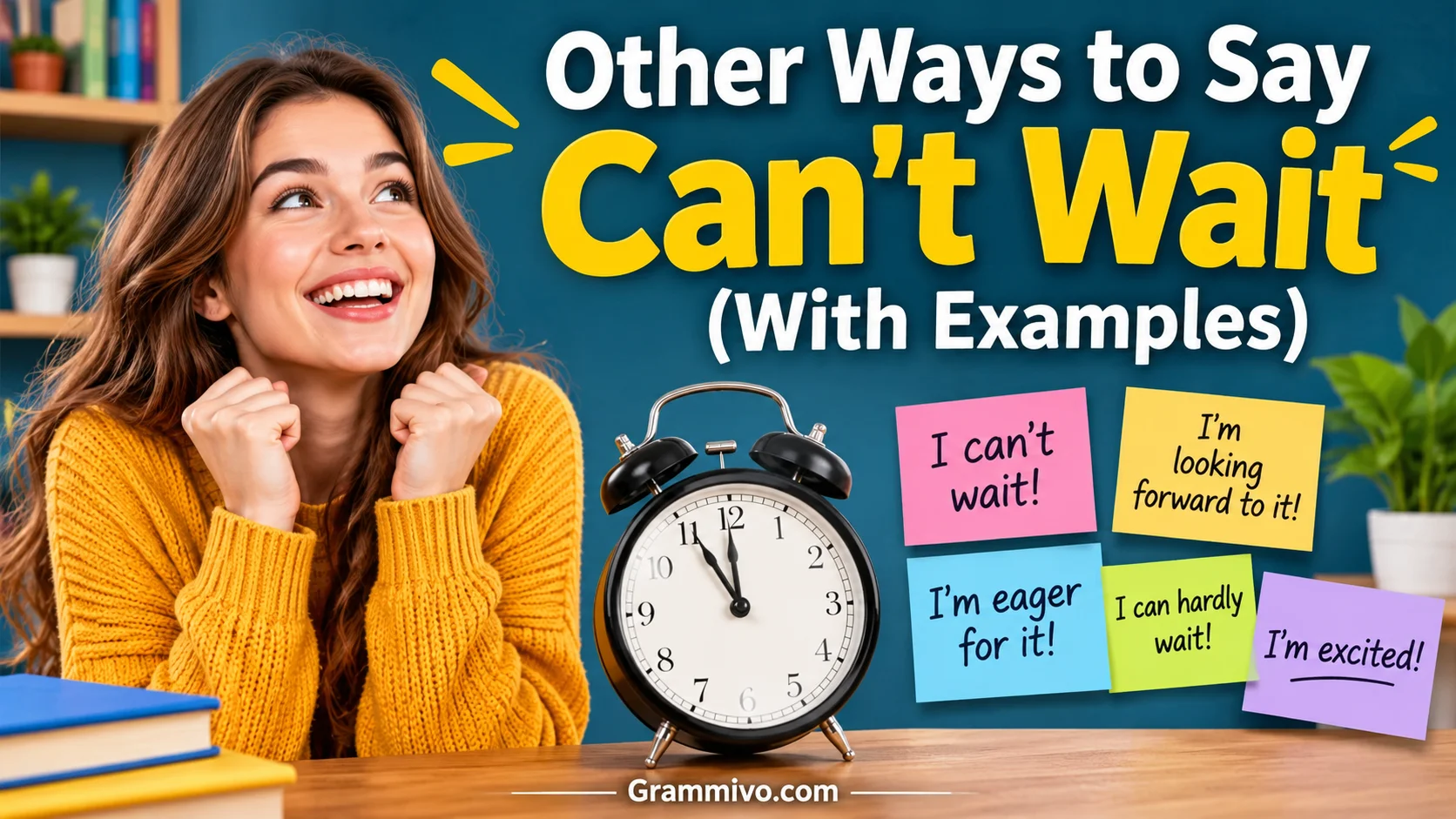
Sometimes, saying “I can’t wait” doesn’t quite capture how excited you feel. You might be looking forward to a vacation, anticipating an important meeting, or counting down the days until you see someone special. In these situations, choosing a different expression can make your message sound more natural, personal, or appropriate.
If you’re searching for other ways to say can’t wait, you’ll find plenty of useful options for everyday conversations, professional emails, and heartfelt messages. Some alternatives communicate excitement, while others emphasize anticipation, eagerness, or impatience. This guide explores 15 natural expressions, explains their differences, and shows you how to use each one correctly.
Quick Answer:
Here are some natural alternatives to “can’t wait” that American English speakers can use in different situations:
- Looking forward to it: A natural, versatile way to express positive anticipation.
- I’m excited about it: Communicates enthusiasm about something upcoming.
- I’m eager to: Shows strong interest in doing something.
- I can hardly wait: Emphasizes intense excitement and anticipation.
- Counting down the days: Suggests you’re eagerly waiting for a particular date.
- I’m thrilled about it: Expresses especially strong happiness and excitement.
- I’m really looking forward to it: A friendly, enthusiastic alternative.
- Eagerly anticipating: A more formal way to express expectation.
- I’m so ready for it: An informal way to show enthusiasm.
- I’m dying to: Communicates intense excitement or curiosity in casual conversation.
The best choice depends on what you’re anticipating and whom you’re speaking with. For example, “looking forward to it” works well in professional emails, while “I’m dying to see you” sounds more personal and informal.
Comparison Overview
The following table compares some of the most useful alternatives based on their tone and appropriate situations.
| Alternative | Best Used For | Tone |
| Looking forward to it | Emails and everyday conversations | Friendly, professional |
| I’m excited about it | Personal and professional situations | Enthusiastic |
| I’m eager to | Work, plans, and opportunities | Professional, positive |
| I can hardly wait | Special events and personal plans | Excited |
| Counting down the days | Vacations, weddings, and celebrations | Enthusiastic |
| I’m thrilled about it | Wonderful news and special occasions | Warm, expressive |
| Eagerly anticipating | Formal communication | Formal |
| I’m so ready for it | Casual conversations | Relaxed, enthusiastic |
| I’m dying to | Friends and informal conversations | Casual, expressive |
What Does “Can’t Wait” Mean?
The expression “can’t wait” means you’re extremely excited or eager for something to happen. It communicates positive anticipation, usually about an upcoming event, experience, opportunity, or meeting.
Grammatically, it’s an informal expression built around the verb “wait.” In this context, it doesn’t literally mean you cannot wait. Instead, it emphasizes how strongly you want something to happen soon.
People commonly use it in conversations, text messages, social media posts, and informal professional communication.
For example:
- I can’t wait for our family vacation next month.
- I can’t wait to hear about your new job.
- We can’t wait to celebrate your graduation.
The expression can also communicate impatience, depending on the situation. However, in everyday American English, it most often conveys excitement and enthusiasm.
When Is It Appropriate to Say “Can’t Wait”?
“Can’t wait” is a versatile expression, but its suitability depends on your relationship with the recipient and the communication setting.
Workplace communication: You can use it when discussing upcoming projects, team events, presentations, or professional opportunities. For example, “I can’t wait to work with everyone on this project” sounds friendly and enthusiastic.
Emails and business messages: The expression works in friendly workplace emails, especially when communicating with familiar colleagues. For more formal correspondence, “I’m looking forward to working with you” may sound more appropriate.
Friends and family: This is one of the most natural settings for “can’t wait.” You can use it when discussing vacations, celebrations, visits, or weekend plans.
Personal messages: The phrase works particularly well when expressing excitement about seeing someone or sharing a special experience.
Formal writing: In academic papers, official correspondence, and formal business documents, more measured expressions such as “I look forward to” or “I eagerly anticipate” may fit better.
Why Choose Different Ways to Say Can’t Wait?
Using different expressions helps you communicate enthusiasm without making every message sound the same.
Here are a few practical benefits:
- Match your tone: Choose wording that suits a professional relationship, friendship, or personal conversation.
- Express stronger emotions: Some alternatives communicate excitement, happiness, or anticipation more clearly.
- Sound more natural: Different situations call for different expressions.
- Personalize your messages: A heartfelt phrase can make your excitement feel more genuine.
- Avoid repetition: Varying your wording keeps emails, conversations, and social media posts engaging.
The goal isn’t to replace “can’t wait” every time. It’s to find an expression that communicates exactly what you mean.
Final List of Alternatives:
- Looking Forward to It
- I’m Excited About It
- I’m Eager to
- I Can Hardly Wait
- I’m Really Looking Forward to It
- I’m Thrilled About It
- Eagerly Anticipating
- Counting Down the Days
- I’m So Ready for It
- I’m Dying to
- I Can’t Wait to Find Out
- I’m Looking Forward to Seeing You
- I Look Forward to It
- I Can Barely Contain My Excitement
- I’m Looking Forward to What Comes Next
1. Looking Forward to It
Meaning and Usage: “Looking forward to it” is one of the most natural alternatives to “can’t wait.” It expresses positive anticipation about something expected to happen. Unlike “can’t wait,” it sounds slightly more measured and works comfortably in both professional and personal communication.
Examples:
- I’m looking forward to our meeting next Thursday.
- We’re looking forward to seeing everyone at the reunion.
- Thanks for inviting me. I’m really looking forward to it.
Best Use For: Professional emails, meetings, social gatherings, and everyday conversations.
Tone: Friendly, positive, and professional.
2. I’m Excited About It
Meaning and Usage: This expression directly communicates enthusiasm about an upcoming event, opportunity, or experience. It’s a straightforward replacement when you want to emphasize how happy or enthusiastic you feel rather than simply saying you’re waiting.
Examples:
- I’m excited about starting my new position.
- She’s excited about the upcoming family trip.
- We’re all excited about the weekend celebration.
Best Use For: Personal conversations, workplace discussions, announcements, and social messages.
Tone: Enthusiastic, friendly, and positive.
3. I’m Eager to
Meaning and Usage: “I’m eager to” communicates a strong desire to do something or experience something soon. It’s particularly useful when discussing opportunities, responsibilities, or future activities. Compared with “can’t wait,” it can sound more purposeful and slightly more professional.
Examples:
- I’m eager to learn more about your proposal.
- We’re eager to begin working on the new project.
- She’s eager to meet the rest of the team.
Best Use For: Professional emails, interviews, workplace conversations, and educational settings.
Tone: Professional, enthusiastic, and confident.
4. I Can Hardly Wait
Meaning and Usage: “I can hardly wait” is a close alternative to “I can’t wait.” Both expressions communicate intense anticipation, but this version emphasizes how difficult it feels to contain your excitement. It’s especially natural when discussing enjoyable personal experiences.
Examples:
- I can hardly wait to see the finished house.
- We can hardly wait for the concert tonight.
- He can hardly wait to open his birthday presents.
Best Use For: Celebrations, vacations, family gatherings, and exciting personal plans.
Tone: Enthusiastic, expressive, and friendly.
5. I’m Really Looking Forward to It
Meaning and Usage: This expression adds extra enthusiasm to the familiar phrase “looking forward to it.” It’s useful when you want to sound genuinely interested without appearing overly excited. It also works well when responding to invitations or discussing upcoming professional activities.
Examples:
- I’m really looking forward to our conversation tomorrow.
- The whole family is really looking forward to the reunion.
- I enjoyed our last meeting and am really looking forward to the next one.
Best Use For: Business emails, personal messages, meetings, and social invitations.
Tone: Warm, polite, and enthusiastic.
6. I’m Thrilled About It
Meaning and Usage: “I’m thrilled about it” communicates a particularly strong feeling of happiness and excitement. It can replace “can’t wait” when the upcoming event is genuinely important or exciting. However, it emphasizes your emotional reaction more than the act of waiting.
Examples:
- I’m thrilled about the opportunity to join your company.
- She’s thrilled about becoming a grandmother.
- We’re thrilled about our upcoming wedding.
Best Use For: Special announcements, major opportunities, celebrations, and personal milestones.
Tone: Excited, joyful, and expressive.
7. Eagerly Anticipating
Meaning and Usage: “Eagerly anticipating” is a more formal expression for looking forward to something with excitement. It works particularly well in polished writing and professional communication. Unlike casual expressions, it has a more deliberate tone and may sound too formal in relaxed conversations.
Examples:
- We are eagerly anticipating the launch of our new product.
- The organizers are eagerly anticipating this year’s event.
- I’m eagerly anticipating the results of the competition.
Best Use For: Formal emails, announcements, professional writing, and event-related communication.
Tone: Formal, polished, and enthusiastic.
Contextual and Casual Alternatives
These expressions can communicate excitement similar to “can’t wait,” but each carries a particular emphasis or works best in specific situations.
8. Counting Down the Days
Meaning and Usage: “Counting down the days” describes the excitement of waiting for a specific date or event. It suggests that you’re keeping track of the remaining time because you’re eager for something to happen. It’s not a universal replacement, but it works naturally when an event has a known date.
Examples:
- We’re counting down the days until our honeymoon.
- She’s already counting down the days until graduation.
- I’m counting down the days until my vacation begins.
Best Use For: Holidays, vacations, weddings, graduations, and special occasions.
Tone: Excited, cheerful, and personal.
9. I’m So Ready for It
Meaning and Usage: This casual expression communicates enthusiasm and readiness for an upcoming experience. It suggests you’re prepared and excited to get started. Unlike “can’t wait,” it places more emphasis on being ready than on the feeling of anticipation.
Examples:
- Summer vacation starts tomorrow, and I’m so ready for it.
- We’re so ready for the big game.
- I’ve finished all my preparations, and I’m ready for the conference.
Best Use For: Friends, family conversations, casual messages, and social media posts.
Tone: Relaxed, confident, and enthusiastic.
10. I’m Dying to
Meaning and Usage: “I’m dying to” is an informal expression that communicates an intense desire to do or experience something. It doesn’t describe literal physical harm. Instead, it adds emotional emphasis. Although it can replace “can’t wait” in casual situations, it may sound overly dramatic in professional communication.
Examples:
- I’m dying to see the pictures from your vacation.
- She’s dying to find out what happened.
- We’re dying to try that new restaurant downtown.
Best Use For: Text messages, conversations with friends, informal discussions, and personal communication.
Tone: Casual, expressive, and enthusiastic.
11. I Can’t Wait to Find Out
Meaning and Usage: This expression communicates excitement or curiosity about discovering information. It’s a more specific alternative because it focuses on learning something rather than experiencing an upcoming event. Use it when you’re anticipating an answer, announcement, result, or surprise.
Examples:
- I can’t wait to find out who won the competition.
- We’re excited to see what the new season brings.
- I can’t wait to hear how your interview went.
Best Use For: Conversations about results, surprises, announcements, and upcoming news.
Tone: Curious, enthusiastic, and conversational.
12. I’m Looking Forward to Seeing You
Meaning and Usage: This expression is particularly useful when you’re excited about meeting someone. It sounds warm and personal while remaining appropriate for professional relationships. Unlike the broader “can’t wait,” it specifically communicates anticipation about seeing another person.
Examples:
- I’m looking forward to seeing you at the family dinner.
- We’re looking forward to seeing you at the office next week.
- It’s been a while, and I’m looking forward to catching up.
Best Use For: Invitations, reunions, personal messages, and professional meetings.
Tone: Friendly, warm, and respectful.
13. I Look Forward to It
Meaning and Usage: “I look forward to it” is a polished and slightly more restrained alternative to “can’t wait.” It’s particularly common in professional correspondence and polite responses to invitations. It communicates positive anticipation without the strong emotional emphasis of more enthusiastic expressions.
Examples:
- Thank you for arranging the interview. I look forward to it.
- I look forward to discussing the proposal with you.
- We appreciate the invitation and look forward to attending.
Best Use For: Business emails, professional correspondence, formal invitations, and workplace communication.
Tone: Professional, courteous, and composed.
14. I Can Barely Contain My Excitement
Meaning and Usage: This expressive phrase emphasizes that you’re so excited that it’s difficult to hide your feelings. It communicates stronger emotion than an ordinary “can’t wait.” It’s best suited to joyful personal situations rather than routine workplace messages.
Examples:
- I can barely contain my excitement about the surprise party.
- She could barely contain her excitement when she received the news.
- We can barely contain our excitement about becoming parents.
Best Use For: Personal milestones, celebrations, wonderful news, and heartfelt messages.
Tone: Emotional, joyful, and expressive.
15. I’m Looking Forward to What Comes Next
Meaning and Usage: This expression communicates optimism and anticipation about an upcoming stage, opportunity, or development. It doesn’t simply mean you’re excited about one event. Instead, it suggests enthusiasm about future possibilities and what may happen afterward.
Examples:
- I’ve learned a lot in this role, and I’m looking forward to what comes next.
- We’re proud of our progress and excited about what comes next.
- It’s been a wonderful year, and I’m looking forward to the next chapter.
Best Use For: Career changes, personal milestones, professional announcements, and discussions about future plans.
Tone: Optimistic, thoughtful, and confident.
How to Replace “Can’t Wait” in Different Sentences
Seeing alternatives in complete sentences makes it easier to understand how they work in real communication. Here are five practical transformations.
Original: I can’t wait to start my new job.
Alternative: I’m eager to start my new job.
Why It Works: Both sentences communicate enthusiasm about a new opportunity. The alternative sounds slightly more professional and purposeful.
Original: I can’t wait for our vacation next month.
Alternative: We’re counting down the days until our vacation next month.
Why It Works: The revised sentence emphasizes anticipation for a specific upcoming date.
Original: I can’t wait to meet you in person.
Alternative: I’m really looking forward to meeting you in person.
Why It Works: This version sounds warm and polite, making it suitable for professional introductions and personal meetings.
Original: I can’t wait to hear the good news.
Alternative: I’m excited to hear the good news.
Why It Works: The alternative preserves the positive anticipation while expressing enthusiasm directly.
Original: I can’t wait to see what happens next.
Alternative: I’m looking forward to what comes next.
Why It Works: The revised sentence emphasizes optimism about future developments rather than impatience for an immediate outcome.
What Are the Best Alternatives to “Can’t Wait” in Professional Emails?
Professional communication usually benefits from expressions that sound positive without becoming overly emotional.
Consider these options:
- I look forward to it: A polished choice when confirming meetings, appointments, or invitations.
- I’m eager to discuss this further: Appropriate when showing interest in a proposal or business opportunity.
- I’m looking forward to working with you: A friendly expression for new professional relationships.
- I’m excited about this opportunity: Useful when responding to a job offer or professional development opportunity.
- I look forward to hearing from you: A courteous way to express anticipation for someone’s response.
For example, instead of writing, “I can’t wait to discuss the proposal,” you could say, “I’m looking forward to discussing the proposal with you.”
The second version sounds professional while maintaining a positive attitude.
How to Choose the Right Alternative
Not every expression communicates the same level of excitement. Consider these practical tips before choosing your wording.
- Consider your audience: Use relaxed expressions with friends and more measured wording with clients, managers, or unfamiliar colleagues.
- Understand your intention: Choose “I’m eager to” when emphasizing willingness, and “I’m thrilled about it” when emphasizing happiness.
- Match the occasion: “Counting down the days” suits a vacation or celebration, while “I look forward to it” fits a business meeting.
- Think about the communication channel: Text messages can accommodate expressive phrases, while formal emails often benefit from restrained language.
- Keep your wording genuine: Don’t use dramatic expressions if you’re only mildly interested. Your words should reflect how you actually feel.
Frequently Asked Questions
What Is Another Way to Say “Can’t Wait”?
Some natural alternatives include “looking forward to it,” “I’m excited about it,” “I can hardly wait,” and “I’m eager to.” These expressions communicate positive anticipation, although they differ slightly in tone and emphasis. Choose one based on the situation and the level of excitement you want to express.
What Is the Most Professional Way to Say “Can’t Wait”?
“I’m looking forward to it” is one of the safest professional alternatives. You can also use “I look forward to discussing this further” or “I’m eager to get started.” These expressions communicate enthusiasm without sounding overly casual or emotionally exaggerated.
How Do You Say “Can’t Wait” in a Polite Way?
You can say “I’m really looking forward to it,” “I look forward to meeting you,” or “I’m excited about the opportunity.” These expressions sound courteous and positive. They’re particularly useful when responding to invitations, confirming appointments, or communicating with someone you don’t know well.
Is “Can’t Wait” Too Informal for Work Emails?
Not necessarily. “Can’t wait” is perfectly understandable in friendly workplace communication, especially when writing to familiar colleagues. However, it may sound too casual in formal business correspondence. For clients, senior executives, or official messages, “I look forward to it” is generally a more measured choice.
What Is a Romantic Way to Say “Can’t Wait”?
If you’re messaging someone you love, try “I can’t wait to see you,” “I’m counting down the days until we’re together,” or “I’m dying to hold you again.” These expressions communicate affection and anticipation. The best choice depends on your relationship and how emotionally expressive you want to sound.
Conclusion:
Finding the right alternative to “can’t wait” helps you express excitement in a way that suits the situation. “Looking forward to it” works well in professional communication, while “I can hardly wait” and “I’m dying to” add more enthusiasm to casual conversations. Other expressions, such as “counting down the days” and “I’m thrilled about it,” communicate more specific feelings.
