
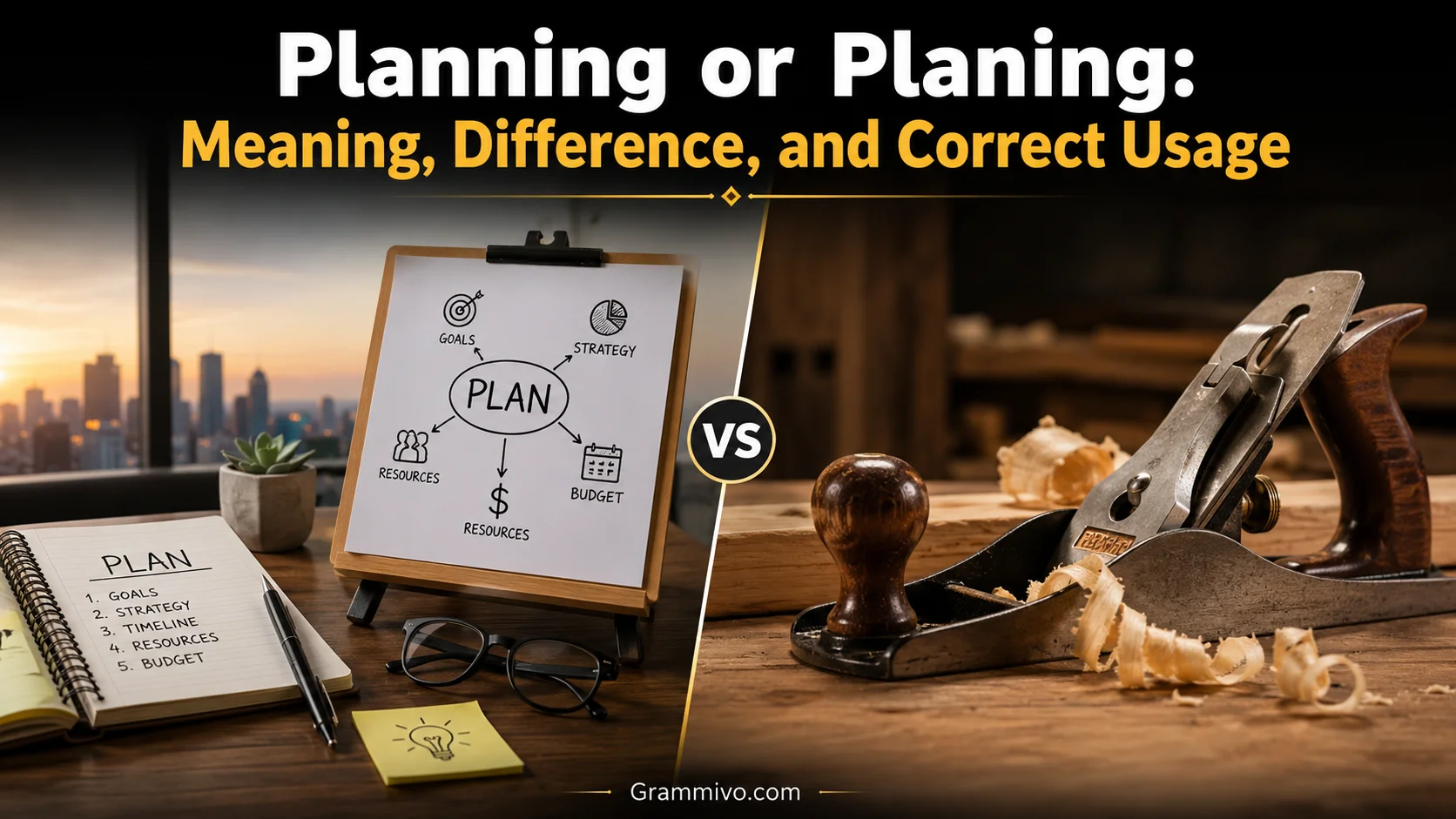
Have you ever wondered whether to write planning or planing? You’re not alone. These two words look almost identical, and the difference comes down to just one letter. However, that small spelling change completely alters their meanings.
The confusion often appears when you’re writing about future goals, organizing an event, preparing a project, or discussing woodworking. Although both spellings are correct English words, they aren’t interchangeable. Choosing the wrong one can make an otherwise clear sentence confusing.
The good news is that understanding the difference between planning and planing doesn’t require memorizing complicated grammar rules. Once you understand their base words and spelling patterns, you’ll know exactly when to use each form.
In this guide, you’ll learn what planning and planing mean, how they differ, why one has a double N, and when the final E disappears. You’ll also find practical examples, spelling rules, and simple memory tricks to help you avoid mistakes.
Quick Answer:
Planning is the correct spelling when you mean organizing, preparing, or making arrangements for something in the future. It comes from the verb plan and follows the consonant-doubling rule when adding -ing.
Planing is also correct, but it has a different meaning. It comes from the verb plane, which means smoothing or leveling a surface with a tool called a plane. In boating, it can also describe a vessel moving across the water’s surface.
Here are two simple examples:
- Planning: We are planning a family vacation for next summer.
- Planing: The carpenter is planing the wooden board to make it smooth.
The easiest way to remember: If you’re organizing something, use planning. If you’re smoothing wood or describing a boat gliding across water, use planing.
Comparison Overview
Although planning and planing differ by only one letter, their meanings, base words, and applications are quite different.
The following table highlights their most important distinctions.
| Feature | Planning | Planing |
| Base word | Plan | Plane |
| Meaning | Organizing or preparing for something | Smoothing or leveling a surface |
| Part of speech | Verb form and gerund | Verb form and gerund |
| Spelling pattern | Doubles the final N | Removes the final E |
| Common context | Business, education, travel, and personal goals | Woodworking, carpentry, and boating |
| Pronunciation | PLAN-ing | PLAY-ning |
| Example | She is planning her wedding. | He is planing the wooden surface. |
Planning: Meaning and Usage
Planning refers to thinking ahead and arranging the steps needed to achieve a particular goal. It involves considering available resources, identifying priorities, setting deadlines, and deciding what needs to happen.
Planing: Meaning and Usage
Planing refers to smoothing or shaping a material with a plane. A plane is a tool commonly used in woodworking to remove thin layers of wood. The term also describes a boat moving quickly across the water with much of its hull lifted above the surface.
The central distinction is simple: planning involves preparation, while planing involves physical movement or surface shaping.
What Does Planning Mean?
Planning is the process of deciding what you want to accomplish and determining how to accomplish it. It involves preparing for future activities rather than making decisions without considering the consequences.
People plan almost everything, from small daily responsibilities to major business projects. A student might plan a study schedule, while a company might plan a product launch months in advance.
The word comes from the verb plan, which means to think about and arrange something before carrying it out.
Definition of Planning
According to its standard English meaning, planning involves making decisions about future actions and organizing the resources needed to complete them.
It can include several activities:
- Setting goals: Identifying what you want to achieve.
- Organizing tasks: Breaking a large objective into manageable steps.
- Managing resources: Deciding how to use available money, time, and materials.
- Setting deadlines: Establishing when different activities should happen.
- Solving potential problems: Considering possible obstacles before they occur.
- Evaluating progress: Checking whether your actions are producing the desired results.
For example, imagine you’re organizing a birthday party. You need to choose a date, prepare a guest list, arrange food, and select a location.
All these activities are part of planning.
When to Use Planning
The word planning appears in many everyday and professional situations. Its meaning remains connected to preparation and organization, although the specific activity changes with context.
Business and Project Management
Businesses use planning to organize projects, manage employees, control expenses, and establish company goals.
For example:
- The marketing team is planning a new advertising campaign.
- Our manager is planning the next product launch.
- The company needs better financial planning.
- We are planning a strategy to increase customer satisfaction.
In project management, planning helps teams understand their responsibilities and complete tasks within established deadlines.
Event Organization
Planning is especially important when organizing events because several activities must come together at the right time.
Examples include:
- She is planning her wedding for October.
- We’re planning a surprise birthday party for our parents.
- They spent several months planning the graduation ceremony.
- The committee is planning a charity fundraiser.
Personal Goals and Daily Activities
People also use planning to manage their personal responsibilities. A simple schedule can make a busy day easier to handle.
For example:
- I’m planning to exercise every morning.
- She is planning her career after graduation.
- We are planning our household budget.
- He spends Sunday evenings planning his week.
Travel Arrangements
Travel planning involves choosing destinations, arranging transportation, booking accommodation, and deciding which activities to enjoy.
Examples:
- We’re planning a trip to California.
- They are planning their summer vacation.
- My family is planning a road trip across the country.
- She is planning an international business trip.
Education and Academic Preparation
Students and teachers use planning to organize lessons, assignments, examinations, and academic goals.
Examples:
- The teacher is planning tomorrow’s lesson.
- I’m planning my study schedule for final exams.
- Students should spend time planning their research projects.
- The university is planning a new academic program.
Examples of Planning in Sentences
Here are additional examples showing how planning works in different situations.
| Sentence | Context |
| We are planning a family reunion. | Family |
| She is planning to start a business. | Career |
| They are planning a new marketing strategy. | Business |
| I’m planning my weekend activities. | Daily life |
| He is planning a surprise proposal. | Relationships |
| The school is planning a science exhibition. | Education |
| We’re planning to move next month. | Personal arrangements |
| The team is planning its next project. | Workplace |
Notice that planning always involves preparing, organizing, or considering something that may happen.
What Does Planing Mean?
Planing is a real English word, but people use it less frequently than planning. It generally refers to smoothing, leveling, or shaping a surface with a tool called a plane.
The word also has a specific meaning in boating. When a boat reaches sufficient speed, it can rise onto the water’s surface and move with less of its hull submerged.
Although these meanings seem unrelated to everyday planning, they share the same spelling: planing.
Definition of Planing
Planing is the action of using a plane to remove thin layers from a material, usually wood. The process helps create an even, smooth, or properly shaped surface.
A woodworking plane typically has a sharp blade that cuts away small amounts of material as someone pushes it across a surface.
For example, a carpenter might use a hand plane to remove an uneven edge from a wooden door.
In boating, planing describes a vessel moving at a speed that allows hydrodynamic lift to support much of its weight. This reduces the amount of hull sitting in the water.
When to Use Planing
The word planing usually appears in specialized contexts rather than everyday conversations.
Woodworking and Carpentry
Carpenters use planing to smooth wooden surfaces, adjust thickness, and create accurate edges.
Examples:
- The carpenter is planing the wooden table.
- He spent the afternoon planing a rough piece of oak.
- The craftsman is planing the cabinet door.
- She is planing the edges of the wooden frame.
Construction and Surface Preparation
Planing can also describe preparing wooden materials for construction or furniture projects.
Examples:
- The worker is planing the timber before installation.
- They finished planing the wooden boards.
- The carpenter is planing the door to make it fit properly.
- The workshop uses a machine for planing large pieces of lumber.
Boating and Marine Terminology
In boating, planing describes a movement that occurs when a boat travels fast enough for hydrodynamic lift to raise much of its hull out of the water.
Examples:
- The speedboat is planing across the lake.
- The boat started planing after gaining speed.
- The captain adjusted the throttle to keep the vessel planing.
- The small motorboat was planing smoothly over the water.
Examples of Planing in Sentences
These examples demonstrate how planing works in different technical situations.
| Sentence | Context |
| He is planing a wooden board. | Woodworking |
| The carpenter finished planing the door. | Carpentry |
| She is planing the surface of the table. | Furniture making |
| The machine is planing thick timber. | Manufacturing |
| The speedboat is planing across the lake. | Boating |
| They used a planer for planing the lumber. | Construction |
Important: Planing doesn’t mean making arrangements or preparing for an event. Using it in that context would be a spelling mistake.
Main Differences Between Planning and Planing
The difference between planning and planing becomes easier to understand when you examine their meanings, spelling patterns, and grammatical functions.
Both words are formed by adding -ing to a verb. However, their base words follow different spelling rules.
Difference in Meaning
The biggest difference involves what each word describes.
Planning refers to organizing or preparing for something. It usually involves thoughts, decisions, and arrangements.
Planing refers to smoothing a surface with a plane or describing a boat moving across the water.
Consider these examples:
- Planning: Sarah is planning a kitchen renovation.
- Planing: Sarah is planing a wooden cabinet door.
In the first sentence, Sarah is organizing a renovation project. In the second, she’s physically smoothing a wooden surface.
The context tells you which spelling belongs in the sentence.
Difference in Spelling
The spelling difference comes from the base words plan and plane.
When you add -ing to plan, you double the final consonant:
– Plan + ing = Planning
When you add -ing to plane, you remove the silent final e:
– Plane – e + ing = Planing
These are two separate spelling rules. Understanding them makes it easier to recognize why both words exist.
Difference in Grammar and Usage
Both words can function as present participles and gerunds.
A present participle works with a helping verb to create a continuous verb tense.
Examples:
- She is planning a conference.
- He is planing a wooden surface.
A gerund functions as a noun even though it ends in -ing.
Examples:
- Planning requires patience and organization.
- Planing helps create smooth wooden surfaces.
Both words can also appear as modifiers.
Examples:
- The planning committee meets every Monday.
- The planing machine needs maintenance.
Their grammatical roles are similar, but their meanings remain different.
Difference in Context
The situations in which you use these words are another important distinction.
| Situation | Correct Word | Example |
| Organizing a wedding | Planning | We’re planning our wedding. |
| Preparing a business strategy | Planning | The team is planning a new strategy. |
| Arranging a vacation | Planning | I’m planning a trip. |
| Smoothing wooden furniture | Planing | He is planing the table. |
| Preparing timber | Planing | The worker is planing the lumber. |
| Describing a speedboat | Planing | The boat is planing across the lake. |
If the sentence describes preparation, choose planning. If it describes woodworking or a boat’s movement, choose planing.
Why Is It Planning Instead of Planing?
One of the most common spelling questions is why planning contains two Ns while planing contains only one.
The answer involves the spelling rules for adding suffixes to English verbs.
When you understand these rules, you can apply them to many other words rather than memorizing every spelling individually.
The Rule for Doubling the Final Consonant
English often doubles a final consonant when adding a suffix that begins with a vowel, such as -ing.
This commonly happens when a one-syllable word ends in a consonant-vowel-consonant (CVC) pattern.
The word plan follows this pattern:
- P = Consonant
- L = Consonant
- A = Vowel
- N = Consonant
When you add -ing, the final consonant doubles.
Plan + ing = Planning
The double N helps preserve the short vowel sound in the original word.
Here are other examples that follow the same general rule:
| Base Word | With -ing |
| Run | Running |
| Sit | Sitting |
| Stop | Stopping |
| Swim | Swimming |
| Begin | Beginning |
| Plan | Planning |
This pattern isn’t limited to planning. It’s a common feature of English spelling.
A useful detail: The doubling rule also depends on syllable stress in longer words. For example, begin becomes beginning because its final syllable carries the stress.
Frequently Asked Questions
Is Planning or Planing the Correct Spelling?
Both spellings are correct, but their meanings differ. Planning means organizing or preparing for something, while planing refers to smoothing a surface with a woodworking tool or describing a boat gliding across water.
Why Does Planning Have Two Ns?
Planning has two Ns because the base word plan follows the consonant-doubling rule. When you add -ing to a one-syllable word with a consonant-vowel-consonant pattern, you double the final consonant. Therefore, plan becomes planning.
Is Planing a Real English Word?
Yes, planing is a legitimate English word. It describes smoothing or leveling wood with a plane. In boating, it also refers to a vessel moving across the water’s surface at sufficient speed.
Is It Planning Ahead or Planing Ahead?
Planning ahead is the correct expression. It means preparing for future events by making arrangements or decisions in advance. For example, “Planning ahead helps you avoid unnecessary stress.”
What Is the Difference Between Planed and Planned?
Planed is the past tense of plane and means smoothed or shaped using a plane. Planned is the past tense of plan and means organized or prepared something.
- Planed: The carpenter planed the wooden door.
- Planned: She planned a family vacation.
Conclusion:
Choosing between planning or planing becomes simple once you understand their meanings and spelling rules. Planning comes from the verb plan and refers to organizing, preparing, or making arrangements for the future. It doubles the final N when adding -ing. Planing comes from plane. It refers to smoothing or shaping a surface with a woodworking tool. In boating, it also describes a vessel gliding across the water. Its spelling follows the silent-E deletion rule.
