
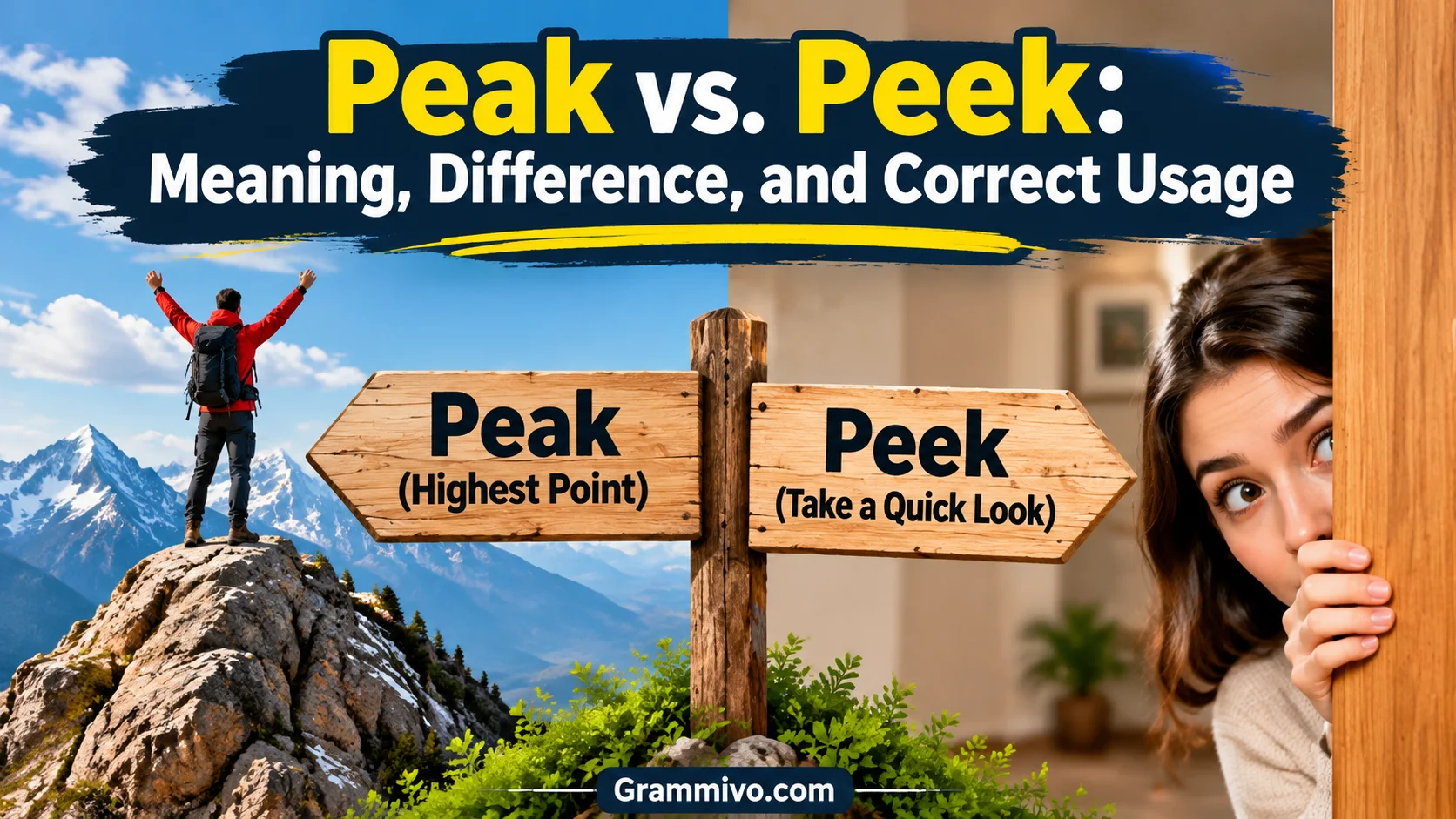
The English language has plenty of words that sound alike but carry completely different meanings. Peak vs. peek is a common example that can confuse even confident writers. Both words share the same pronunciation, yet their meanings and uses have little in common.
The confusion usually appears in everyday writing. You might describe a company’s highest sales figures, someone looking through a window, or a tourist reaching the top of a mountain. Each situation requires a different word.
Here’s the simple distinction: peak refers to the highest point, maximum level, or greatest degree of something. Peek means taking a quick, brief, or sometimes secret look at something.
Although they sound identical, you cannot use them interchangeably. Choosing the wrong spelling can change your sentence’s meaning entirely. Understanding their definitions, grammatical roles, common expressions, and examples will help you use both words confidently.
Quick Answer:
Peak means the highest point or maximum level of something. It can describe a mountain’s summit, someone’s best performance, or the busiest period of an activity.
– Example: The mountain climbers finally reached the peak.
Peek means taking a quick, brief, or secret look at something. It works as both a noun and a verb.
– Example: She took a peek inside the gift box.
Easy way to remember: You climb a peak, but you take a peek.
Comparison Overview
Although peak and peek sound alike, their meanings, spelling, and everyday applications differ. The following table highlights their main distinctions.
| Comparison Point | Peak | Peek |
| Meaning | Highest point or maximum level | A quick or brief look |
| Part of speech | Noun and verb | Noun and verb |
| Pronunciation | /piːk/ | /piːk/ |
| Main idea | Height, maximum, or highest achievement | Looking briefly or secretly |
| Physical meaning | Top of a mountain or object | Looking through an opening |
| Figurative meaning | Greatest level of success or activity | Briefly viewing or examining something |
| Common expressions | Peak season, peak performance, at its peak | Take a peek, sneak a peek, peek inside |
| Example | Sales reached their peak in December. | He took a peek at the invitation. |
The easiest distinction comes down to one question: Are you describing a highest point or looking at something? If you’re describing a maximum level, choose peak. If you’re describing a quick look, choose peek.
What Does Peak Mean?
Peak refers to the highest point, greatest level, or maximum degree of something. It commonly appears in conversations about mountains, business performance, popularity, demand, and personal achievements.
The word has both literal and figurative meanings. Its literal meaning describes physical height, while its figurative meaning describes the highest level something reaches.
For example, a mountain has a physical peak. A singer can reach the peak of popularity. Similarly, a business might experience peak sales during a particular season.
Peak as a Noun
As a noun, peak identifies the highest point of a physical object or the maximum level of an activity, condition, or achievement.
Its most familiar physical meaning relates to mountains. A mountain’s peak is its highest point, often forming a sharp summit above the surrounding landscape.
For example:
- The climbers reached the mountain’s peak before sunset.
- Snow covered the peak throughout the winter.
- We could see several distant peaks from the valley.
- The hikers stopped near the peak to enjoy the view.
However, peak doesn’t always describe physical height. It also represents the greatest point in a measurable or unmeasurable process.
Consider these examples:
- The company’s profits reached their peak last year.
- Her popularity reached its peak after the movie premiered.
- Electricity demand usually reaches its peak during summer.
- The athlete performed at the peak of his career.
In these sentences, peak describes a maximum rather than a physical location.
Important distinction: A peak doesn’t necessarily represent a permanent condition. It can describe a temporary high point before something declines, stabilizes, or continues growing.
For instance, a retailer might experience peak sales during the holiday season. Sales may decrease once the holiday rush ends.
Peak as a Verb
As a verb, peak means to reach the highest point or maximum level. It often describes a process that rises over time before reaching its greatest intensity or value.
For example:
- Tourism usually peaks during the summer months.
- Her athletic performance peaked when she was 25.
- The company’s revenue peaked in the fourth quarter.
- Traffic tends to peak between 5 p.m. and 6 p.m.
- Demand for heating services peaks during winter.
The verb frequently appears in business reports, scientific discussions, sports commentary, and everyday conversations.
For example, an economist might say that inflation peaked during a particular period. This means inflation reached its highest level within the timeframe being discussed.
Similarly, when someone says a person’s career peaked early, they suggest that the person’s greatest professional success occurred relatively early.
Grammar tip: When using peak as a verb, remember that its past tense and past participle are both peaked.
| Verb Form | Example |
| Present | Demand peaks in December. |
| Past | Demand peaked last December. |
| Present participle | Demand is peaking this month. |
| Past participle | Demand has peaked already. |
Don’t confuse peaked with peaked out in every context. Although both can describe reaching a maximum, peaked is often sufficient and more concise.
Common Expressions With Peak
The word peak appears in several established expressions. Understanding these phrases will help you recognize its meaning in different situations.
Peak performance: This phrase describes someone’s highest level of ability or effectiveness.
Example: Regular practice helps athletes maintain peak performance.
Peak season: This refers to the busiest or most popular period for a particular activity, industry, or destination.
Example: Hotel prices usually increase during peak season.
Peak hours: These are the busiest hours of the day, especially for transportation, electricity use, or business activity.
Example: Avoid traveling during peak hours if you want to escape traffic.
Peak condition: This describes the best possible physical, operational, or functional condition.
Example: The mechanic kept the racing car in peak condition.
At its peak: This expression means something has reached its highest level.
Example: The restaurant’s popularity was at its peak during the opening month.
Reach a peak: This means to arrive at the highest point of something.
Example: The excitement reached a peak when the winning team entered the stadium.
These expressions demonstrate why peak is useful beyond conversations about mountains. It describes maximum levels in almost every area of life.
Read More: Cozy vs. Cosy: Meaning, Difference, and Correct Usage
What Does Peek Mean?
Peek means taking a quick, brief, or sometimes secret look at something. It describes the act of looking without spending much time examining what you see.
Unlike peak, which relates to height or maximum levels, peek always connects to the idea of looking. You might peek through a doorway, peek inside a package, or sneak a peek at someone’s surprise gift.
Like peak, peek functions as both a noun and a verb. However, its grammatical role changes how it appears in a sentence.
Peek as a Noun
As a noun, peek refers to a brief or quick look at something. It usually appears with verbs such as take, get, or have.
For example, the expression take a peek means to look at something briefly. You might use it when someone offers you a preview or when curiosity makes you want to see something.
Consider these examples:
- Can I take a peek at your new phone?
- She got a peek at the wedding dress before the ceremony.
- We had a quick peek inside the newly renovated house.
- He managed to get a peek at the surprise decorations.
- The preview gives readers a peek into the upcoming novel.
Notice how peek describes the act or opportunity of looking. It doesn’t suggest that someone spends a long time studying or examining something.
For instance, looking at a photograph for two seconds counts as a peek. Studying every detail for several minutes would be a more thorough examination.
Grammar tip: As a noun, peek commonly follows articles and descriptive words.
- A quick peek
- A little peek
- A secret peek
- One last peek
- A sneak peek
These combinations appear frequently in casual conversations, entertainment, marketing, and everyday writing.
Peek as a Verb
As a verb, peek means to look quickly, cautiously, or secretly at something. It often suggests curiosity or an attempt to see something without attracting attention.
For example:
- The little boy peeked through the curtains.
- She peeked inside the envelope before opening it.
- He peeked around the corner to check whether anyone was there.
- The children peeked through the window at the birthday decorations.
- I peeked at the message while waiting for my friend.
The verb can describe an intentional action or a brief opportunity to see something.
Someone might peek through a slightly open door because they hear an unfamiliar sound. Another person might peek at a birthday present because they cannot wait for the celebration.
In both situations, the person takes a quick look rather than examining something thoroughly.
Peek also has regular verb forms:
| Verb Form | Example |
| Present | I peek through the window. |
| Past | I peeked through the window. |
| Present participle | I am peeking through the window. |
| Past participle | I have peeked inside the room. |
Remember that the past tense is peeked, not peaked. The spelling matters because peaked belongs to the verb peak.
Common Expressions With Peek
Several everyday expressions use peek to describe different kinds of quick looks. Some suggest curiosity, while others imply secrecy or a preview.
Take a peek: This means to look at something briefly.
Example: Take a peek at the menu before deciding what to order.
Sneak a peek: This describes looking secretly or without someone noticing.
Example: The children tried to sneak a peek at their Christmas presents.
Have a peek: This is a casual way to invite someone to look at something.
Example: Have a peek at these vacation pictures.
Peek inside: This means to look briefly into a container, room, building, or enclosed space.
Example: She peeked inside the box to see what was there.
Peek through: This describes looking through an opening or something that partially blocks your view.
Example: The sunlight peeked through the clouds.
Peek at something: This means to look at something quickly, often without examining it closely.
Example: He peeked at his watch before leaving the meeting.
A sneak peek: This noun phrase refers to an early or limited preview of something that hasn’t been fully revealed.
Example: The company shared a sneak peek of its upcoming product.
These expressions are common in everyday American English. You’ll also encounter them in advertisements, entertainment announcements, social media captions, and informal messages.
Main Differences Between Peak and Peek
Although peak and peek share the same pronunciation, their meanings and grammatical applications remain distinct. Understanding these differences makes choosing the correct spelling much easier.
Meaning and Definition of Peak vs. Peek
The most important difference between peak and peek is what each word communicates.
Peak describes the highest point or maximum level. It can refer to a physical summit or the greatest degree of something.
Peek describes a quick or brief look. It usually involves seeing something momentarily, sometimes secretly or through a small opening.
Consider these contrasting examples:
- The climbers reached the peak. This sentence describes the highest point of a mountain.
- The climbers took a peek at the map. This sentence describes a quick look at a map.
Both sentences involve climbers, but the words communicate entirely different actions or ideas.
Here’s another comparison:
- Her career reached its peak. This means she achieved her greatest professional success.
- She took a peek at her career report. This means she briefly looked at the report.
The surrounding words provide helpful clues. However, the definitions themselves should guide your spelling choice.
Parts of Speech: Peak vs. Peek
Both words can function as nouns and verbs. Their grammatical roles depend on how you use them within a sentence.
| Part of Speech | Peak | Peek |
| Noun | The mountain’s peak was covered in snow. | He took a peek at the letter. |
| Verb | Sales usually peak in December. | She peeked through the door. |
As nouns, both words identify something. Peak identifies a highest point, while peek identifies a brief look.
As verbs, they describe actions or processes. Peak means reaching a maximum, whereas peek means looking quickly.
This distinction becomes particularly useful when editing sentences. Instead of relying on pronunciation, examine the role the word plays.
Context and Usage: When to Use Peak or Peek
Context helps you determine which spelling belongs in a sentence. The subject and surrounding words usually reveal the intended meaning.
Use peak when discussing:
- The highest point of a mountain or hill.
- The maximum level of sales or profits.
- The busiest period of a season.
- Someone’s greatest professional achievement.
- The highest intensity of an activity.
- The maximum demand for a service or product.
Use peek when discussing:
- Taking a quick look at something.
- Looking through a window or doorway.
- Secretly viewing a surprise.
- Checking something briefly.
- Getting an early preview of a product or event.
- Looking at something out of curiosity.
For example, consider a sentence about a new movie.
The movie’s popularity peaked during its opening weekend.
Here, peaked describes the highest level of popularity.
Now consider this sentence:
Fans got a peek at the movie’s trailer.
Here, peek describes a brief opportunity to view the trailer.
The subject matter might be similar, but the intended meaning determines the correct word.
Pronunciation and Spelling of Peak vs. Peek
One reason people confuse these words is their identical pronunciation. Both peak and peek are pronounced /piːk/.
They are examples of homophones. Homophones are words that sound alike but have different meanings and spellings.
Other familiar homophone pairs include:
- Their and there
- See and sea
- Right and write
- Flour and flower
- Pair and pear
- Brake and break
Because peak and peek sound identical, listening alone won’t help you distinguish them. You must understand the sentence’s meaning.
Their spellings also offer a useful memory clue:
- Peak: Think of the letter A in peak as a reminder of a mountain’s apex.
- Peek: Associate the double E with eyes looking at something.
These aren’t formal spelling rules. They’re simple memory tricks that can help you avoid mistakes.
Frequently Asked Questions
Is It Peak or Peek?
Both peak and peek are correct English words, but they have different meanings. Use peak when referring to the highest point or maximum level of something. Use peek when describing a quick or secret look at something.
For example, The mountain has a snowy peak is correct. Similarly, She took a peek inside the room uses the correct spelling.
What Is the Difference Between Peak and Peek?
The main difference involves their meanings. Peak refers to the highest point, greatest achievement, or maximum level. Peek means taking a brief look at something.
Both words function as nouns and verbs. They also share identical pronunciation, which makes them common sources of spelling confusion.
Is Peek a Real Word?
Yes, peek is a standard English word. It functions as both a noun and a verb.
As a noun, it means a quick look, as in take a peek. As a verb, it means looking briefly or secretly, as in She peeked through the window.
Does Peak Mean to Look?
No. Peak doesn’t mean to look at something. It refers to the highest point or maximum level of something.
For example, The athlete peaked during the championship means the athlete reached their highest level of performance. If you mean taking a quick look, use peek instead.
What Does Take a Peek Mean?
Take a peek means to look at something briefly. It often suggests curiosity or a quick examination rather than a detailed inspection.
For example, Can I take a peek at your new laptop? means someone wants to see the laptop for a short time.
Conclusion:
Understanding peak vs. peek becomes simple once you connect each word with its meaning. Peak describes the highest point, maximum level, or greatest achievement. Peek refers to taking a quick, brief, or sometimes secret look at something. Although all three words sound identical, their meanings are entirely different. Pay attention to context rather than pronunciation and you’ll choose the correct spelling every time.
