
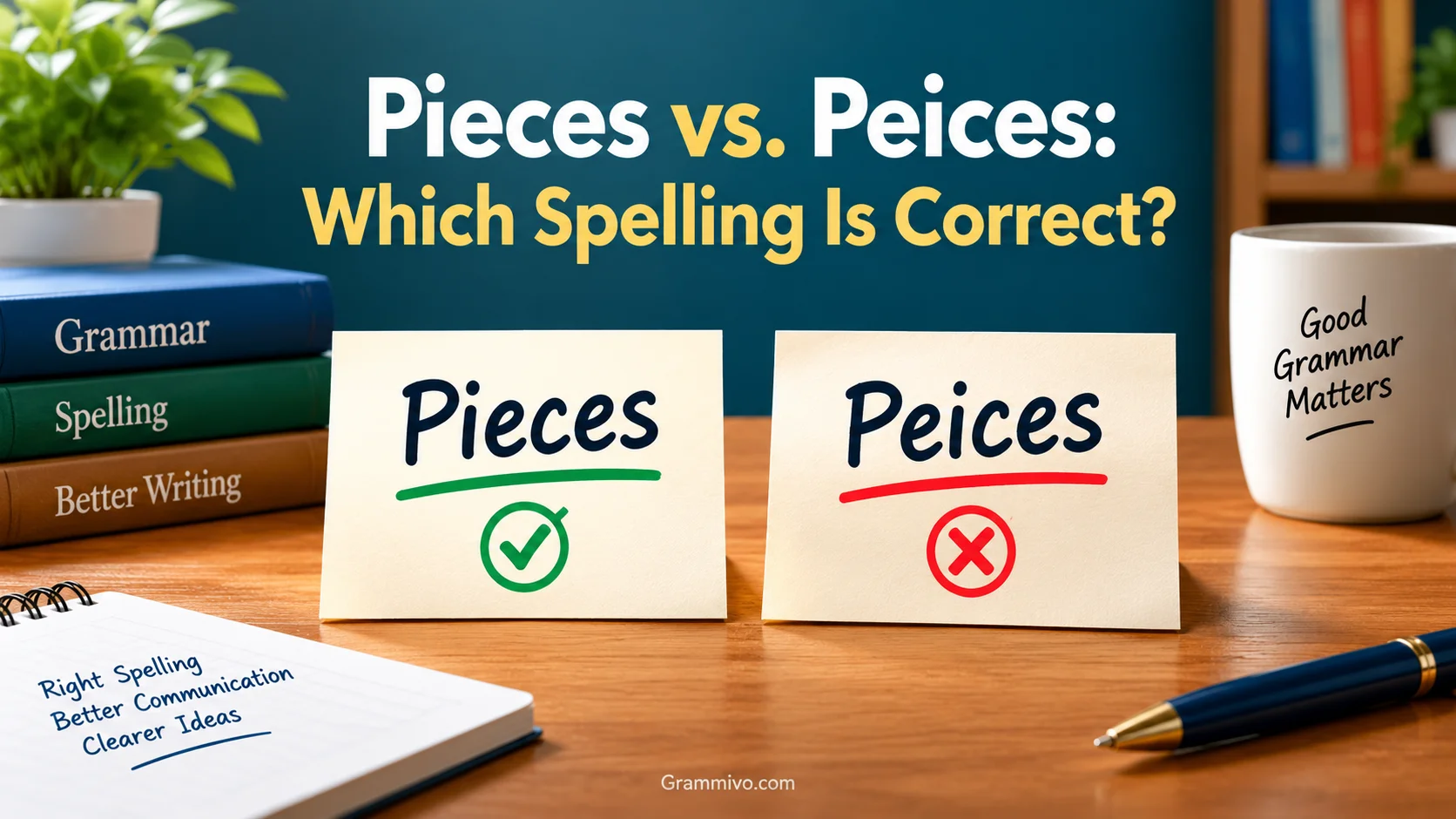
Have you ever written peices and wondered whether it was the correct spelling? You’re not alone. Many English writers mix up these two spellings because they look almost identical. However, only one is accepted in standard English.
The correct spelling is pieces, which is the plural form of piece. The spelling peices is a common spelling mistake that occurs when people place the letters i and e in the wrong order. Although the difference seems small, using the correct spelling helps make your writing clear, accurate, and professional.
Whether you’re writing a school assignment, preparing a business email, or posting something online, understanding the difference between pieces and peices can help you avoid an easy mistake. Let’s explore their meanings, spelling patterns, grammatical uses, and examples so you can confidently choose the correct word every time.
Quick Answer
Pieces is the correct spelling, while peices is incorrect in standard English. The word pieces is the plural form of piece and refers to separate parts, portions, or individual items.
For example:
- Correct: She divided the chocolate into four pieces.
- Incorrect: She divided the chocolate into four peices.
The mistake happens because people sometimes reverse the letters i and e. To remember the correct spelling, focus on the sequence p-i-e-c-e-s.
Comparison Overview
The following table highlights the main differences between pieces and peices.
| Feature | Pieces | Peices |
| Spelling status | Correct | Incorrect in standard English |
| Meaning | Separate parts or portions of something | No accepted standard meaning |
| Grammatical role | Plural noun | Misspelling of pieces |
| Singular form | Piece | Not applicable |
| Example | I picked up the broken pieces. | I picked up the broken peices. |
| Appropriate for formal writing | Yes | No |
| Appropriate for everyday communication | Yes | Only when discussing the misspelling itself |
The important distinction is simple: pieces is a recognized English word, but peices is a spelling error when the intended word is pieces. You should use pieces in schoolwork, professional documents, personal messages, and other forms of standard writing.
What Does Pieces Mean?
The word pieces is the plural form of the noun piece. It describes two or more separate parts, portions, or individual items. The exact meaning depends on what you’re discussing.
For example, a broken plate might have several pieces. A pizza can be divided into eight pieces, and a puzzle contains many individual pieces that fit together.
The word also appears in less physical contexts. You might read several pieces of information, listen to pieces of music, or examine pieces of evidence.
In each case, pieces refers to distinct parts or units associated with something larger or with a collection.
Pieces as the Plural of Piece
The singular noun piece refers to one part or item. When you have more than one, you generally add -s to form pieces.
Consider these examples:
- One piece of bread becomes two pieces of bread.
- One piece of paper becomes several pieces of paper.
- One puzzle piece becomes multiple puzzle pieces.
- One piece of furniture becomes several pieces of furniture.
Notice that the word following pieces doesn’t always become plural. In phrases such as pieces of bread and pieces of furniture, the noun after of remains singular because it refers to the material or category being divided or counted.
This distinction is particularly useful when writing about things that English speakers don’t normally count individually by using a plural noun.
For instance, you would usually say, “I need two pieces of advice,” rather than “I need two advices.” The word advice is generally uncountable in standard English, so pieces of advice allows you to refer to separate recommendations.
Pieces in Different Contexts
Although pieces often describes physical objects, its meaning extends to ideas, creative works, and abstract concepts.
Here are some common uses.
Physical objects: When an object breaks or someone divides it into smaller parts, those parts can be called pieces.
Example: “The children collected the pieces of the broken toy.”
Food and portions: Cooks and servers frequently use pieces to describe individual servings or portions.
Example: “We ordered six pieces of fried chicken.”
Information: The word can describe separate facts, details, or bits of knowledge.
Example: “The detective gathered several pieces of information before questioning the suspect.”
Advice: When someone offers multiple suggestions, each suggestion can be described as a piece of advice.
Example: “My teacher gave me three useful pieces of advice.”
Music and art: A musical composition or creative work can be called a piece. Its plural form is pieces.
Example: “The pianist performed two beautiful pieces during the concert.”
Evidence: In investigations, legal discussions, and research, pieces of evidence refers to individual items or facts that support a conclusion.
Example: “The investigators examined several pieces of evidence.”
These examples show why pieces is a versatile word. Its spelling stays the same regardless of whether you’re describing a physical object, an idea, or a creative work.
Example Sentences With Pieces
Seeing the correct spelling in different sentences makes it easier to recognize and remember.
- She cut the sandwich into four pieces for the children.
- I found several pieces of paper underneath the desk.
- The artist assembled small pieces of glass into a colorful design.
- We need a few more pieces to complete the puzzle.
- He shared two important pieces of information during the meeting.
- The chef arranged the cake pieces neatly on a serving plate.
- My grandmother owns several beautiful pieces of jewelry.
- The orchestra performed three musical pieces at the event.
- The mechanic replaced the damaged pieces of the engine.
- She gave me some helpful pieces of advice before the interview.
Each sentence uses pieces correctly because it refers to multiple parts, items, or units.
Read More: Steer vs. Stear: Meaning, Difference, and Correct Usage
What Does Peices Mean?
The spelling peices is a common error made when someone intends to write pieces. It doesn’t have an established meaning as a standard English word.
People may write it because they remember the general sound and appearance of pieces but confuse the order of the middle letters. This type of error can happen when typing quickly, writing from memory, or relying on an uncertain spelling pattern.
For example, someone might write, “Please put the peices back in the box.” The intended meaning is clear, but the spelling is incorrect.
The correct sentence is:
“Please put the pieces back in the box.”
Although readers can often understand the intended word, that doesn’t make the misspelling acceptable in standard written English.
Is Peices a Real Word?
In standard English, peices isn’t an accepted spelling of the plural noun piece. Dictionaries recognize piece and its plural form pieces, not peices as an alternative spelling.
You might encounter peices in text messages, online comments, social media posts, or documents written by people who aren’t sure about the spelling. These examples show that the error occurs in everyday writing, not that the spelling is correct.
There is one important distinction: you can write peices when you’re specifically discussing the misspelling itself.
For example:
“Many students mistakenly write peices instead of pieces.”
In this sentence, the incorrect spelling appears intentionally because the writer is identifying an error. The word still isn’t being used as a correctly spelled substitute for pieces.
If you’re writing a formal document, an academic paper, or a professional email, use pieces whenever that’s the word you intend.
Why Do People Misspell Pieces as Peices?
The error usually comes from confusion about letter order. The words look similar, and the incorrect version may seem plausible when someone writes it without checking.
Several factors can contribute to this mistake.
- Letter reversal: Writers may place e before i instead of following the correct sequence in pieces.
- Uncertain spelling patterns: English contains many words with different ie and ei combinations, which can make spelling less predictable.
- Typing too quickly: When people focus on the meaning of a sentence, they may overlook small letter-order mistakes.
- Memory errors: Someone who has seen a word many times may still remember its general appearance without recalling every letter correctly.
- Limited proofreading: A writer may reread a sentence for meaning without noticing a familiar-looking spelling error.
For example, consider this sentence:
“I bought several peices of chocolate for the party.”
The sentence makes sense, and the misspelling doesn’t prevent readers from understanding it. However, a spelling checker or careful proofread should identify the problem.
The corrected sentence is:
“I bought several pieces of chocolate for the party.”
The best solution is to learn the spelling of the base word piece and recognize that its plural form simply adds s.
Main Differences Between Pieces and Peices
The difference between pieces and peices isn’t a matter of meaning, regional preference, or writing style. It comes down to correct spelling.
Correct Spelling: Pieces vs. Peices
Pieces is the standard plural form of piece. The spelling follows the sequence p-i-e-c-e-s.
By contrast, peices places the middle letters in the wrong order. Standard English doesn’t recognize it as a valid alternative.
Compare the following examples:
| Incorrect sentence | Correct sentence |
| I need three peices of paper. | I need three pieces of paper. |
| The glass broke into small peices. | The glass broke into small pieces. |
| She arranged the cake peices on a plate. | She arranged the cake pieces on a plate. |
| We found all the puzzle peices. | We found all the puzzle pieces. |
| He shared two peices of advice. | He shared two pieces of advice. |
The correction is the same in every example. Replace peices with pieces.
Meaning and Usage of Pieces vs. Peices
The word pieces has several established uses. It can describe fragments of a broken object, portions of food, individual components, or separate units of information.
The spelling peices doesn’t carry a separate standard meaning. In ordinary writing, it signals that the writer intended to use pieces but spelled it incorrectly.
This difference matters because correct spelling supports clear communication. Even when the intended meaning is obvious, spelling errors can distract readers or make a document appear less polished.
Imagine you’re preparing instructions for assembling a product. If the instructions say, “Connect the two peices before tightening the screws,” most readers will understand the sentence. However, the incorrect spelling can make the instructions seem less professional.
Writing “Connect the two pieces before tightening the screws” communicates the same information with correct spelling.
Examples of Correct and Incorrect Usage
The easiest way to distinguish the two spellings is to compare them in familiar situations.
Example: Cooking
Incorrect: “Cut the apple into small peices.”
Correct: “Cut the apple into small pieces.”
The corrected sentence describes multiple portions of an apple.
Example: Schoolwork
Incorrect: “The teacher handed out several peices of paper.”
Correct: “The teacher handed out several pieces of paper.”
Here, pieces refers to separate sheets or portions of paper.
Example: Puzzles
Incorrect: “I still need five peices to finish the puzzle.”
Correct: “I still need five pieces to finish the puzzle.”
The correct spelling identifies the remaining puzzle components.
Example: Business writing
Incorrect: “Please review the attached peices of information.”
Correct: “Please review the attached pieces of information.”
In professional writing, correct spelling helps keep your message polished and easy to read.
The same rule applies in every context. Whether you’re discussing food, schoolwork, hobbies, or business, pieces is the correct spelling.
How to Spell Pieces Correctly
Remembering the correct spelling becomes much easier when you break the word into smaller parts and connect it to familiar examples.
Remember the Letter Order in Pieces
The correct spelling contains six letters:
P – I – E – C – E – S
The key is to remember that the word begins with pi, followed by ece, and ends with s.
The incorrect spelling peices reverses the order of the i and e near the beginning. That small change creates a spelling error.
Try saying the word slowly while writing it:
- Start with p.
- Add i.
- Follow with e.
- Write c.
- Add the second e.
- Finish with s.
This technique can help if you tend to type the letters in the wrong order.
You can also write the word several times while saying each letter aloud. Repetition helps reinforce the correct sequence, especially when a particular misspelling has become a habit.
Use the Base Word Piece
Another reliable strategy is to start with the singular word piece.
The plural form follows a straightforward pattern:
| Form | Word | Example |
| Singular | Piece | I ate one piece of chocolate. |
| Plural | Pieces | I ate three pieces of chocolate. |
Because piece already contains the correct letter order, you don’t need to change its spelling when making it plural. Simply add s.
This is a useful reminder because the error often occurs when someone tries to recall the plural word independently instead of building it from the singular form.
Think of it this way: if you know how to spell piece, you already know how to spell pieces.
FAQs:
Is Pieces or Peices Correct?
Pieces is correct. It’s the plural form of piece and refers to multiple parts, portions, or individual items. Peices is a misspelling in standard English.
Example: “The children divided the cookies into equal pieces.”
How Do You Spell Pieces Correctly?
Spell the word P-I-E-C-E-S. Start with piece, then add s to form the plural.
A useful way to remember it is to learn the singular form first. Once you know how to spell piece, forming pieces becomes straightforward.
Why Is Peices Incorrect?
Peices is incorrect because it reverses the order of the letters i and e in the standard spelling pieces. English doesn’t accept it as an alternative spelling of the word.
You may encounter the mistake online or in informal messages, but that doesn’t make it correct.
What Is the Singular Form of Pieces?
The singular form of pieces is piece.
Use piece when referring to one item or portion. Use pieces when referring to two or more.
Examples:
- Singular: I found one piece of the broken plate.
- Plural: I found three pieces of the broken plate.
What Is the Difference Between Piece and Pieces?
Piece is singular, while pieces is plural. Both are correct spellings, but you use them in different situations.
For example, “She ate one piece of cake” refers to one portion. “She ate two pieces of cake” refers to two portions.
Conclusion:
When choosing between pieces and peices, the answer is clear: pieces is the correct spelling in standard English. It’s the plural form of piece and can describe physical objects, food portions, information, advice, evidence, and creative works. The spelling peices is a common mistake caused by reversing the letters i and e. Although readers may understand what you mean, using the correct spelling keeps your writing clear and professional.
