
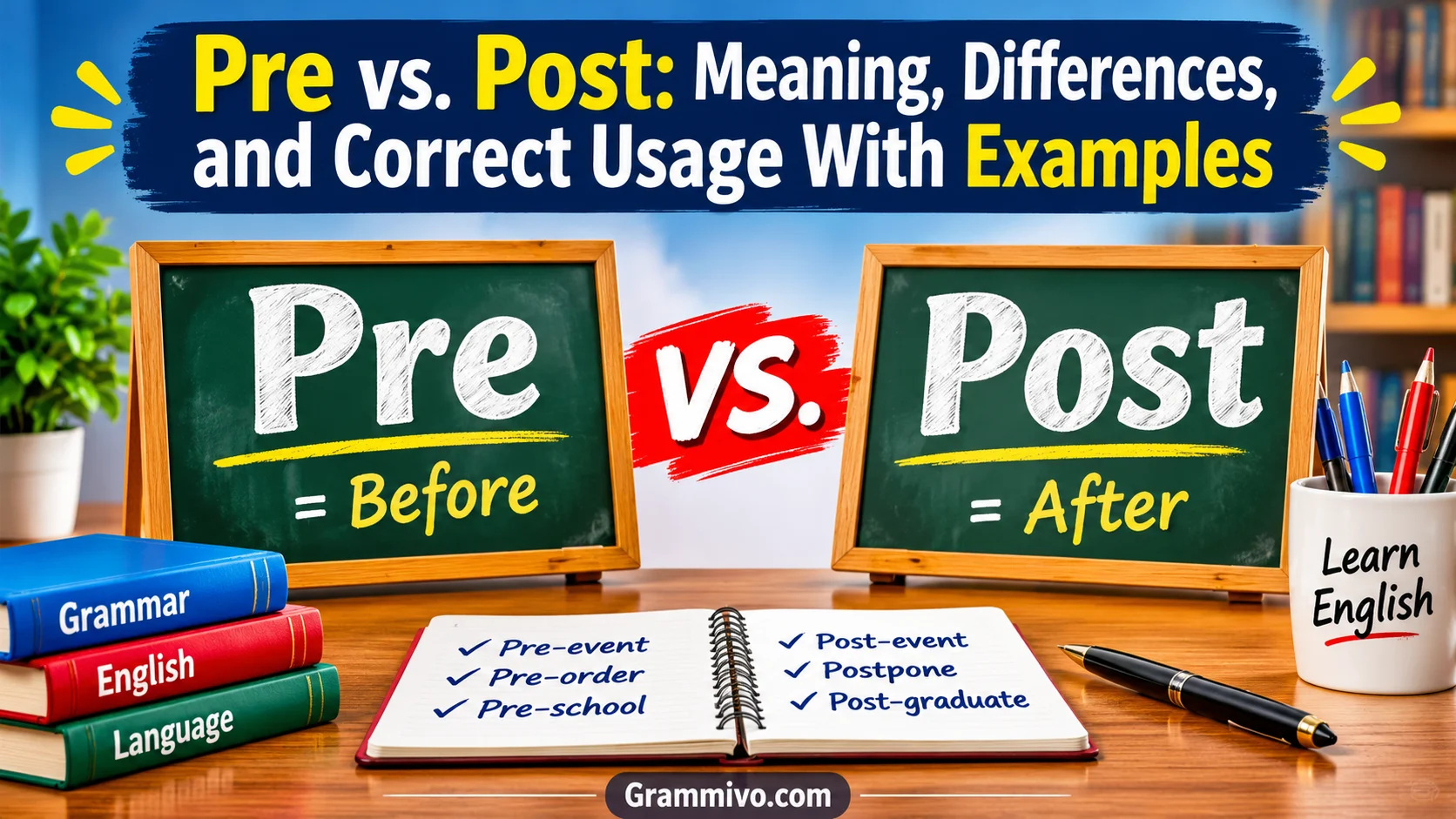
The words pre and post help you explain when something happens in relation to a particular event. Although they look similar and often appear in compound words, they have opposite meanings. One points to an earlier time while the other refers to something that happens afterward.
You’ll encounter these prefixes in everyday expressions such as preorder, prepaid, postwar, and postgraduate. They’re also common in healthcare, education, business, fitness, and technology. Understanding their differences makes it easier to choose the right word and avoid confusing your readers.
The main distinction is simple: pre means before, whereas post means after. However, their usage involves more than memorizing two definitions. You also need to understand how they attach to other words, when to use hyphens, and how their meanings change in different situations.
Quick Answer:
Pre means before something happens. It refers to an action, condition, or period that comes ahead of a particular event.
Post means after something happens. It describes an action, condition, or period that follows a particular event.
For example:
- Pre-workout: Something you do or consume before exercising.
- Post-workout: Something you do or consume after exercising.
- Pre-event: A period or activity before an event.
- Post-event: A period or activity after an event.
An easy way to remember the difference is to associate pre with preparation and post with what follows.
Comparison Overview
Although pre and post both describe time or sequence, they point in opposite directions. The following table highlights their main differences.
| Comparison Point | Pre | Post |
| Meaning | Before | After |
| Time reference | Earlier than an event | Later than an event |
| Word function | Prefix | Prefix |
| Main purpose | Indicates something that comes first | Indicates something that comes afterward |
| Common association | Preparation and anticipation | Completion and follow-up |
| Common examples | Prepaid, preview, preorder | Postpaid, postwar, postproduction |
| Opposite term | Post | Pre |
| Example phrase | Pre-event preparation | Post-event review |
The easiest distinction is chronological: pre describes what happens before a reference point, while post describes what happens after it.
For example, a pretest measures someone’s knowledge before instruction. A post-test measures their knowledge after instruction. Both tests may cover similar material, but they serve different purposes.
What Does Pre Mean?
The prefix pre- means before, in advance of, or prior to. It comes from the Latin word prae, which carries the idea of being in front of or preceding something.
When you add pre- to another word, it generally changes that word’s meaning to indicate an earlier time, position, or stage.
For example, a preview happens before someone watches a complete movie. Similarly, a preorder allows customers to purchase an item before its official release.
The prefix appears in many everyday words. You might use it without realizing that it carries a specific time-related meaning.
Definition and Meaning of Pre
Pre indicates that something exists, happens, or takes place before a particular event or condition.
Consider these examples:
- Preseason: The period before a sports season officially begins.
- Prepaid: Something paid for in advance.
- Preexisting: Something that existed before a particular time or event.
- Prearranged: Something organized or agreed upon beforehand.
- Preview: An opportunity to see something before its full release.
Notice how each example establishes an earlier point in time.
For instance, a prepaid phone plan requires payment before you use the included service. A preseason training program prepares athletes before their competitive season begins.
How to Use Pre in a Sentence
You can use pre- as a prefix to create words that describe advance preparation, earlier conditions, or events that happen beforehand.
Here are some natural examples:
- The company offered a preorder option before launching its new smartphone.
- Students completed a pretest before starting the science course.
- We discussed the schedule during a pre-event meeting.
- The doctor reviewed my preexisting medical conditions.
- She watched a preview before purchasing movie tickets.
- The team started its preseason training in July.
In each sentence, pre indicates that something happens before another event or stage.
Common Words That Use the Prefix Pre
English contains many established words that begin with pre-. Learning these words will help you recognize the prefix in different contexts.
| Word | Meaning | Example |
| Prepaid | Paid in advance | I purchased a prepaid phone card. |
| Preview | An advance look | We watched a preview of the film. |
| Preexisting | Existing beforehand | The policy covers certain preexisting conditions. |
| Prearranged | Organized beforehand | They followed a prearranged schedule. |
| Preorder | Order before release | Customers can preorder the new book. |
| Preseason | Period before a sports season | The team improved during preseason training. |
| Pretest | Test conducted beforehand | Students took a pretest on Monday. |
| Preproduction | Preparation before production | The film entered preproduction last month. |
| Preapproval | Preliminary approval | She received mortgage preapproval. |
| Prewriting | Preparation before writing | Brainstorming is part of prewriting. |
These words demonstrate how pre- works across different subjects without losing its central meaning.
Examples of Pre in Different Contexts
The prefix pre- appears in several areas of daily life. Its meaning stays consistent even when the subject changes.
Education: Teachers use pretests to evaluate students’ existing knowledge before introducing new lessons. This helps them identify learning gaps.
Business and finance: Banks may offer preapproval before completing the full loan approval process. Similarly, customers can make advance payments through prepaid services.
Healthcare: Medical professionals review a patient’s medical history and preexisting conditions before recommending certain treatments.
Technology: Developers perform preprocessing to prepare raw information before analyzing or using it.
Sports and fitness: Athletes follow preseason training programs to build strength and improve performance before competitions begin.
What Does Post Mean?
The prefix post- means after, following, or subsequent to. It comes from the Latin word post, which means after or behind.
When attached to another word, post- usually indicates that something happens after a particular event, stage, or period.
For example, postgraduate education follows the completion of an undergraduate degree. Similarly, postproduction describes the work that takes place after filming or recording finishes.
The prefix helps establish the order of events. It tells readers that an action or condition belongs to a later stage.
Definition and Meaning of Post
Post indicates something that happens, exists, or takes place after a particular event or point in time.
Consider these examples:
- Postwar: Relating to the period after a war.
- Postpaid: Paid for after receiving or using a service.
- Postgraduate: Relating to education after completing an undergraduate degree.
- Postoperative: Relating to the period after surgery.
- Postproduction: Work performed after filming or recording.
Each example connects an activity or condition to something that has already happened.
For instance, postoperative care begins after a surgical procedure. A postwar economy develops during the period following a war.
How to Use Post in a Sentence
Use post- when describing something that follows an event, activity, or completed stage.
Here are some practical examples:
- The company reviewed customer feedback during its postlaunch evaluation.
- She started a postgraduate program after earning her bachelor’s degree.
- The patient received careful postoperative care.
- The documentary entered postproduction after filming ended.
- The country experienced major economic changes during the postwar period.
- We discussed the results in a post-event meeting.
Each example places the action after a recognizable reference point.
Common Words That Use the Prefix Post
Many familiar English words begin with post-. Their meanings connect to events or conditions that occur afterward.
| Word | Meaning | Example |
| Postpaid | Paid after using a service | I switched to a postpaid mobile plan. |
| Postwar | Relating to the period after war | The museum displays postwar artwork. |
| Postgraduate | Education after an undergraduate degree | He applied for a postgraduate course. |
| Postseason | Period after the regular sports season | The team qualified for postseason play. |
| Postproduction | Work completed after filming | The movie is still in postproduction. |
| Postoperative | Relating to the period after surgery | The nurse explained postoperative instructions. |
| Postmortem | An examination or analysis after death or completion | The team held a project postmortem. |
| Postscript | Additional text added after a letter’s main message | She added a short postscript. |
| Postdate | To assign a date later than the current date or actual date of an event | The check was postdated. |
| Postnatal | Relating to the period after childbirth | The clinic offers postnatal support. |
One important detail: some post- words have specialized meanings. For example, postmortem can describe a medical examination after death or a review conducted after a project ends.
Examples of Post in Different Contexts
The prefix post- appears in professional, academic, medical, and everyday communication.
Education: Postgraduate programs provide advanced study after completing an undergraduate degree. Master’s and doctoral programs are common examples.
Business: Companies conduct postlaunch evaluations to examine sales, customer reactions, and product performance after releasing something.
Healthcare: Postoperative instructions explain how patients should care for themselves after surgery. Postnatal care supports mothers and babies following childbirth.
Technology: Postprocessing involves modifying or refining information after its initial processing.
Media: Film editors, sound designers, and visual effects specialists work during postproduction after filming ends.
Main Differences Between Pre and Post
Understanding the individual definitions is easy. However, seeing how the two prefixes contrast in actual situations makes their differences even clearer.
Difference in Meaning: Before vs. After
The most important difference between pre and post is their relationship with time.
Pre refers to something that happens before an event. It often describes preparation, anticipation, or an existing condition.
Post refers to something that happens after an event. It commonly describes results, recovery, evaluation, or later stages.
For example, consider a medical procedure:
- A preoperative examination takes place before surgery.
- A postoperative examination takes place after surgery.
Both expressions relate to the same medical procedure. The prefixes simply identify different stages.
Difference in Time and Sequence
Pre and post establish chronological order. They help readers understand which activity comes first and which follows.
Imagine a company preparing to release a new product.
| Stage | Activity | Meaning |
| Before launch | Prelaunch research | Research completed before release |
| Before launch | Prelaunch marketing | Promotional activities before release |
| Launch day | Product launch | The official release |
| After launch | Postlaunch analysis | Evaluation after release |
| After launch | Postlaunch support | Assistance provided following release |
This sequence makes the difference easy to understand.
Pre activities happen ahead of the reference event. Post activities follow it.
Difference in Word Formation
Both prefixes attach to base words to create new meanings. However, the resulting words describe opposite time relationships.
For example:
- Prepaid vs. postpaid: Payment made in advance versus payment made afterward.
- Preseason vs. postseason: Period before a sports season versus period following the regular season.
- Preproduction vs. postproduction: Preparation before production versus work after filming or recording.
- Pretest vs. post-test: Assessment before instruction versus assessment afterward.
Not every base word forms a commonly accepted opposite when combined with both prefixes. Always consider whether the resulting expression is established and appropriate for your context.
Difference in Practical Usage
Choose pre when you want to describe preparation or something that existed beforehand.
Choose post when you want to describe an activity, result, or condition that follows an event.
For example:
- Pre-event planning: Organizing activities before an event.
- Post-event reporting: Reviewing and documenting what happened afterward.
Similarly:
- Pre-treatment assessment: An evaluation before treatment.
- Post-treatment assessment: An evaluation after treatment.
The reference event determines which prefix makes sense.
Pre vs. Post Examples in Everyday Language
Everyday expressions provide some of the clearest examples of how pre and post work together.
Pre-Event vs. Post-Event
Event planning involves activities before and after the actual occasion.
Pre-event refers to preparation that happens before the event begins. This may include invitations, venue arrangements, rehearsals, and equipment checks.
Post-event describes activities after the event finishes. These may include collecting feedback, cleaning the venue, reviewing attendance, and sending thank-you messages.
Examples:
- The organizers completed all pre-event arrangements on Friday.
- Volunteers checked the equipment during the pre-event inspection.
- The company published its post-event report the following morning.
- We collected post-event feedback from attendees.
Pre-Workout vs. Post-Workout
Fitness enthusiasts often use these terms when discussing exercise preparation and recovery.
Pre-workout refers to activities or products used before exercise. These may include warm-ups, hydration, and certain supplements.
Post-workout refers to activities performed after exercise. Examples include cooling down, drinking water, and eating a balanced meal.
Examples:
- I usually eat a light snack before my workout.
- She follows a pre-workout warm-up routine.
- A post-workout meal can help replenish energy.
- Stretching after exercise is part of his post-workout routine.
Pre-Production vs. Post-Production
These expressions are especially common in filmmaking, television, and digital media.
Preproduction includes planning and preparation before filming begins. Activities may involve script development, budgeting, casting, location scouting, and scheduling.
Postproduction starts after the filming or recording stage. It includes editing, sound mixing, color correction, visual effects, and final delivery.
For example, a filmmaker might spend several weeks preparing a movie during preproduction. After filming wraps, the production team moves into postproduction.
Frequently Asked Questions
Does Pre Mean Before or After?
Pre means before. It’s a prefix that indicates something happens or exists earlier than a particular event or point in time.
For example, a pretest takes place before instruction begins.
Does Post Mean Before or After?
Post means after. It’s a prefix that describes something happening or existing following a particular event.
For example, a post-test takes place after instruction finishes.
Are Pre and Post Opposites?
Yes. When used as time-related prefixes, pre and post generally have opposite meanings.
Pre refers to something before an event. Post refers to something after it.
For example, preproduction happens before production, while postproduction follows the filming or recording stage.
Is Pre a Prefix or a Word?
Pre- is primarily used as a prefix in English. It attaches to other words to indicate something that happens beforehand.
Examples include prepaid, preview, preexisting, and preproduction.
It also appears as a shortened form in informal expressions, depending on context.
Is Post a Prefix or a Word?
Post- functions as a prefix when attached to another word to mean after or following.
Examples include postwar, postgraduate, postnatal, and postoperative.
However, post can also function independently as a noun or verb. Its meaning depends on the sentence.
Conclusion:
Understanding pre vs. post becomes easy once you remember their opposite meanings. Pre means before, while post means after. Both prefixes help establish the timing and sequence of activities, events, and conditions. You’ll find pre in words such as prepaid, preview, and preexisting. Meanwhile, post appears in words such as postwar, postgraduate, and postoperative. Whether you’re discussing healthcare, education, business, technology, or everyday activities, the same basic distinction applies.
