
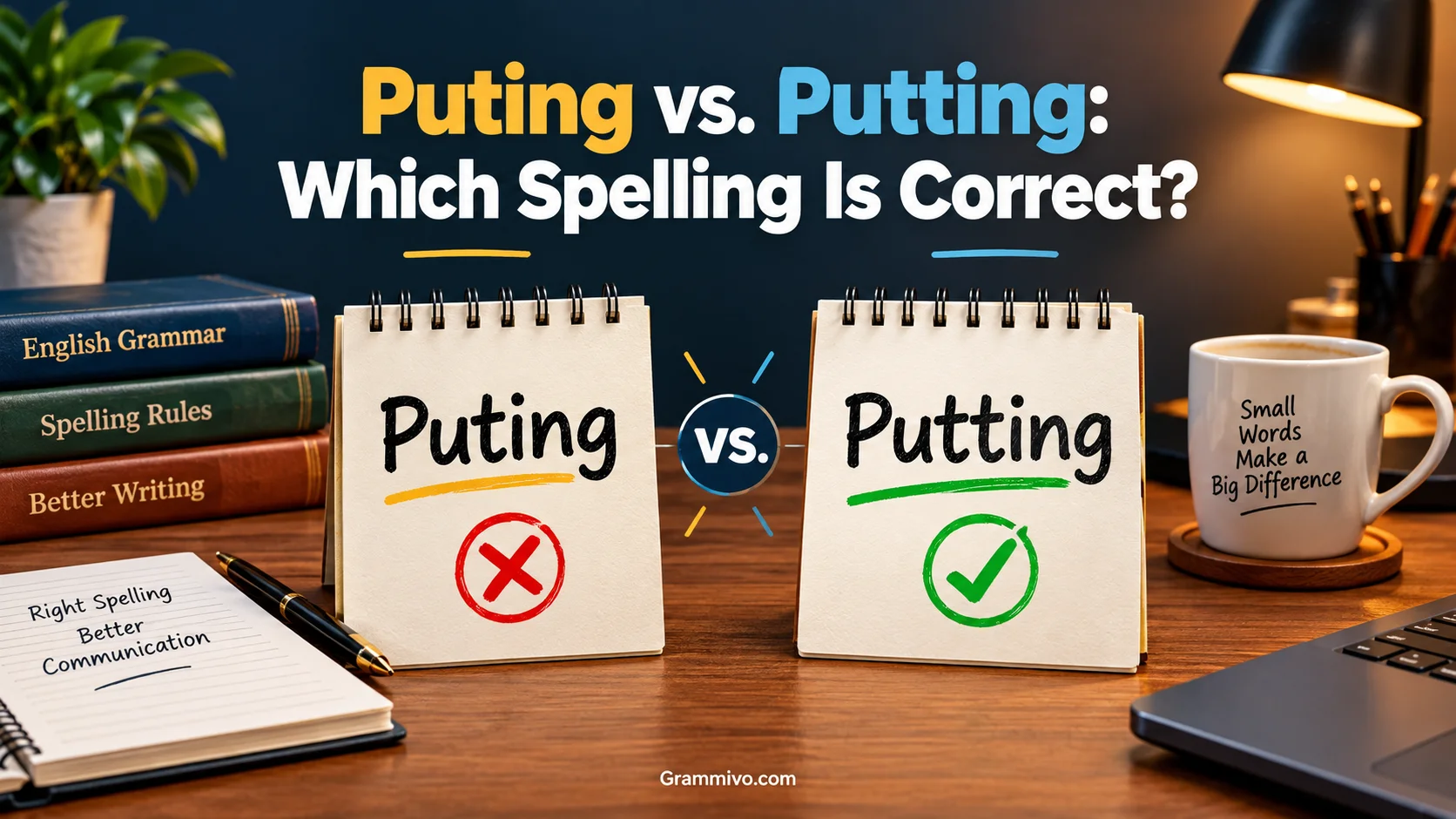
Puting vs. Putting can confuse English learners, but the correct spelling is Putting, following standard English spelling rules for adding -ing. Puting and Putting are similar words, so learners may feel confused when they frequently search for puting or putting and need a quick, clear answer.
The right version is Putting, formed from the verb put. The word describes the action of placing or moving something. The spelling difference causes confusion because the forms sound almost the same, but Puting is the wrong form, making it a spelling mistake and common mistake.
The rule is easy to remember: Putting doubles the t because put has a short vowel followed by a consonant before the -ing ending. This grammar rule shows why you should use the correct form and write it properly.
Quick Answer
Putting is the correct spelling. Puting is a misspelling.
Putting is formed by adding -ing to the verb put:
put + ing = putting
The final t doubles before the -ing ending. Therefore, the correct forms are:
- putting
- puting
For example:
She is putting the dishes in the cabinet.
Not:
She is puting the dishes in the cabinet.
The word putting works as both a present participle and a gerund. You can use it in continuous verb forms or when the action functions like a noun.
Comparison Overview
| Word | Correct Spelling? | Word Type | Meaning | Example |
| Putting | Yes | Present participle / gerund | The action of putting | She is putting the keys away. |
| Puting | No | Misspelling | No standard English meaning | She is puting the keys away. |
| Put | Yes | Base verb / past / past participle | To place or position something | Please put the keys here. |
The key distinction is simple. Putting is an established English word, while puting is simply a spelling mistake.
Main Differences Between Puting vs. Putting
The biggest difference between puting vs. putting is correctness. Putting follows standard English spelling rules, while puting leaves out one of the two required t’s.
There are several useful distinctions to remember:
- Putting is the correct -ing form of put.
- Puting is not a standard English word.
- Putting can function as a present participle.
- Putting can also function as a gerund.
- The spelling contains two consecutive t’s.
- The same spelling is used in standard American and British English.
The extra t isn’t decorative. It forms part of the standard spelling of the word.
What Does “Putting” Mean?
Putting is the -ing form of the verb put. The basic meaning of put is to place something somewhere, although the verb has many other meanings depending on context.
Consider these examples:
She is putting the book on the shelf.
Here, putting means placing something in a particular location.
However, put can also describe expressing an idea, applying something, making an effort, or taking part in an activity.
Putting Something Somewhere
This is probably the most familiar use.
He is putting his phone on the desk.
The sentence describes an action happening now. The person moves the phone into a particular position.
Putting Something Into Words
The word can also describe expressing thoughts or feelings.
She had difficulty putting her feelings into words.
Here, putting doesn’t involve physically moving anything. Instead, it means expressing something verbally or in writing.
Putting Effort Into Something
You can use putting when talking about effort or commitment.
You’re putting a lot of effort into your studies.
In this expression, the object isn’t literally being placed somewhere. The phrase means directing or investing effort toward a particular goal.
Putting Something Together
Putting together often means assembling or combining separate parts.
They are putting together a presentation for the meeting.
It can also mean organizing information, people, plans, or ideas.
Why Is “Putting” Spelled With Two Ts?
The spelling putting often surprises people because the base word contains only one t.
The basic formation is:
put + ing → putting
When the suffix -ing attaches to put, the final t doubles.
This produces:
p-u-t-t-i-n-g
That double t is essential. Removing one produces the misspelling puting.
The Spelling Pattern Behind “Putting”
English spelling rules can become complicated because verbs don’t all behave identically. Many short verbs ending in a consonant follow a consonant-doubling pattern before certain suffixes.
For example:
- run → running
- sit → sitting
- stop → stopping
- plan → planning
- put → putting
The doubled consonant helps preserve the pronunciation and follows established English spelling conventions.
However, you shouldn’t assume that every verb ending in a consonant behaves exactly the same way. English has plenty of exceptions and historical spelling patterns.
Why “Puting” Looks Tempting
The incorrect form puting looks plausible because writers may think they can simply attach -ing to the unchanged spelling:
put + ing = puting
That visual shortcut feels logical at first glance. Unfortunately, standard English spelling requires the second t.
It’s one of those tiny spelling details that can slip past you when you’re typing quickly.
Why “Puting” Is Incorrect
Puting isn’t a standard spelling of the English verb put with the -ing suffix.
If you encounter it in an article, message, assignment, email, or social media post, it generally represents a typographical or spelling error.
For example:
He is puting the groceries away.
The corrected version is:
He is putting the groceries away.
The same correction applies regardless of the sentence’s tense or context.
Common Places You May See “Puting”
Because puting is an easy typo to make, you might encounter it in:
- Quickly typed messages
- Comments and social media posts
- Student assignments
- Search queries
- Informal online writing
- Draft documents
- Text written by English learners
Seeing a spelling repeatedly doesn’t make it correct. Internet usage can preserve mistakes surprisingly well.
Putting in Different Grammatical Contexts
Understanding grammar makes the spelling easier to remember because you’ll recognize when putting belongs in a sentence.
Putting in the Present Continuous
The present continuous uses a form of be + putting.
Common structures include:
am + putting
I am putting the groceries away.
is + putting
She is putting her coat on.
are + putting
They are putting the chairs outside.
This construction generally describes an action that is happening now or around the current time.
Putting in the Past Continuous
The past continuous uses was/were + putting.
Examples include:
He was putting the dishes away when the phone rang.
We were putting the equipment together all afternoon.
Again, the spelling remains putting. The auxiliary verb changes, but the -ing form doesn’t.
Putting as a Gerund
A gerund is an -ing form that functions as a noun.
For example:
Putting things off can create unnecessary stress.
Here, putting things off acts as the subject of the sentence.
Another example:
She enjoys putting flowers in the vase.
The word putting follows the verb enjoys and refers to the activity itself.
Putting After Other Verbs
Certain verbs can naturally be followed by an -ing form.
For example:
- enjoy putting
- keep putting
- start putting
- stop putting
- avoid putting
Examples:
I enjoy putting my thoughts on paper.
He keeps putting his keys in the wrong place.
She started putting the decorations up early.
The spelling doesn’t change according to the preceding verb.
Putting vs. Put: Understanding the Verb Forms
One reason putting can be confusing is that put has an unusually stable verb pattern.
| Verb Form | Word | Example |
| Base form | put | Please put the book here. |
| Third-person singular | puts | She puts the keys on the table. |
| Past tense | put | He put the bag downstairs. |
| Past participle | put | They have put the chairs away. |
| Present participle | putting | They are putting the chairs away. |
Notice something unusual: the base form, past tense, and past participle are all put.
For example:
I put the book here every day.
I put the book here yesterday.
I have put the book here before.
Only the -ing form changes:
I am putting the book here now.
This pattern makes put an especially useful verb to study when learning English grammar.
Read More: Take Effect or Take Affect: Which One Is Correct?
Putting in Everyday English
The word putting appears constantly in ordinary conversation. It can describe physical movement, preparation, organization, communication, and effort.
Putting Something Somewhere
Please stop putting your shoes in the hallway.
Here, putting means placing.
Putting Something Away
I’m putting the groceries away.
The phrase put away means returning something to its proper storage place.
Putting Something Together
We’re putting the new desk together.
This usually means assembling separate pieces.
Putting Something Into Words
He struggled with putting his ideas into words.
This means expressing thoughts clearly.
Putting Effort Into Something
She’s putting more time into her writing.
The phrase describes directing effort toward an activity.
Putting Something On
He’s putting on his jacket.
Here, putting on means placing clothing on your body.
Putting in Golf
Putting also has a specific meaning in golf.
A putt is a stroke made on the putting green, usually with a putter, to roll the ball toward or into the hole. The activity is called putting.
For example:
His putting improved after several weeks of practice.
This meaning is unrelated to the spelling confusion itself. However, it demonstrates how one word can operate naturally in several contexts.
The golf sense also produces related terms such as putter, putt, and putting green.
Common Phrases With “Putting”
The word putting appears in many familiar phrasal verbs and expressions. Learning these phrases can make the correct spelling easier to recognize.
Putting Off
Putting off means delaying something.
She keeps putting off her dentist appointment.
The phrase often suggests postponement that could have been avoided.
Putting On
Putting on can mean wearing clothing.
I’m putting on my shoes.
It can also have other meanings depending on context, including applying something or presenting something in a particular way.
Putting Away
Putting away usually means returning something to its proper place.
Please start putting away the dishes.
It can also have other meanings in specific contexts, so context matters.
Putting Together
Putting together often means assembling or organizing.
They’re putting together a new training program.
You can put together physical objects, plans, presentations, teams, or ideas.
Putting Down
Putting down has several meanings.
It can describe physically placing something on a surface:
She is putting down the box.
It can also describe writing information:
I’m putting down a few notes.
Because the phrase has several meanings, the surrounding sentence determines the intended sense.
Putting Up With
Putting up with means tolerating something unpleasant or irritating.
I can’t keep putting up with the noise.
This expression is common in everyday English and is worth learning as a complete phrase.
Common Mistakes With “Putting”
Writing “Puting” Instead of “Putting”
This is the central spelling mistake.
She is puting the books on the shelf.
She is putting the books on the shelf.
The correction requires only one letter, but that letter matters.
Confusing “Putting” With “Put”
The words put and putting aren’t interchangeable in every sentence.
Compare:
Please put the keys on the table.
She is putting the keys on the table.
The first sentence uses the base form after the imperative please. The second uses the -ing form after is to describe an ongoing action.
Forgetting the Double “T”
A simple visual check can help:
Correct: p-u-t-t-i-n-g
Incorrect: p-u-t-i-n-g
If you’re using the -ing form of put, remember that putting always has two t’s.
Putting vs. Puting Examples
Seeing the words in complete sentences makes the distinction much clearer.
Correct Examples With “Putting”
She is putting the plates on the table.
I’m putting my phone in my bag.
They were putting together a new schedule.
He enjoys putting his ideas into writing.
We are putting the furniture away.
The chef is putting the finishing touches on the dish.
She kept putting off the difficult conversation.
He is putting more effort into his training.
Each sentence uses the standard spelling putting.
Incorrect Examples With “Puting”
The following sentences contain the common spelling error:
She is puting the plates on the table.
I’m puting my phone in my bag.
They were puting together a new schedule.
He enjoys puting his ideas into writing.
Correct each one by adding the second t:
She is putting the plates on the table.
I’m putting my phone in my bag.
They were putting together a new schedule.
He enjoys putting his ideas into writing.
Quick Correction Table
| Incorrect | Correct |
| She is puting the food away. | She is putting the food away. |
| I’m puting my phone on the desk. | I’m putting my phone on the desk. |
| They were puting the chairs outside. | They were putting the chairs outside. |
| He enjoys puting things together. | He enjoys putting things together. |
| We are puting the plan into action. | We are putting the plan into action. |
FAQs:
Is Puting or Putting correct?
Putting is the correct spelling in standard English. Puting is a misspelling. The verb put becomes putting when you add -ing.
Why does Putting have two t’s?
Putting has two t’s because the final consonant in put is doubled before adding -ing. The correct form is therefore putting, not puting.
Is Putting correct in American and British English?
Yes. Putting is correct in both American English and British English. There is no spelling difference between the two varieties for this word.
What does Putting mean?
Putting means placing, moving, or positioning something somewhere. For example, “She is putting the books on the shelf.”
How can I remember the spelling of Putting?
A simple tip is to remember put + ting = putting. When you add -ing to put, keep the double t. This can help you avoid the common mistake puting.
Conclusion:
Putting is the correct spelling, while puting is incorrect. The difference is small, but remembering the double t makes your writing clearer and more accurate. Whether you’re writing an email, completing homework, or sending a message, use putting whenever you mean the action of placing or moving something.
