
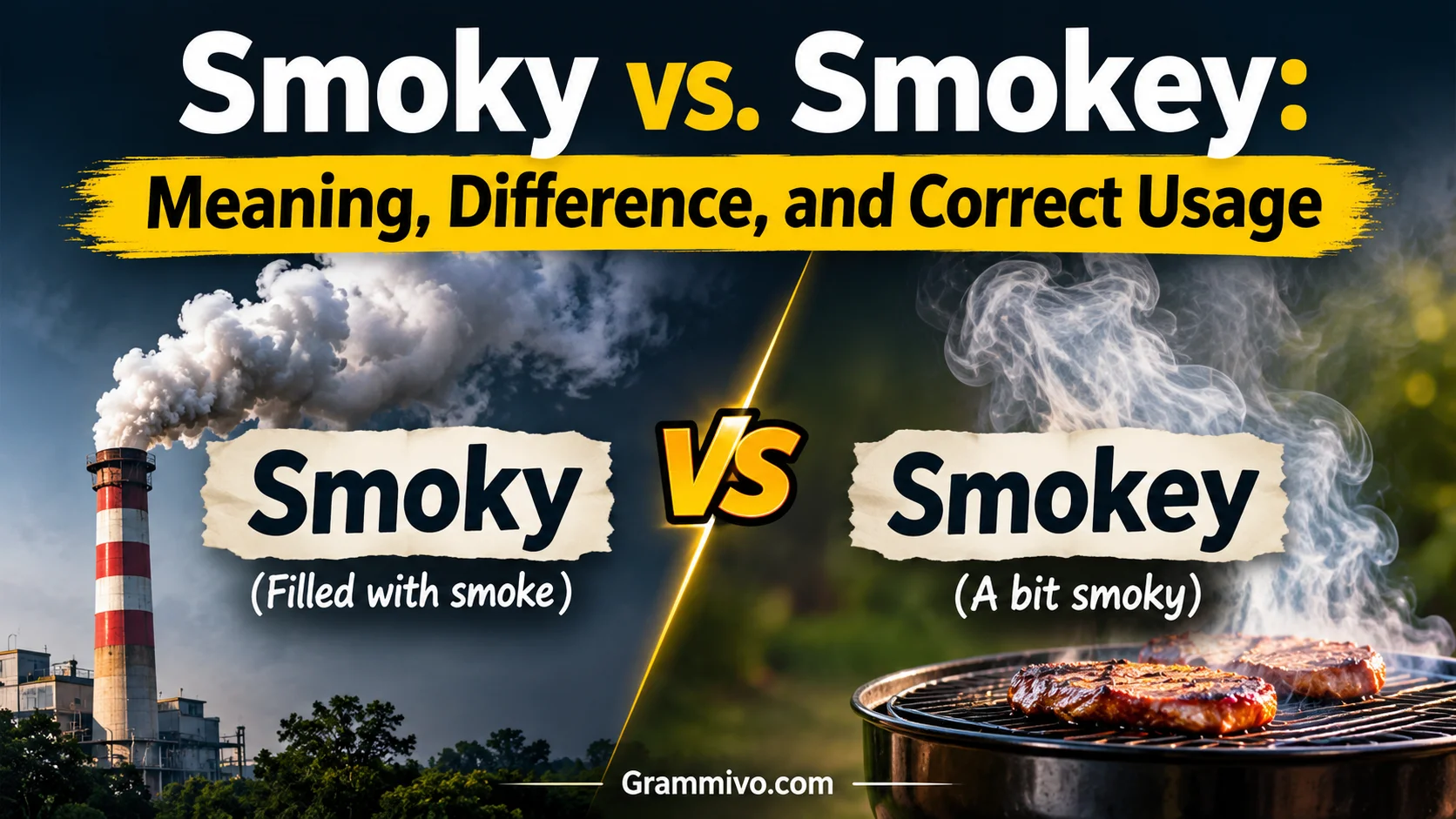
Have you ever wondered whether the correct spelling is smoky or smokey? Both forms appear in English, which makes it easy to mix them up. You might see smoky in a restaurant description and Smokey in someone’s name. Although they look almost identical, their uses differ.
The main distinction comes down to grammar and context. Smoky is the standard spelling of the adjective that describes something filled with smoke or having a smoke-like quality. Smokey, on the other hand, commonly appears as a personal name, nickname, or stylized spelling.
For example, you would describe a room filled with smoke as smoky, not smokey. However, if someone’s nickname is Smokey, you should preserve that spelling. Understanding this small difference will help you choose the right word in everyday writing.
Quick Answer
Smoky vs. Smokey: Smoky is the standard English adjective for something containing smoke or having a smoke-like smell, taste, or appearance. Smokey is primarily a proper name or nickname. Use smoky when describing food, air, fires, or colors. Use Smokey when referring to someone or something with that established name.
Examples:
- Smoky: The restaurant served delicious smoky barbecue ribs.
- Smokey: Smokey is the nickname my grandfather has used for decades.
Remember this simple rule: If you’re describing smoke, choose smoky. If you’re referring to a name, Smokey may be correct.
Comparison Overview
Although smoky and smokey differ by only one letter, their grammatical roles and everyday applications aren’t quite the same. The first is a standard descriptive adjective, while the second usually functions as a proper noun.
| Feature | Smoky | Smokey |
| Part of speech | Adjective | Usually a proper noun |
| Primary meaning | Full of smoke or resembling smoke | A personal name, nickname, or stylized spelling |
| Standard adjective | Yes | No |
| Capitalization | Usually lowercase | Capitalized as a proper name |
| Common usage | Food, air, smells, colors, and atmosphere | Names, characters, and established titles |
| Example | The room looks smoky. | Smokey is his nickname. |
The distinction becomes easier when you consider what each spelling communicates.
Smoky describes a quality or condition. You can use it to explain how something smells, tastes, looks, or feels.
Smokey generally identifies someone or something by name. For instance, Smokey Bear is the familiar name of the famous wildfire-prevention mascot.
One important detail: Smokey can appear in informal writing as a variant spelling of the adjective. However, that doesn’t make it the preferred spelling in standard edited American English.
What Does Smoky Mean?
Smoky is an adjective that describes something containing smoke, producing smoke, or having characteristics associated with smoke. It can also describe flavors, scents, and appearances that remind you of smoke.
The word comes from the noun smoke, with the suffix -y added to form an adjective. This spelling follows a familiar English word-building pattern.
For example:
- Cloud → Cloudy
- Rain → Rainy
- Dust → Dusty
- Smoke → Smoky
The suffix -y often means that something contains, produces, or resembles the quality expressed by the original noun.
Different Meanings and Uses of Smoky
The word smoky has several related meanings. Its precise meaning depends on the situation in which you use it.
A smoky atmosphere: When an area contains visible smoke or feels filled with smoke, you can describe it as smoky.
Examples:
- The kitchen became smoky after the oil caught fire.
- We couldn’t see the road through the smoky air.
- A smoky haze covered the city after the wildfire.
A smoky flavor: In cooking, smoky describes a taste that resembles food cooked over burning wood, charcoal, or other smoke-producing materials.
Examples:
- The chef added smoked paprika for a smoky flavor.
- These barbecue ribs have a rich and smoky taste.
- I prefer smoky cheese over mild varieties.
A smoky flavor doesn’t always mean someone cooked the food directly over a fire. Ingredients such as smoked paprika, liquid smoke, and smoked salt can also create that taste.
A smoky smell: You can use smoky when something has an odor resembling burning wood, tobacco, or other smoke.
Examples:
- A smoky smell came from the fireplace.
- His jacket carried a faint smoky odor.
- The room had a smoky scent after the candles burned.
A smoky appearance: The word can also describe something that resembles smoke in color, texture, or visual effect.
Examples:
- She wore smoky gray eyeshadow.
- The artist used smoky shades to create a dramatic painting.
- A smoky mist drifted across the valley.
Smoky as an Adjective in Everyday English
You’ll encounter smoky in several everyday settings. Food writers use it to describe rich flavors while photographers use it for hazy visual effects.
Here are some common combinations:
| Expression | Meaning | Example |
| Smoky air | Air containing smoke | The smoky air made breathing uncomfortable. |
| Smoky flavor | A taste resembling smoke | The sauce has a smoky flavor. |
| Smoky smell | An odor associated with smoke | A smoky smell filled the garage. |
| Smoky eyes | A dramatic makeup style | She created a smoky eye look. |
| Smoky gray | A gray shade resembling smoke | The walls have a smoky gray finish. |
| Smoky atmosphere | An environment filled with smoke or haze | The smoky atmosphere reminded us of an old jazz club. |
| Smoky barbecue | Barbecue with a smoke-like flavor | We ordered smoky barbecue chicken. |
These expressions demonstrate why smoky is such a useful descriptive word. It works across different subjects without changing its spelling.
Why Is Smoky the Standard Spelling?
The spelling smoky follows the established adjective-forming pattern in English. Dictionaries recognize it as the standard spelling for describing something containing or resembling smoke.
Although smokey appears in some informal contexts, standard American English generally favors smoky for descriptive writing.
Consider these examples:
- Correct: The backyard smells smoky.
- Nonstandard: The backyard smells smokey.
- Correct: I love smoky barbecue sauce.
- Nonstandard: I love smokey barbecue sauce.
If you’re writing an article, school assignment, professional email, or product description, choose smoky whenever you intend to describe smoke-related qualities.
What Does Smokey Mean?
Smokey is a spelling most commonly associated with personal names, nicknames, fictional characters, and established titles.
Unlike smoky, which functions as a regular descriptive adjective, Smokey often identifies a particular person or character. Its spelling may reflect a family tradition, personal preference, or established naming convention.
For example, someone might have the nickname Smokey because of their hair color, personality, association with smoke, or another personal reason.
The spelling doesn’t need to follow the standard adjective convention when it forms part of someone’s actual name.
Smokey as a Personal Name or Nickname
People sometimes use Smokey as a nickname. It can also appear as an informal given name or an affectionate name used among family members and friends.
For example:
- Smokey is my grandfather’s childhood nickname.
- Everyone at work calls him Smokey.
- Smokey has always been the family dog’s name.
In these sentences, Smokey identifies a particular individual or animal rather than describing a smoky quality.
You should preserve the spelling that the person uses. Changing someone’s name from Smokey to Smoky would alter the established name.
Smokey in Fictional Characters and Popular Culture
One of the best-known examples of this spelling is Smokey Bear, the American wildfire-prevention mascot.
Smokey Bear became widely recognized through public service campaigns that encouraged people to prevent human-caused wildfires.
His familiar slogan, “Only YOU can prevent wildfires,” helped make the character a lasting symbol of wildfire awareness.
Notice the spelling: Smokey Bear, not Smoky Bear.
That’s because Smokey is part of the character’s established name. It isn’t being used as an ordinary adjective.
Other fictional characters, pets, and entertainment figures may also use the spelling Smokey as part of their names.
Smokey in Brand Names and Established Titles
Businesses, products, entertainment works, and organizations sometimes use Smokey as a distinctive name.
For example, a restaurant might choose Smokey’s BBQ as its business name. A company could also use Smokey in a product title or promotional campaign.
In these situations, the spelling depends on the official name rather than standard adjective rules.
However, there’s an important distinction:
- Smokey’s BBQ: Smokey is part of a business name.
- Smoky barbecue: Smoky describes the flavor of the food.
Both spellings can appear in the same sentence without creating a grammatical problem.
Should Smokey Always Be Capitalized?
When Smokey functions as a person’s name, nickname, or official title, capitalize its first letter.
Examples:
- Smokey is coming to dinner tonight.
- We watched a documentary about Smokey Bear.
- My neighbor named his dog Smokey.
However, if someone uses smokey as an informal descriptive spelling in lowercase, that doesn’t automatically make it a proper noun. In standard writing, though, smoky remains the preferred adjective.
Read More: Across vs. Accros: Which Spelling Is Correct?
Main Differences Between Smoky vs. Smokey
Understanding the individual meanings is helpful. However, comparing the two spellings directly makes their differences even clearer.
Meaning and Definition
The most important difference between smoky and smokey involves their meanings.
Smoky describes something related to smoke. It can refer to smoke-filled air, a strong smell, a particular flavor, or a hazy appearance.
Smokey usually identifies a person, animal, fictional character, or established name.
For example:
- The fireplace made the living room smoky.
- Smokey is the name of our family dog.
The first sentence describes a condition. The second identifies an individual.
Spelling and Standard Usage
English spelling can be tricky, especially when two forms look equally familiar.
Nevertheless, smoky is the standard adjective spelling in American English. The spelling smokey is generally reserved for names and stylized uses.
Compare these examples:
| Standard spelling | Nonstandard descriptive spelling |
| Smoky barbecue | Smokey barbecue |
| Smoky air | Smokey air |
| Smoky smell | Smokey smell |
| Smoky eyes | Smokey eyes |
| Smoky flavor | Smokey flavor |
When you’re describing something rather than naming it, the version without the extra e is the safer choice.
Grammatical Function
Another important difference involves how each spelling works in a sentence.
Smoky functions as an adjective. It modifies nouns by providing additional information about their qualities.
Examples:
- The smoky kitchen needed ventilation.
- We enjoyed a smoky cocktail.
- A smoky cloud appeared above the trees.
In each example, smoky describes another word.
Smokey generally functions as a proper noun. It identifies a specific person, animal, character, or named entity.
Examples:
- Smokey works at the local restaurant.
- Smokey Bear appears in wildfire-prevention campaigns.
- Our cat Smokey loves sleeping near the window.
This grammatical difference helps you determine which spelling belongs in your sentence.
Context and Application
The surrounding words often reveal which spelling you need.
Use smoky when discussing:
- Cooking and food descriptions.
- Smoke-filled rooms and outdoor environments.
- Burning wood and fireplaces.
- Fragrances and odors.
- Makeup styles and colors.
- Art and visual effects.
Use Smokey when discussing:
- Personal names.
- Nicknames.
- Fictional characters.
- Pets with that name.
- Established business names.
- Official titles and cultural references.
For instance, a restaurant review might describe a sauce as smoky while mentioning that the restaurant’s owner is named Smokey.
Capitalization
Capitalization also helps distinguish the two spellings.
The adjective smoky normally appears in lowercase unless it starts a sentence or forms part of a title.
Examples:
- The smoky air made everyone cough.
- We ordered smoky chicken wings.
Meanwhile, Smokey takes a capital letter when it represents a proper name.
Examples:
- Smokey arrived before everyone else.
- We bought a Smokey Bear collectible.
However, capitalization alone doesn’t determine whether the spelling is correct. You still need to consider the word’s intended meaning.
Smoky vs. Smokey: Examples in Everyday Sentences
Sometimes the easiest way to understand a spelling difference is to see it in realistic situations.
The following examples show how each form works in everyday writing.
Examples Using Smoky
Use smoky when you want to describe something that contains smoke or resembles its qualities.
- The restaurant serves delicious smoky barbecue ribs.
- A smoky haze covered the neighborhood after the fire.
- My jacket still has a smoky smell from the campfire.
- She prefers smoky eyeshadow for evening events.
- The chef added smoked paprika for a deeper smoky flavor.
- We noticed a smoky cloud rising above the factory.
- This whiskey has a bold and smoky finish.
- The fireplace created a warm but smoky atmosphere.
- He painted the walls in a soft smoky gray.
- The smoky aroma of grilled vegetables filled the backyard.
Notice how smoky consistently describes a characteristic of something else.
Examples Using Smokey
Use Smokey when referring to a name or nickname.
- Smokey is my uncle’s favorite childhood nickname.
- Our family dog, Smokey, loves chasing squirrels.
- Smokey Bear teaches people about wildfire prevention.
- Everyone calls the old motorcycle Smokey.
- Smokey joined the group for dinner.
- My grandfather named his first horse Smokey.
- The character Smokey appears in the comedy film.
- Smokey’s restaurant serves traditional American food.
In these sentences, Smokey identifies someone or something rather than describing its qualities.
Smoky vs. Smokey in Paired Sentences
Paired examples make the distinction especially easy to remember.
| Smoky | Smokey |
| The room became smoky after dinner. | Smokey left the room after dinner. |
| I love the smoky taste of grilled meat. | Smokey loves grilled meat. |
| The smoky sky looked unusual. | Smokey watched the sky from the porch. |
| She applied smoky eyeshadow. | Smokey is her makeup artist’s nickname. |
| The fireplace produced smoky air. | Smokey cleaned the fireplace. |
The key is simple: smoky describes a quality while Smokey generally identifies a name.
FAQs:
Is Smoky or Smokey the Correct Spelling?
Smoky is the standard spelling when describing something filled with smoke or having a smoke-like quality. Smokey is generally used as a personal name, nickname, or stylized spelling. For example, smoky barbecue is standard while Smokey Bear is the correct character name.
Is Smokey Ever a Correct Word?
Yes, Smokey is a correct spelling when it forms part of an established name or nickname. For example, Smokey Bear is the famous wildfire-prevention mascot. However, smoky remains the standard adjective in ordinary descriptive writing.
Should Smoky Be Capitalized?
No, smoky doesn’t normally need capitalization unless it begins a sentence or appears in a proper name. For example, write “The kitchen smells smoky.” However, capitalize Smoky in geographical names such as the Great Smoky Mountains.
Is It Smoky Flavor or Smokey Flavor?
Smoky flavor is the standard spelling in American English. It describes food with a taste resembling smoke or wood-fired cooking. For example, smoked paprika gives chili a rich smoky flavor. Use Smokey only when it belongs to an established name.
Why Is Smokey Bear Spelled With an E?
Smokey Bear uses the spelling Smokey because that’s the established name of the famous American wildfire-prevention mascot. The spelling is part of the character’s identity. It doesn’t change the standard spelling of the adjective smoky.
Conclusion:
The difference between smoky vs. smokey comes down to meaning, grammar, and context. Although both spellings look familiar and sound alike, they don’t serve the same purpose in standard writing. Use smoky when describing smoke-filled air, barbecue flavors, burning smells, colors, or hazy appearances. Choose Smokey when referring to a person’s name, nickname, fictional character, or established title.
