
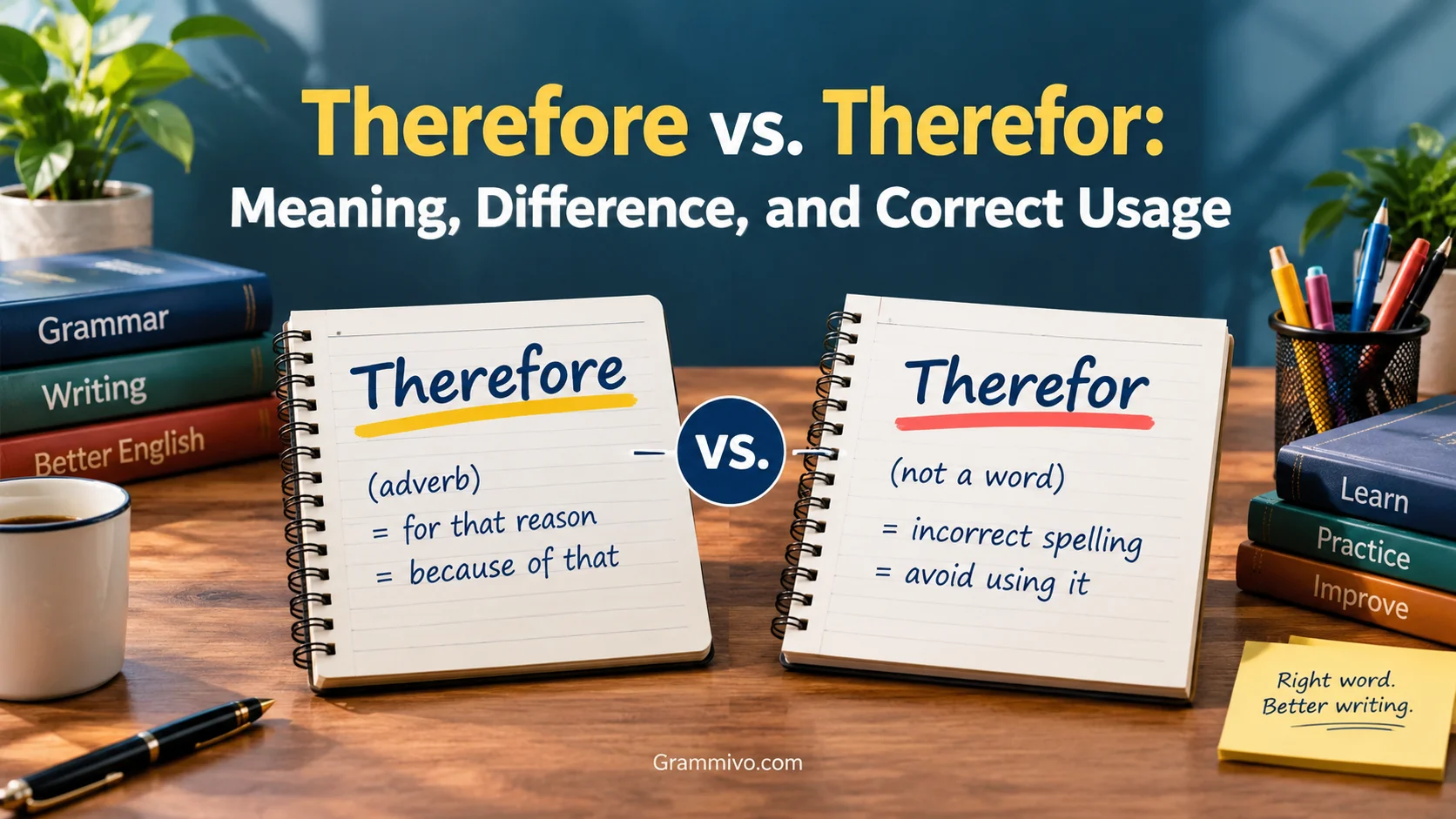
Have you ever wondered whether to write therefore or therefor? These two words look almost identical, so it’s easy to assume they’re interchangeable. However, they serve different purposes in English. Choosing the wrong one can change the meaning of your sentence or make your writing confusing.
The good news is that you can learn the difference with a few simple rules. Therefore is the word you need when you want to express a result, explain a conclusion, or show what follows logically from something. Therefor, on the other hand, is a legitimate but uncommon word that generally means “for that” or “in exchange for that.” You’ll encounter it most often in legal, contractual, and other specialized writing.
For example, consider these sentences:
- Therefore: The roads were icy; therefore, the school closed for the day.
- Therefor: The agreement specified the payment therefor, referring to payment for the service or item previously mentioned.
The first sentence connects a cause with its result. The second uses therefor to refer to something provided in exchange for a service or item. Although the spellings differ by just one letter, their meanings are distinct.
Understanding this difference will help you write more accurately, avoid common spelling mistakes, and interpret formal documents with greater confidence.
Quick Answer
Therefore is correct when you mean “for that reason,” “as a result,” or “consequently.” Therefor is also a correct English word, but it means “for that” or “in exchange for that” and appears mainly in formal or specialized contexts.
- Use therefore to introduce a conclusion or consequence.
- Use therefor to refer to something given, paid, or provided in exchange for something else.
- Don’t use therefor as a substitute for therefore in ordinary writing.
- Remember that neither spelling is universally wrong. The intended meaning determines which word fits.
Example: Maya forgot her umbrella; therefore, she arrived at work with wet clothes.
Example: The contract specified the equipment and the payment therefor. Here, therefor refers to payment for the equipment.
Comparison Overview
The easiest way to distinguish therefore from therefor is to examine the relationship between the words and the surrounding sentence. One expresses a logical result, while the other points back to something for which an exchange or provision occurs.
| Feature | Therefore | Therefor |
| Meaning | For that reason; as a result | For that; in exchange for that |
| Part of speech | Adverb | Adverb |
| Main purpose | Expresses a conclusion or consequence | Refers to something provided or paid in exchange |
| Common usage | Everyday, academic, business, and professional writing | Legal, contractual, financial, and specialized writing |
| Frequency | Very common | Relatively uncommon |
| Typical sentence | The evidence was incomplete; therefore, the case required further review. | The contract established the fee therefor. |
| Suitable replacement | Consequently, thus, as a result | For that, in exchange for that, depending on context |
Both words are valid, but they aren’t interchangeable. If you can replace the word with “as a result” without changing the intended meaning, therefore is usually the correct choice. If the sentence means “for that” or “in exchange for that,” therefor may be appropriate.
What Does Therefore Mean?
Definition of Therefore
Therefore is an adverb that means “for that reason,” “consequently,” or “as a result.” Writers use it to connect information with a conclusion that follows from it.
The word signals a logical relationship between two ideas. The first idea provides a reason, fact, condition, or piece of evidence. The second presents the result or conclusion that follows.
For example:
- The store had no electricity; therefore, it closed early.
- Jordan studied consistently and therefore performed well on the exam.
- The figures don’t match; therefore, we need to review the calculations.
- All registered members must sign in. Therefore, visitors should check with the front desk.
In each example, therefore tells readers how one idea relates to another. It helps the writing flow logically instead of presenting separate facts without explanation.
When to Use Therefore
Use therefore whenever you want to express a conclusion, consequence, or logical result. It works in many types of writing, including school assignments, business reports, emails, explanations, and everyday conversations.
To show cause and effect
Use therefore when one event leads to another.
- The temperature dropped below freezing; therefore, the lake began to ice over.
- The delivery truck arrived late; therefore, several orders missed their scheduled departures.
To draw a logical conclusion
Use it when evidence supports a conclusion.
- Every square has four sides. This shape is a square; therefore, it has four sides.
- The customer provided an invalid account number. Therefore, the payment couldn’t be processed.
To explain a decision
You can use therefore to show why someone made a particular choice.
- The restaurant was fully booked; therefore, we chose another place.
- The project exceeded its budget; therefore, the team reduced its expenses.
To connect ideas in academic or professional writing
In formal writing, therefore can introduce a conclusion based on evidence, research, or analysis.
- The sample size was too small to support a reliable conclusion. Therefore, additional testing is necessary.
- The survey showed a consistent decline in customer satisfaction; therefore, management reviewed its service procedures.
However, don’t add therefore simply to make a sentence sound more formal. The word should express a genuine logical connection.
Therefore in Sentences
The following examples show how therefore works in different situations.
| Example sentence | What therefore expresses |
| The alarm didn’t ring; therefore, I overslept. | A consequence |
| Water freezes at 32°F under standard atmospheric pressure; therefore, it can turn to ice at that temperature. | A logical result |
| The invoice was overdue; therefore, the supplier sent a reminder. | A resulting action |
| The two estimates were different; we therefore requested a third opinion. | A conclusion or response |
| The team met every deadline and therefore completed the project on schedule. | A result |
| The witness couldn’t identify the person; therefore, the identification remained uncertain. | A conclusion based on evidence |
Notice that therefore doesn’t always appear at the beginning of a sentence. You can place it in the middle when the sentence reads naturally and the connection remains clear.
For instance, “The team therefore postponed the launch” is grammatically acceptable. It means that the postponement followed from previously stated information.
Punctuation Rules for Therefore
Although therefore expresses a connection between ideas, it doesn’t function like a coordinating conjunction such as and or but. Its punctuation depends on how the sentence is constructed.
When therefore begins a sentence
Place a comma after it when it introduces a sentence-level conclusion.
- Correct: The roads were flooded. Therefore, the event was postponed.
- Correct: The figures were incomplete. Therefore, we requested a revised report.
The comma helps separate the transition word from the main statement.
When therefore connects two independent clauses
Use a semicolon before therefore and a comma after it when connecting two closely related independent clauses.
- Correct: The deadline had passed; therefore, the application was rejected.
- Correct: The store had run out of supplies; therefore, the manager placed an urgent order.
Both clauses can stand alone as complete sentences. The semicolon links them, while the comma follows the conjunctive adverb.
When therefore appears in the middle of a sentence
You can place therefore between the subject and the main verb or elsewhere in a sentence when the construction remains clear.
- The company therefore revised its hiring plans.
- The proposal was therefore rejected.
- We must therefore reconsider our original assumptions.
You don’t need to surround every occurrence of therefore with commas. Use punctuation that reflects its placement and the sentence’s structure.
Avoid comma splices
A comma splice occurs when a comma alone joins two independent clauses.
- Incorrect: The roads were icy, therefore, school closed.
- Correct: The roads were icy; therefore, school closed.
- Correct: The roads were icy. Therefore, school closed.
Remember that therefore doesn’t replace the punctuation needed between complete sentences.
What Does Therefor Mean?
Definition of Therefor
Therefor is an English adverb that generally means “for that,” “for it,” or “in exchange for that.” It refers to something mentioned earlier in a sentence or passage, often an item, service, payment, or obligation.
Unlike therefore, it doesn’t normally introduce a conclusion. Instead, it points to what someone gives, pays, provides, or receives in connection with something else.
Consider this example:
“The agreement identifies the equipment and the payment therefor.”
Here, therefor means payment for the equipment. It refers back to the equipment rather than announcing a result.
Another example is:
“The buyer accepted the goods and paid the amount specified therefor.”
In this sentence, therefor refers to the amount specified for the goods.
The word can sound unfamiliar because most everyday writing uses clearer alternatives, such as “for the equipment” or “in exchange for the goods.” Nevertheless, therefor remains a legitimate English word.
Read More: Labor vs. Labour: Meaning, Difference, and Correct Usage
When to Use Therefor
Use therefor only when its specific meaning fits the sentence. It’s most likely to appear in legal documents, contracts, financial language, and other formal contexts.
In contracts and agreements
Legal and contractual writing sometimes uses therefor to refer to payment or another obligation associated with something previously mentioned.
Example:
“The supplier shall deliver the materials and receive the agreed compensation therefor.”
In plain English, this means the supplier will receive the agreed compensation for the materials.
In financial or commercial writing
The word may refer to money paid for goods, services, or obligations.
Example:
“The invoice lists the replacement parts and the charges therefor.”
The phrase means that the invoice lists the replacement parts and the charges for those parts.
In formal or specialized documents
You might encounter therefor in older documents, established legal expressions, or specialized writing that favors compact wording.
Example:
“The applicant submitted the required documents and the fee therefor.”
This means the applicant submitted the required documents and the fee associated with them.
However, don’t assume that every formal sentence needs therefor. In modern general writing, “the fee for those documents” will often be clearer.
Therefor in Sentences
Here are additional examples that show the word’s intended meaning.
| Example sentence | Meaning of therefor |
| The contract specifies the goods and the payment therefor. | Payment for the goods |
| The invoice includes the service charge therefor. | The charge for the service previously mentioned |
| The buyer received the equipment and paid the agreed price therefor. | The agreed price for the equipment |
| The application requires supporting documents and the fee therefor. | The fee for the application or its required processing |
| The agreement identifies the materials and the compensation payable therefor. | Compensation for the materials |
These examples illustrate the same basic idea: therefor refers to something connected with an earlier-mentioned item, service, or obligation.
When reading a sentence containing this word, look backward for the thing it refers to. That reference usually makes its meaning easier to understand.
Is Therefor Still Used Today?
Yes. Therefor is still used in modern English, although it’s much less common than therefore.
Its continued use is especially noticeable in legal and contractual writing. These fields often retain compact expressions that have precise meanings within a particular context. However, the word isn’t exclusive to lawyers, and its appearance doesn’t automatically make a sentence legally significant.
Most readers won’t need therefor in everyday emails, school assignments, blog posts, or casual messages. In these settings, straightforward phrases are usually easier to understand.
For example:
- Less familiar: The company issued a refund therefor.
- Clearer: The company issued a refund for the returned item.
The second sentence is more direct when the context doesn’t require the specialized term.
The important distinction is meaning, not age. Therefor isn’t simply an outdated spelling of therefore. Both words have distinct meanings, and both can be correct when used appropriately.
Main Differences Between Therefore and Therefor
Difference in Meaning
The central difference between therefore and therefor is the relationship each word expresses.
Therefore introduces a result or conclusion. It answers a question such as “What follows from this?” or “What happened because of that?”
Example: The server stopped working; therefore, the website became unavailable.
The website’s unavailability is the result of the server failure.
Therefor refers to something given, paid, or provided for an earlier-mentioned item or service. It answers a question such as “What was paid for that?” or “What was provided in exchange?”
Example: The contract specified the equipment and the payment therefor.
Here, the payment is associated with the equipment.
A quick comparison makes the difference clear:
- Therefore: A reason leads to a conclusion.
- Therefor: Something is provided or exchanged for something else.
FAQs:
Is Therefore or Therefor Correct?
Both words are correct, but they have different meanings. Use therefore to express a reason, consequence, or conclusion. Use therefor to mean “for that” or “in exchange for that,” especially in formal or specialized contexts.
For example, “The road was closed; therefore, we took another route” expresses a result. “The contract specifies the payment therefor” refers to payment for something previously mentioned.
What Is the Difference Between Therefore and Therefor?
Therefore means “for that reason” or “as a result,” while therefor means “for that” or “in exchange for that.”
The first word connects a reason with a conclusion. The second refers to an item, service, or obligation for which something is provided or paid.
Is Therefor a Real Word?
Yes. Therefor is a legitimate English adverb, not simply a misspelling of therefore. It appears most often in legal, contractual, financial, and other specialized writing.
Although it’s uncommon in everyday conversation, you may encounter it in agreements, invoices, and formal documents. Its exact meaning depends on what the surrounding text identifies as the item or obligation involved.
Can I Use Therefor Instead of Therefore?
No, not when you mean “as a result” or “for that reason.” The words aren’t interchangeable.
Incorrect: “The store was closed, therefor we went home.”
Correct: “The store was closed; therefore, we went home.”
Use therefor only when the intended meaning is “for that” or “in exchange for that.”
Why Is Therefor Used in Legal Documents?
Legal and contractual writing sometimes uses therefor as a concise way to refer to payment, compensation, or another obligation associated with something previously mentioned.
For example, “the goods and the consideration therefor” refers to the goods and the payment or other value provided in exchange for them.
The exact legal effect depends on the surrounding provisions and the applicable law. The word itself doesn’t establish a particular legal obligation; the document’s full wording determines the intended meaning.
Conclusion:
The difference between therefore and therefor comes down to meaning. Although the words look almost identical, they perform different jobs in a sentence. Use therefore when you want to express a result, consequence, or logical conclusion. It’s the common choice in everyday communication, academic writing, and professional documents. Use therefor when you mean “for that” or “in exchange for that.” The word remains valid in English, but you’ll encounter it more often in legal, contractual, financial, and specialized contexts.
