
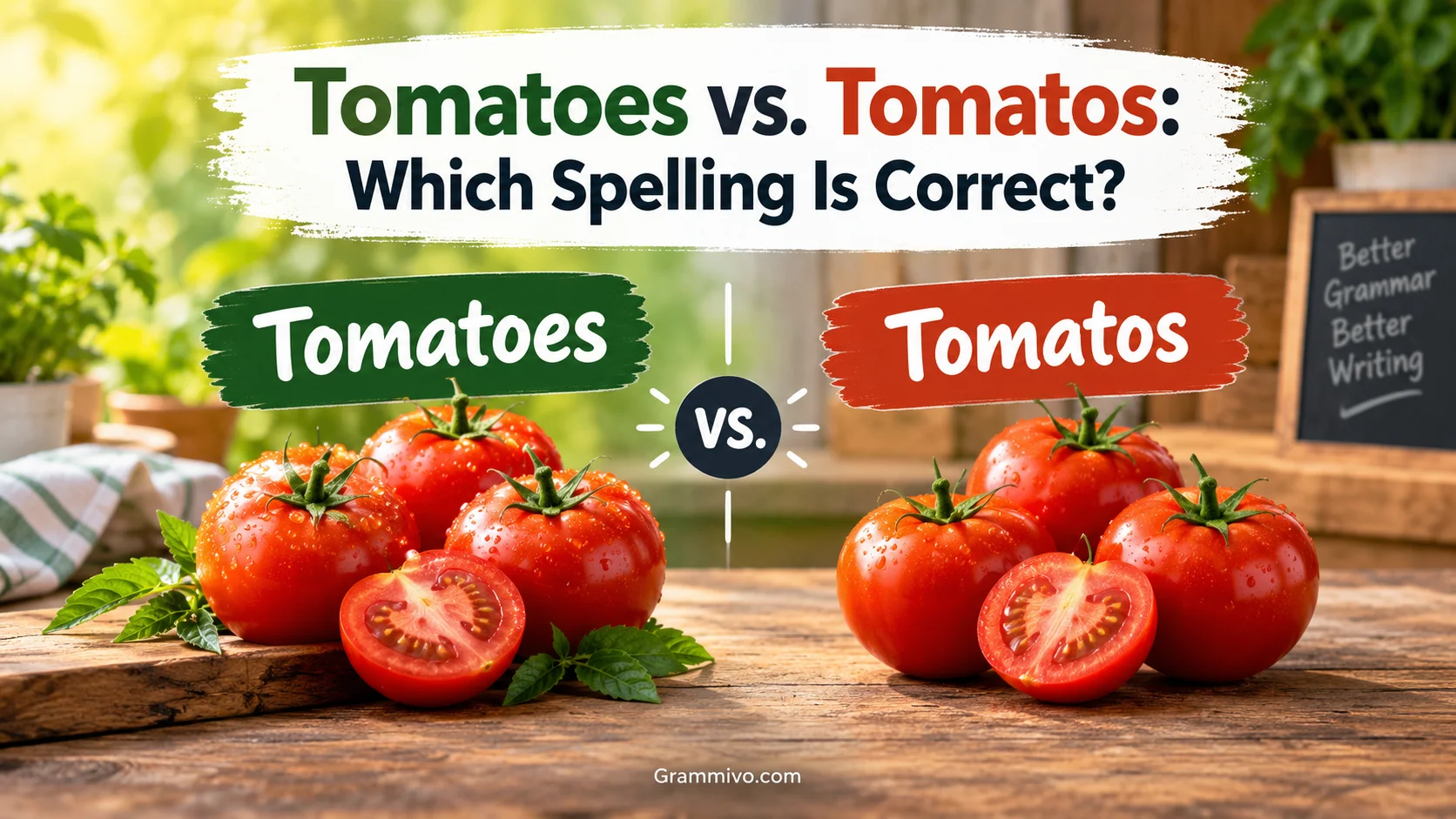
For Tomatoes vs. Tomatos, confused and unsure writers can quickly learn the correct spelling and avoid a common mistake. If you’ve ever paused mid-sentence, this common spelling question can make English writing feel tricky. Both forms look similar, but Tomatoes is correct, while Tomatos is the wrong form and incorrect in standard English spelling.
The simple rule is easy to remember: the singular form is tomato, and the plural form is tomatoes. Because words ending in -o can follow different spelling rules, learners and native speakers may second-guess themselves. Here, the plural takes -es, not -s, giving you the correct form.
This difference matters when you’re writing, blogging, cooking, or chatting online, especially when a spelling mistake can make your written English look unpolished. With a few clear examples, the confusion becomes easy to understand, and you can spell the right word with more confidence.
Quick Answer
Tomatoes is the correct plural spelling of tomato.
Tomatos is not the standard English plural form and should be avoided in formal, academic, professional, and everyday writing.
- Singular: tomato
- Plural: tomatoes
- Incorrect: tomatos
- Example: “We bought five tomatoes at the grocery store.”
The important spelling change is the addition of -es:
tomato → tomatoes
Think of the ending as a small grammatical signal. Once you see tomato as a word that commonly takes -es, the spelling becomes much easier to remember.
Comparison Overview
| Word | Correct Spelling? | Form | Meaning | Example |
| tomato | Yes | Singular | One tomato | “I sliced a tomato.” |
| tomatoes | Yes | Plural | More than one tomato | “The tomatoes are ripe.” |
| tomato’s | Yes, in specific contexts | Singular possessive | Something belonging to one tomato | “The tomato’s skin is thin.” |
| tomatoes’ | Yes, in specific contexts | Plural possessive | Something belonging to multiple tomatoes | “The tomatoes’ skins were removed.” |
| tomatos | No | Incorrect plural | Intended to mean multiple tomatoes | “I bought three tomatos.” ❌ |
The key difference between tomatoes and tomatos is spelling rather than meaning. Someone writing tomatos usually intends to write the plural tomatoes. Standard English, however, requires the -es ending.
Main Differences Between Tomatoes vs. Tomatos
The two forms aren’t competing words with different definitions. Instead, one is the correct plural spelling and the other is a spelling error.
Tomatoes Is the Correct Plural
Tomatoes is the standard plural form of tomato. Use it whenever you are talking about two or more tomatoes.
For example:
- “The farmer harvested hundreds of tomatoes.”
- “These tomatoes are perfect for the salad.”
- “She chopped three tomatoes for the sauce.”
- “The garden produced several large tomatoes this year.”
The word works the same way whether you’re talking about food, gardening, farming, recipes, or the plants themselves.
Tomatos Is a Misspelling
Tomatos is generally incorrect in standard English.
The mistake makes sense from a spelling perspective. English has many nouns that form their plurals simply by adding -s:
- book → books
- car → cars
- table → tables
- apple → apples
A writer may therefore assume:
tomato + s = tomatos
However, standard English uses tomatoes, not tomatos.
The Extra “E” Makes the Difference
The easiest way to spot the problem is to compare the endings:
tomato + es = tomatoes
The plural ending isn’t merely -s. It is -es.
That gives you:
tomato → tomatoes ✅
rather than:
tomato → tomatos ❌
This is a small spelling detail, but it makes a significant difference in polished writing.
What Does Tomatoes Mean?
Tomatoes is the plural form of tomato. It refers to more than one tomato.
Depending on the sentence, the word can refer to the fruits themselves or to multiple tomato plants in a broader gardening context.
For example, you might say:
- “The tomatoes are ready to harvest.”
- “I planted several tomatoes this spring.”
- “The recipe requires two large tomatoes.”
- “The market sells locally grown tomatoes.”
In everyday usage, context usually makes the meaning obvious.
Tomatoes in Food and Cooking
The plural tomatoes appears frequently in recipes and food writing.
You might see instructions such as:
- “Dice two tomatoes.”
- “Add the chopped tomatoes to the pan.”
- “Roast the tomatoes for 20 minutes.”
- “Remove the seeds from the tomatoes.”
Here, the word clearly refers to multiple tomato fruits.
Tomatoes in Gardening
The same spelling works in gardening contexts.
For example:
“The tomato plants produced dozens of tomatoes during the summer.”
In this sentence, tomatoes refers to the fruits produced by the plants. The plants themselves would normally be called tomato plants.
That distinction can help prevent another common misunderstanding. A tomato plant isn’t usually called a tomatoes plant.
What Does Tomatos Mean?
Tomatos doesn’t have a separate standard definition. In ordinary English writing, it is simply a misspelling of tomatoes.
If you see a sentence such as:
“The farmer picked 50 tomatos.”
The intended word is almost certainly tomatoes.
The corrected sentence is:
“The farmer picked 50 tomatoes.”
This distinction matters because spelling errors can affect the professionalism and clarity of written communication. A single misspelled word might seem minor, but repeated errors can make otherwise good writing look careless.
Why Do People Spell It as Tomatos?
The mistake usually comes from applying a familiar plural pattern.
For many English nouns, you add -s:
- tomato? A writer may incorrectly treat it like:
- potato? No, that also uses -es.
- photo → photos
- piano → pianos
The difficulty comes from the fact that English doesn’t use one universal rule for every noun ending in -o.
Some take -s, while others traditionally take -es. A few words allow more than one plural form depending on usage.
That’s why relying on a single rule can cause trouble.
Why Is Tomatoes Correct?
The standard plural of tomato is tomatoes.
Historically, English developed several plural patterns for nouns ending in -o, especially words influenced by different languages and spelling traditions. Modern English doesn’t always provide a perfectly predictable rule for deciding whether an -o word takes -s or -es.
For practical writing, the best approach is to learn common forms individually.
Tomato Becomes Tomatoes
The plural transformation is straightforward:
Singular: tomato
Plural: tomatoes
The ending changes from the singular word to the -es plural form.
Compare these examples:
- one tomato → two tomatoes
- one potato → several potatoes
- one hero → several heroes
- one echo → several echoes
These examples show a useful spelling pattern.
Not Every -O Word Takes -ES
This point is important.
You shouldn’t assume that every English noun ending in -o automatically takes -es.
For example:
- photo → photos
- piano → pianos
- radio → radios
- video → videos
- studio → studios
So the simplistic rule “all words ending in o take -es” is incorrect.
A better strategy is to remember common plural forms. Tomato → tomatoes is one of the forms worth learning as a fixed spelling pattern.
Tomatoes vs. Tomatos: Key Difference
The core difference can be summarized in one sentence:
Tomatoes is correct, while tomatos is a misspelling.
Both forms usually appear when the writer intends to refer to multiple tomatoes. Only one belongs in standard English.
| Feature | Tomatoes | Tomatos |
| Standard English | Yes | No |
| Plural of tomato | Yes | No |
| Refers to multiple tomatoes | Yes | Intended meaning, but misspelled |
| Suitable for formal writing | Yes | No |
| Correct spelling | Yes | No |
There’s no special situation in ordinary English where tomatos becomes the accepted plural of tomato.
Tomato vs. Tomatoes
Understanding the singular and plural forms makes the spelling even clearer.
Tomato Is Singular
Use tomato when you’re talking about one.
Examples:
- “I bought one tomato.”
- “This tomato is ripe.”
- “She sliced a tomato.”
- “A tomato fell from the basket.”
The singular noun doesn’t need an ending.
Tomatoes Is Plural
Use tomatoes when you’re referring to two or more.
Examples:
- “I bought three tomatoes.”
- “These tomatoes are ripe.”
- “She sliced several tomatoes.”
- “The basket contains fresh tomatoes.”
A simple quantity test can help.
If the sentence includes one, use tomato.
If it includes two, three, several, many, dozens, or another plural quantity, use tomatoes.
Read More: Inconsolable vs. Unconsolable: Meaning, Differences, and Correct Usage
Tomato and Tomatoes in Context
Consider these examples:
“I need one tomato for the sandwich.”
One fruit means tomato.
“I need four tomatoes for the salad.”
Four fruits require tomatoes.
The same pattern applies regardless of the sentence structure.
The Plural Rule Behind Tomatoes
The spelling of tomatoes connects to a broader pattern in English nouns ending in -o.
Some nouns use -es to form their plural:
- tomato → tomatoes
- potato → potatoes
- hero → heroes
- echo → echoes
Other nouns use -s:
- photo → photos
- radio → radios
- piano → pianos
- video → videos
English spelling developed through centuries of borrowing and language change. As a result, pluralization isn’t always perfectly systematic.
Why the Rule Isn’t Completely Predictable
English contains vocabulary from many linguistic sources. Words ending in -o entered English through different routes, which helped produce different plural patterns.
That’s why a rigid rule can lead you astray.
Instead of thinking:
“Every word ending in o needs -es.”
Think:
“Some common -o words take -es, and tomato is one of them.”
That approach is both simpler and more accurate.
Common Mistakes With Tomatoes
Spelling mistakes often happen when writers type quickly or rely on pronunciation.
Here are the most common forms to watch:
- tomato — correct singular
- tomatoes — correct plural
- tomato’s — correct singular possessive
- tomatoes’ — correct plural possessive
- tomatos — incorrect standard plural
Tomatos vs. Tomatoes
Incorrect:
“The recipe needs three tomatos.”
Correct:
“The recipe needs three tomatoes.”
The correction is simple. Insert the e before the final s.
Tomatoes vs. Tomato’s
These forms look similar but perform different grammatical jobs.
Tomatoes is plural:
“The tomatoes are fresh.”
Tomato’s is singular possessive:
“The tomato’s skin is wrinkled.”
The apostrophe changes the grammatical function.
Tomatoes vs. Tomatoes’
There’s another form worth remembering.
Tomatoes’ indicates possession by more than one tomato:
“The tomatoes’ skins were removed before cooking.”
You don’t use an apostrophe simply because a noun is plural.
That means:
“I bought five tomatoes.” ✅
Not:
“I bought five tomato’s.” ❌
How to Remember the Spelling of Tomatoes
Spelling becomes easier when you attach the word to a memorable pattern.
Remember Tomato + ES
The simplest memory trick is:
tomato + es = tomatoes
Say it mentally when you’re unsure.
The word doesn’t become tomatos. It keeps the e before the plural s.
Connect Tomato With Potato
Another useful pairing is:
tomato → tomatoes
potato → potatoes
These two everyday words follow the same familiar plural pattern. If you can remember one, the other becomes easier.
Use the “Two or More” Test
When you see a sentence involving multiple fruits, pause briefly:
“I bought six ______.”
Because six means more than one, you need the plural.
The correct answer is:
“I bought six tomatoes.”
This simple technique works well for learners who frequently confuse singular and plural forms.
Tomatoes in American English
In American English, tomatoes is the standard plural spelling.
There isn’t an American spelling such as tomatos that replaces tomatoes. The standard form remains the same.
For US English writing, use:
- tomato for one
- tomatoes for more than one
For example:
“The grocery store sells fresh tomatoes.”
That spelling is standard in American writing.
Tomatoes in British English
British English also uses tomatoes as the standard plural spelling.
So this isn’t a major US-versus-UK spelling difference.
Some words do change between American and British English. For example:
- color → colour
- favorite → favourite
- center → centre
But tomato → tomatoes doesn’t follow that kind of regional spelling split.
The Pronunciation Can Differ
Although the spelling remains tomatoes, pronunciation can vary between American and British English.
The singular tomato is also famously pronounced differently in the two varieties.
That difference sometimes contributes to the word’s cultural familiarity, but it doesn’t change its standard plural spelling.
The written form remains:
tomatoes
Examples of Tomatoes Used Correctly
Seeing the word in different contexts helps reinforce its correct usage.
Everyday Examples
- “The tomatoes are sitting on the kitchen counter.”
- “We bought fresh tomatoes this morning.”
- “Those tomatoes look perfectly ripe.”
- “She washed the tomatoes before cutting them.”
Cooking Examples
- “Chop two tomatoes into small pieces.”
- “Add the tomatoes to the soup.”
- “The sauce contains roasted tomatoes.”
- “Place the sliced tomatoes on the bread.”
Gardening Examples
- “The plants produced several large tomatoes.”
- “These tomatoes need plenty of sunlight.”
- “We harvested the ripe tomatoes yesterday.”
- “The garden yielded more tomatoes than expected.”
Incorrect and Correct Examples
| Incorrect | Correct |
| “I bought three tomatos.” | “I bought three tomatoes.” |
| “The tomatos are ripe.” | “The tomatoes are ripe.” |
| “She chopped two tomatos.” | “She chopped two tomatoes.” |
| “Fresh tomatos taste better.” | “Fresh tomatoes taste better.” |
The pattern is consistent. Replace tomatos with tomatoes.
FAQs:
Is “Tomatoes” or “Tomatos” correct?
Tomatoes is the correct spelling. Tomatos is a common spelling mistake. The plural of tomato is formed by adding -es, giving you tomatoes.
Why is “Tomatos” incorrect?
Tomatos doesn’t follow the standard plural spelling pattern for tomato. Although some words ending in -o take -s, tomato traditionally takes -es in standard English.
What is the singular form of “Tomatoes”?
The singular form is tomato. When you’re talking about more than one, use tomatoes. For example, “I bought one tomato” becomes “I bought five tomatoes.”
How can I remember the spelling of “Tomatoes”?
A simple trick is to remember tomato + es = tomatoes. The extra e before s can help you avoid writing tomatos by mistake.
Is “Tomatos” ever acceptable in English?
In standard English writing, tomatos is considered incorrect. Use tomatoes when referring to more than one tomato.
Conclusion:
Tomatoes is the correct plural spelling, while Tomatos is the misspelled form. The key rule is simple: tomato + es = tomatoes. Once you remember this pattern, you can avoid this common spelling mistake in everyday writing.
