
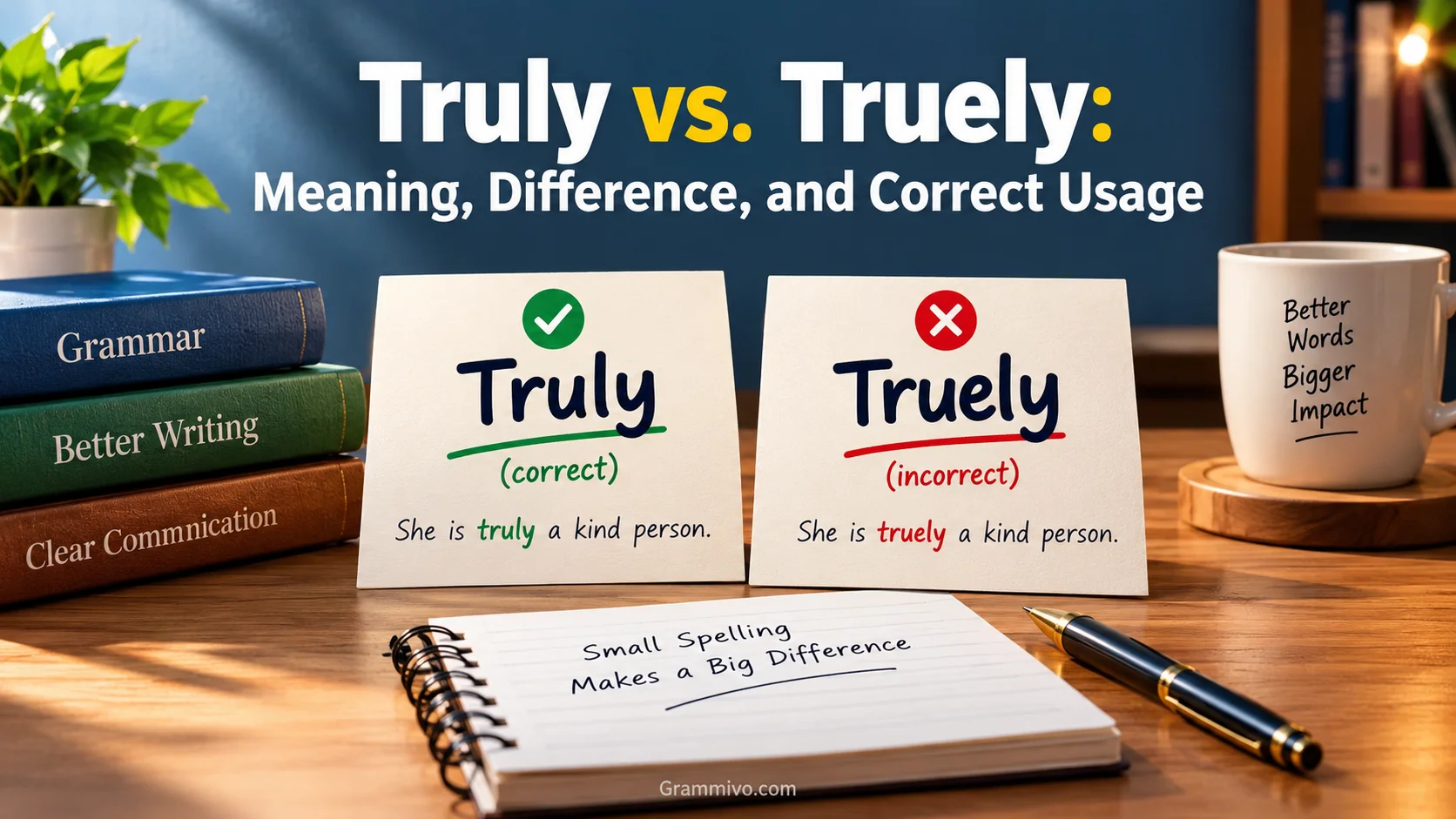
Have you ever paused while writing because you weren’t sure whether to use truly or truely? You’re not alone. English spelling can be tricky, especially when a word seems to follow a familiar pattern but breaks your expectations.
The confusion makes sense. The adjective true ends with an e, and many writers assume that adding -ly produces truely. However, English spelling doesn’t always work that way. In this case, one small letter makes the difference between the standard spelling and a common mistake.
Truly is the correct spelling in American English and standard modern English. Truely is a misspelling that you should avoid in everyday writing, academic assignments, professional emails, and published content.
Understanding why truly is correct will help you remember the spelling and use the word confidently. You’ll also learn what truly means, how it works in sentences, and when alternatives such as genuinely or truthfully might fit better.
Quick Answer
Truly is the correct spelling. Truely is incorrect in standard modern English.
The word truly is an adverb meaning genuinely, sincerely, or in a way that agrees with the truth. It comes from the adjective true, but its spelling drops the final e before adding -ly.
Examples:
- Correct: I truly appreciate your help.
- Incorrect: I truely appreciate your help.
- Correct: She is truly talented.
- Incorrect: She is truely talented.
Easy rule to remember: Write true as truly when you need the adverb. Don’t carry the final e into the new word.
Comparison Overview
Although truly and truely look almost identical, they don’t have the same status in standard English. One is an established word, while the other is a spelling error.
| Feature | Truly | Truely |
| Spelling status | Correct | Incorrect in standard English |
| Part of speech | Adverb | Not a standard adverb spelling |
| Meaning | Genuinely, sincerely, or accurately | Intended to mean the same as truly |
| Root word | True | Based on the same word but incorrectly formed |
| American English | Accepted | Not accepted as the standard spelling |
| British English | Accepted | Not accepted as the standard spelling |
| Formal writing | Appropriate | Should be corrected |
| Example | I truly enjoyed the event. | I truely enjoyed the event. |
The main difference is spelling, not meaning. Writers who use truely usually intend to communicate the same idea as truly. However, readers may notice the error, particularly in professional or academic writing.
For example, consider this sentence:
Your support has truly made a difference.
The word truly emphasizes the speaker’s sincere appreciation. Replacing it with truely doesn’t create a new meaning. It simply introduces a spelling mistake.
Remember that truly works in American and British English. This isn’t a regional difference like color versus colour or center versus centre. The standard spelling remains the same across both varieties.
Main Differences Between Truly and Truely
The distinction between truly and truely becomes easier to understand when you look at their spelling, meaning, and grammatical roles. Let’s examine each point so you can recognize and avoid the mistake.
Meaning of Truly
Truly is an adverb that describes how something happens, how someone feels, or how accurately a statement reflects reality. Depending on the context, it can mean genuinely, sincerely, really, or accurately.
An adverb often modifies a verb, an adjective, or another adverb. In a sentence, truly can add sincerity, emphasis, or a sense of authenticity.
For example:
- I truly believe in your abilities. The speaker expresses a sincere belief.
- The painting is truly beautiful. The word emphasizes the painting’s beauty.
- She is a truly remarkable teacher. The adverb strengthens the adjective remarkable.
- He truly understood the problem. The word emphasizes that his understanding was genuine.
- This account truly reflects what happened. The adverb emphasizes the accuracy of the account.
Notice how the meaning changes slightly with each sentence. In the first example, truly emphasizes sincerity. In the second, it adds emphasis. In the final example, it highlights accuracy.
This flexibility makes truly useful in conversations, personal messages, essays, reviews, and professional communication.
Truly as a Word of Sincerity
One of the most common uses of truly involves expressing honest feelings. People often use it when they want their words to sound heartfelt rather than routine.
Consider these examples:
- I truly appreciate everything you’ve done for me.
- We are truly grateful for your support.
- She was truly sorry for the misunderstanding.
- I truly hope things work out for you.
In each sentence, truly signals that the feeling is genuine. It can make a statement sound more personal and sincere.
However, the word doesn’t automatically make a statement honest. The surrounding context and the speaker’s actions determine whether the sentiment is believable.
Truly as an Intensifier
Truly can also strengthen an adjective or description. In this role, it adds emphasis and helps communicate how strongly the speaker feels about something.
Examples include:
- The performance was truly outstanding.
- It was a truly unforgettable experience.
- Their kindness was truly inspiring.
- This is a truly useful solution.
In these sentences, truly adds weight to the description. It tells readers that the speaker considers the quality especially noteworthy.
Still, moderation matters. If every experience is truly amazing or every result is truly impressive, the word gradually loses its impact. Choose it when you genuinely want to emphasize something.
Meaning of Truely
Truely is a common misspelling of truly. Writers often produce it because they assume the word should retain the final e in true.
The mistake is understandable. Many English words keep their final e when forming related words, while others drop it. Because English spelling rules have exceptions, writers sometimes apply the wrong pattern.
However, truely isn’t the standard spelling in contemporary American or British English. If you intend to express sincerity, genuineness, or accuracy, use truly.
Here are some common corrections:
| Incorrect sentence | Correct sentence |
| I truely value your friendship. | I truly value your friendship. |
| She is truely gifted. | She is truly gifted. |
| We truely enjoyed the trip. | We truly enjoyed the trip. |
| He truely believes in his team. | He truly believes in his team. |
| Your words truely inspired me. | Your words truly inspired me. |
The correction is simple: remove the unnecessary e before the l.
Although readers can often understand truely from context, that doesn’t make it correct. In school assignments, business writing, resumes, articles, and formal correspondence, use the recognized spelling.
Read More: Trek vs. Treck: Meaning, Difference, and Correct Usage
Why Is Truly Correct and Truely Incorrect?
The answer comes down to how English forms adverbs from adjectives.
The adjective true describes something that agrees with facts or reality. To form the adverb, English uses truly, not truely.
The spelling changes because the final e disappears before the -ly ending. This produces a word that looks slightly different from its root but follows an established spelling pattern.
The transformation is straightforward:
True → Truly
The word doesn’t become truely because English doesn’t simply preserve every letter of the original adjective when adding a suffix.
Consider these related examples:
| Base word | Related word | Explanation |
| True | Truly | The final e disappears. |
| Due | Duly | The final e disappears. |
| Whole | Wholly | The final e disappears and the l is doubled. |
| Gentle | Gently | The final e disappears. |
| Simple | Simply | The final e disappears. |
| Happy | Happily | The final y changes to i. |
| Careful | Carefully | The adjective keeps its spelling before -ly. |
These examples show why it’s helpful to learn common spelling patterns. They also demonstrate that you can’t apply one rule to every word.
For instance, careful becomes carefully, while true becomes truly. The spelling depends on the word and the way English forms its related expressions.
The Role of the Suffix -ly
The suffix -ly often turns an adjective into an adverb. It helps explain how an action occurs or adds information about a quality.
For example:
- Quick → Quickly
- Slow → Slowly
- Careful → Carefully
- Honest → Honestly
- True → Truly
However, the addition of -ly doesn’t always involve the same spelling changes. Some words keep their original forms, while others drop a final e or change a final y.
That’s why memorizing the correct form of common words remains useful. You can understand the general rule and still need to remember specific exceptions or established spellings.
The practical lesson: Learn truly as a complete word rather than trying to construct it from true every time you write.
When to Use Truly
You can use truly whenever you want to communicate sincerity, genuineness, accuracy, or emphasis. The surrounding sentence determines which meaning the reader will understand.
Here are the most common situations.
When Expressing Sincere Feelings
Use truly to emphasize that an emotion or statement is genuine.
Examples:
- I truly care about your well-being.
- We truly appreciate your patience.
- She truly regrets her decision.
- I truly wish you success in your new role.
These sentences work well in personal messages, thank-you notes, and thoughtful conversations. They communicate warmth without requiring complicated vocabulary.
When Describing Something Genuine
Use truly to emphasize that a quality or experience is authentic.
Examples:
- He is truly a generous person.
- The museum offers a truly memorable experience.
- This recipe produces a truly delicious meal.
- Their partnership became truly meaningful over time.
Here, truly reinforces the description. It suggests that the quality isn’t merely superficial or exaggerated.
When Emphasizing Accuracy or Reality
You can also use truly when a statement accurately represents something.
Examples:
- The report truly reflects the team’s progress.
- This photograph truly captures the atmosphere of the event.
- Her account truly represents what happened that afternoon.
In these cases, truly emphasizes the relationship between the statement and reality.
However, be careful when writing factual or scientific material. If you need to establish accuracy, support the claim with evidence rather than relying on an intensifier alone.
When Writing Formal or Professional Messages
Truly is acceptable in formal writing, but the best choice depends on your intended tone.
For example:
- Professional: We truly appreciate your continued cooperation.
- Academic: The findings truly demonstrate the importance of further research.
- Personal: I’m truly grateful for your kindness.
- Customer service: We truly value your feedback.
In academic writing, consider whether truly adds useful meaning. Sometimes a direct statement is stronger.
Instead of writing, “The results truly demonstrate a difference,” you might write, “The results demonstrate a significant difference” if the evidence supports that conclusion.
The goal isn’t to avoid truly. It’s to use the word when it improves clarity or emphasis.
Truly vs. Truely: Examples in Sentences
Examples make the spelling difference easier to remember. The following sentences show how to use truly in different situations and how to correct truely when it appears.
| Incorrect usage | Correct usage |
| I truely love this song. | I truly love this song. |
| She is truely happy with the result. | She is truly happy with the result. |
| We truely appreciate your generosity. | We truly appreciate your generosity. |
| He truely understands the risks. | He truly understands the risks. |
| This is a truely special occasion. | This is a truly special occasion. |
| I truely hope you succeed. | I truly hope you succeed. |
| They truely care about the environment. | They truly care about the environment. |
| Your advice was truely helpful. | Your advice was truly helpful. |
| The documentary was truely fascinating. | The documentary was truly fascinating. |
| She truely deserves the recognition. | She truly deserves the recognition. |
In every correction, the same principle applies: replace truely with truly.
Examples From Everyday Conversations
People frequently use truly when discussing relationships, feelings, and personal experiences.
- “I truly enjoyed spending time with you.”
- “You are truly one of my closest friends.”
- “I’m truly sorry I missed your call.”
- “That was a truly thoughtful gift.”
These expressions sound natural because truly reinforces the sincerity of the message.
For casual communication, you don’t need to force the word into every sentence. “I appreciate your help” is already clear. Adding truly simply places more emphasis on the feeling.
Examples From School and Work
Correct spelling matters in settings where people expect polished communication.
- School assignment: The experiment truly changed our understanding of the process.
- Business email: We truly appreciate your time and consideration.
- Resume summary: I am truly committed to improving customer satisfaction.
- Presentation: This achievement represents a truly important milestone.
- Research discussion: The findings truly reflect the limits of the available evidence.
The resume example is grammatically correct, but it may not be the strongest professional wording. A more specific statement about your skills or achievements usually communicates greater value.
For instance, “I improved customer satisfaction by resolving support requests more efficiently” provides concrete information rather than relying on truly committed.
This illustrates an important writing principle: correct spelling matters, but precise wording matters too.
FAQs:
Is Truly or Truely Correct?
Truly is correct in standard English. Truely is a common misspelling that you should avoid in formal and informal writing.
For example, write “I truly appreciate your help,” not “I truely appreciate your help.”
Why Is Truely Spelled Incorrectly?
The mistake usually happens because writers retain the final e in true when adding -ly. However, the established spelling drops that letter, producing truly.
Remember the correct transformation: true → truly.
What Does Truly Mean?
Truly is an adverb meaning genuinely, sincerely, or accurately. It can express sincere feelings, emphasize a quality, or indicate that something reflects reality.
For example, “She is truly kind” emphasizes the speaker’s genuine assessment of her character.
Is Truly a Real Word?
Yes. Truly is a standard English adverb used in everyday conversations, professional writing, literature, and formal communication.
You can use it to express sincerity, emphasize a description, or indicate that something accurately reflects the facts.
How Do You Spell Truly in American English?
The correct American English spelling is truly. The spelling truely is not an accepted standard alternative.
The same spelling applies in British English, so you don’t need to change the word based on your audience’s location.
Conclusion:
The difference between truly and truely comes down to one unnecessary letter. Truly is the correct spelling in standard American and British English, while truely is a misspelling. Use truly when you want to express sincere feelings, describe something genuine, or emphasize a statement. Whether you’re writing a personal message, a school assignment, or a professional email, the correct spelling remains the same.
