
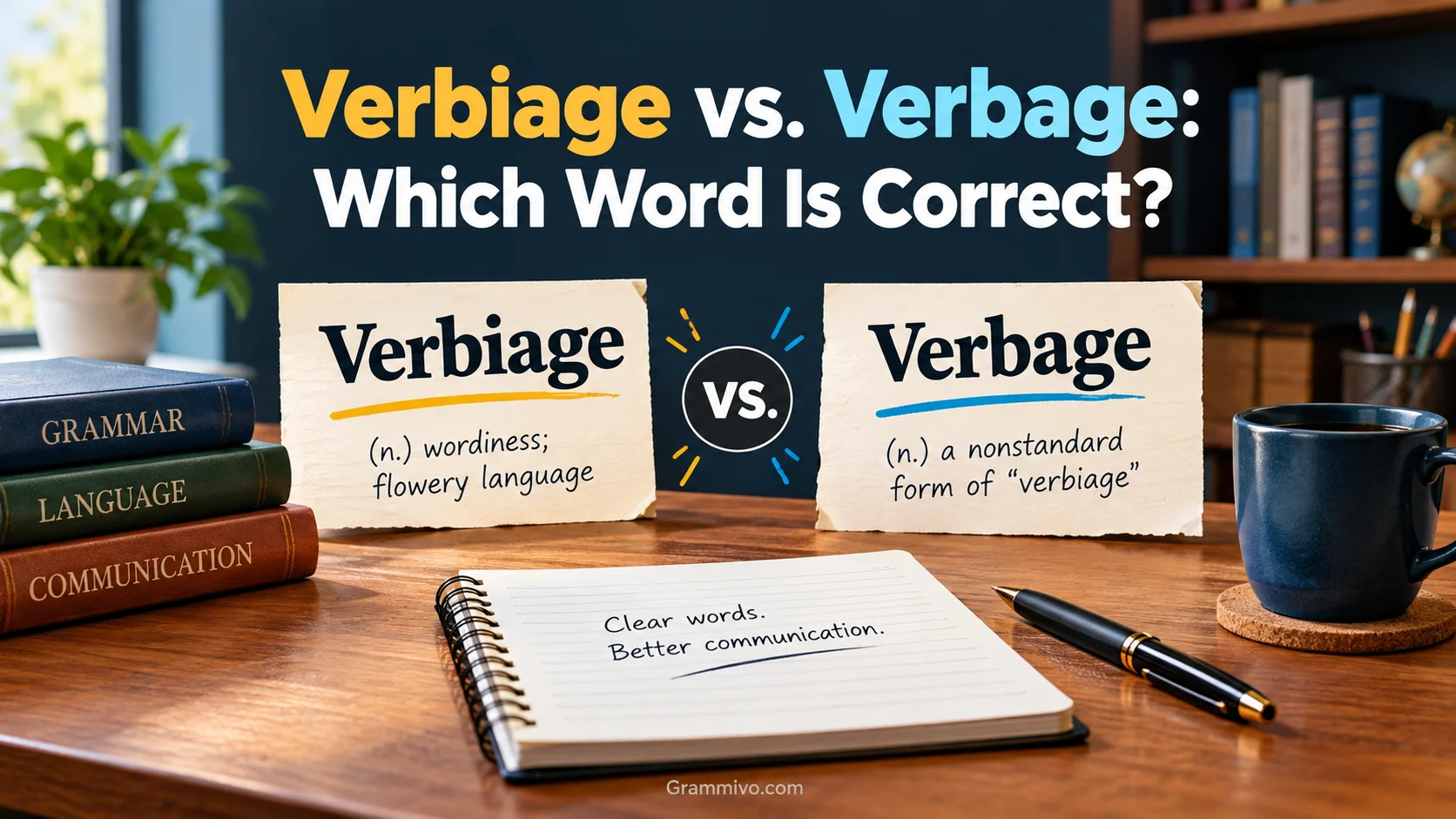
Verbiage and verbage look almost identical, so it’s easy to see why writers mix them up. Both forms appear in everyday writing, online discussions, business communication, and even professional documents. However, they don’t have the same status in standard English.
The correct spelling is verbiage. It is an established English word that refers to the words or wording used to express an idea. It can describe language neutrally, although it often carries a negative sense when someone uses too many unnecessary words.
Verbage, by contrast, is generally considered a nonstandard spelling or misspelling of verbiage. People often write it because the word seems connected directly to “verb,” but that spelling doesn’t follow the standard form.
Quick Answer
Verbiage is the correct standard spelling. Verbage is generally a nonstandard form that writers use when they mean verbiage.
Verbiage can mean the wording or language used to express something. It can also refer specifically to language that contains more words than necessary.
For example:
The contract contains complicated verbiage that readers may struggle to understand.
Here, verbiage refers to the wording in the contract.
Another example:
Please simplify the verbiage in the instructions.
Again, verbiage is the correct spelling.
If you’re choosing between verbiage vs. verbage in standard US English, use verbiage.
Comparison Overview
| Word | Standard English? | Meaning | Common Use |
| Verbiage | Yes | Words, wording, or language used to express something; sometimes unnecessarily wordy language | Professional, academic, technical, and everyday writing |
| Verbage | Generally no | Usually intended to mean verbiage | Informal writing, online content, or spelling errors |
The key difference isn’t really between two competing definitions. Instead, it’s primarily a matter of standard spelling and usage.
Verbiage is the established form. Verbage commonly appears because people hear or construct the word incorrectly.
Main Differences Between Verbiage vs. Verbage
The biggest difference between verbiage vs. verbage is simple: verbiage is the standard spelling, while verbage is generally nonstandard.
However, understanding why the confusion happens can make the distinction much easier to remember.
Spelling Difference
The correct word contains an i before the final part of the word:
V-E-R-B-I-A-G-E
The common incorrect form removes that i:
V-E-R-B-A-G-E
That tiny difference causes a surprisingly common spelling problem.
Think of it this way:
- Correct: verbiage
- Generally incorrect: verbage
The extra i isn’t decorative. It’s part of the established spelling of the word.
Meaning Difference
In standard English, verbiage has a recognized meaning.
Verbage doesn’t normally function as a separate standard word with a different established meaning. When someone writes “verbage,” they usually mean verbiage.
That means replacing verbage with verbiage generally fixes the problem without changing the intended message.
Usage Difference
You can use verbiage in polished writing without concern.
For example:
The proposal uses clear and concise verbiage.
You wouldn’t normally want to write:
The proposal uses clear and concise verbage.
The second version may be understandable, but it doesn’t follow standard spelling.
Professional Writing Difference
The distinction becomes particularly important in formal contexts.
If you’re preparing a:
- Business proposal
- Resume
- Academic assignment
- Legal document
- Technical report
- Marketing campaign
- Website
- Professional email
Verbiage is the appropriate choice.
A nonstandard spelling can distract readers from your actual point. In professional writing, small details often shape how polished the entire document feels.
What Does Verbiage Mean?
Verbiage refers to the words, wording, or language used to express an idea.
The word has a particularly interesting history of usage because it can carry either a neutral or negative sense depending on context.
In one sentence, it can simply mean “wording.”
The policy’s verbiage is easy to understand.
Here, the word doesn’t necessarily criticize the policy. It simply refers to the language used in the policy.
In another sentence, verbiage can suggest unnecessary or excessive wording:
The report contains too much legal verbiage.
Here, the writer implies that the language is overly complicated or wordy.
That distinction is important. Verbiage doesn’t automatically mean bad writing. Context determines the tone.
Verbiage as Wording
Modern English frequently uses verbiage to refer to the particular words used in a document or statement.
For example:
The company changed the verbiage on its refund policy.
This means the company changed the wording of the policy.
Another example:
The new verbiage makes the instructions much clearer.
Here, verbiage simply means the language used in the instructions.
Verbiage as Excessive Language
The word can also describe language that feels unnecessarily complicated, repetitive, or long-winded.
For example:
The lawyer suggested removing unnecessary verbiage from the agreement.
The issue isn’t that words exist in the agreement. The issue is that some of those words may add little value.
This sense explains why verbiage sometimes sounds mildly critical.
Is Verbiage Always Negative?
No.
That’s one of the most useful points to remember.
Some dictionaries and usage references describe verbiage in ways that emphasize excessive or elaborate language. Modern usage also commonly uses it more neutrally for wording.
Compare these sentences:
The brochure’s verbiage explains the product clearly.
This is relatively neutral.
The brochure is filled with unnecessary verbiage.
This is clearly negative.
The surrounding words tell you how verbiage is being used.
What Does Verbage Mean?
Verbage is generally a nonstandard form used when the writer intends verbiage.
It commonly appears because the spelling seems logical at first glance. People see verb inside verbiage and may naturally shorten the word to “verbage.”
That spelling, however, isn’t the standard form.
For example:
Incorrect: The contract contains confusing verbage.
The standard correction is:
Correct: The contract contains confusing verbiage.
The intended meaning remains the same. Only the spelling changes.
Why Does Verbage Look Correct?
English spelling isn’t always intuitive. Words can contain letter combinations that don’t match the way people expect them to sound.
Verbiage is one of those words.
When someone hears the word rather than sees it in print, the i can be easy to overlook. The connection with verb also makes “verbage” look plausible.
That’s one reason the nonstandard spelling persists.
Why Do People Spell Verbiage as Verbage?
Several factors can contribute to the confusion.
The Word Verb Creates a False Clue
The beginning of verbiage resembles verb, which is a familiar English word.
That can make people assume the word should continue directly from “verb” to “bage.”
But English doesn’t always build words in such neat, predictable pieces.
Pronunciation Can Hide the Spelling
When people hear verbiage, they don’t necessarily notice every letter represented in the written form.
This creates a classic spelling trap. You may know exactly what the word means while still spelling it incorrectly.
Familiarity Reinforces Mistakes
A misspelling can start looking normal after you encounter it often enough.
Online writing makes this especially noticeable. If a person repeatedly sees verbage, the spelling can begin to feel legitimate even though frequency doesn’t establish standard usage.
This is an important general lesson about spelling:
A word appearing frequently doesn’t automatically make its spelling correct.
How to Use Verbiage Correctly
Using verbiage correctly is straightforward once you understand its meaning.
You can use it when discussing the wording of something or when criticizing language for being overly complicated.
Example: Business Writing
The marketing team revised the product description’s verbiage.
Here, verbiage means the wording of the description.
Example: Legal Writing
The agreement contains legal verbiage that may confuse consumers.
Here, the term refers to the specialized wording used in the agreement.
Example: Technical Writing
The engineer simplified the technical verbiage for general readers.
This use emphasizes language that might otherwise be difficult for nonexperts.
Example: Everyday Conversation
I like the message, but the verbiage could be simpler.
This sentence uses the word in a fairly natural, conversational way.
Example: Editing
The editor removed unnecessary verbiage from the introduction.
This use carries a negative meaning because the writer considers some of the language unnecessary.
Verbiage in a Sentence
Here are several examples showing how verbiage works in different contexts.
- The website’s verbiage makes the checkout process easy to understand.
- The company updated the verbiage in its privacy policy.
- The report contains technical verbiage that requires careful reading.
- The editor removed repetitive verbiage from the article.
- The instructions use simple verbiage for younger readers.
- The contract’s legal verbiage caused confusion among customers.
- Please review the verbiage before publishing the announcement.
- The new verbiage gives the policy a more welcoming tone.
Notice how the word doesn’t always criticize the writing. Sometimes it simply points to the language or wording being used.
Verbage in a Sentence: Why It’s Usually Incorrect
Because verbage is generally treated as a nonstandard spelling, it’s best avoided in edited writing.
Consider these corrections:
| Nonstandard | Standard |
| The contract contains confusing verbage. | The contract contains confusing verbiage. |
| We need to change the verbage on the website. | We need to change the verbiage on the website. |
| The report has too much technical verbage. | The report has too much technical verbiage. |
| Please simplify the verbage. | Please simplify the verbiage. |
The correction is simple: replace verbage with verbiage.
Read More: Inquire or Enquire (2026): Which Spelling Is Correct?
Verbiage Synonyms
Depending on the context, several words can replace verbiage. However, they aren’t perfect substitutes in every sentence.
| Synonym | Best Used When You Mean |
| Wording | The particular words used to express something |
| Language | The general style or system of expression |
| Phrasing | The way a particular idea is expressed |
| Expression | A particular way of communicating an idea |
| Prose | Written language, especially continuous writing |
| Terminology | Specialized words used in a particular field |
| Wordiness | Excessive or unnecessary use of words |
| Verbosity | The use of more words than necessary |
Wording is often the simplest replacement.
For example:
Please review the wording of this paragraph.
That sentence may sound more natural than:
Please review the verbiage of this paragraph.
However, verbiage can be useful when you’re discussing the overall language or wording of a document.
Verbiage vs. Verbosity
Verbiage and verbosity overlap, but they aren’t interchangeable in every situation.
Verbiage can refer to the actual wording or language used. Verbosity specifically focuses on excessive wordiness.
Consider these examples:
The contract’s verbiage is difficult to understand.
This refers to the wording.
The contract suffers from excessive verbosity.
This criticizes the amount of language.
The distinction becomes clearer with a simple analogy.
Imagine a suitcase.
Verbiage describes what’s packed inside the suitcase—the words and wording.
Verbosity focuses on whether you packed far more than necessary.
That difference helps you choose the right word.
Verbiage vs. Verbosity Table
| Term | Core Idea | Example |
| Verbiage | Words or wording used to express something | The policy’s verbiage is clear. |
| Verbosity | Excessive use of words | The report’s verbosity makes it difficult to read. |
So, if you’re talking about what the wording says, choose verbiage. If you’re criticizing how excessively someone uses words, verbosity may be more precise.
Common Mistakes With Verbiage
Even after learning the correct spelling, several usage mistakes can still cause trouble.
Mistake: Writing Verbage
This is the most obvious problem.
❌ The document contains unnecessary verbage.
Use:
✅ The document contains unnecessary verbiage.
Mistake: Assuming Verbiage Always Means Wordiness
That’s too narrow.
Verbiage can refer simply to wording or language.
The new verbiage sounds friendlier.
There’s no claim here that the language is excessive.
Mistake: Confusing Verbiage With Verbosity
These words are related, but their meanings aren’t identical.
If you mean “excessive use of words,” verbosity may be the better choice.
Mistake: Using Verbiage When Wording Is Clearer
Although verbiage is correct, simpler wording can sometimes make a sentence stronger.
For example:
Please change the verbiage in this sentence.
could become:
Please change the wording in this sentence.
Neither is necessarily wrong. The second option is simply more direct.
A Simple Memory Trick for Verbiage
If you often forget the i in verbiage, use a visual reminder.
Think:
VERB + I + AGE = VERBIAGE
The key is the I.
You can also connect the word with wording:
Verbiage = wording
Whenever you’re tempted to write verbage, pause and check for the missing i.
A quick mental test helps:
“Am I talking about wording or language?”
If yes, the standard spelling you’re looking for is verbiage.
Case Study: Fixing a Professional Sentence
Imagine an employee writes this sentence in a business report:
The current policy has a lot of unnecessary verbage that customers don’t understand.
Two issues stand out.
First, verbage should be verbiage.
Second, the sentence could become more precise.
A polished version might read:
The current policy contains unnecessary verbiage that may confuse customers.
The revised sentence removes the casual phrase “a lot of” and uses more precise wording.
An even simpler version could be:
The current policy uses unnecessary wording that may confuse customers.
This example demonstrates an important writing principle: correct spelling matters, but precise language matters too.
Why Verbiage Matters in Professional Communication
Clear language can save time, prevent misunderstandings, and make information easier to act on.
That’s particularly important when you’re writing instructions, policies, contracts, customer notices, or technical documentation.
Consider two versions of a message:
Please submit the requested documentation pursuant to the aforementioned procedural requirements.
Compared with:
Please submit the required documents according to the procedure above.
The second version communicates the same basic idea with less linguistic clutter.
This is where the negative sense of verbiage becomes useful. Sometimes the problem isn’t the subject matter. The problem is the unnecessary language surrounding it.
Good writing doesn’t mean eliminating every sophisticated word. It means choosing words that serve a purpose.
FAQs:
Is “verbage” a correct word?
Verbage is generally considered a nonstandard spelling when used to mean verbiage. In standard US English, verbiage is the preferred form.
Is verbiage a negative word?
Not necessarily. Verbiage can refer neutrally to the wording or language used in something. It can also carry a negative sense when it describes excessive, complicated, or unnecessary wording.
What is the difference between verbiage and verbosity?
Verbiage can mean wording or language. Verbosity specifically refers to excessive use of words. For example, you can discuss the verbiage of a contract without saying that the contract is excessively wordy.
How do you spell verbiage?
The standard spelling is V-E-R-B-I-A-G-E: verbiage.
The common nonstandard form verbage leaves out the i.
What is an easier word for verbiage?
Wording is often the simplest alternative. Depending on the context, you could also use language, phrasing, expression, or wordiness.
Conclusion:
When you’re choosing between verbiage vs. verbage, the answer is straightforward: verbiage is the standard spelling. Use verbiage when you mean the words, wording, or language used to express an idea. The word can be neutral, or it can suggest unnecessary or complicated language depending on context. Verbage is generally a nonstandard form that appears when writers omit the i from the established spelling.
