
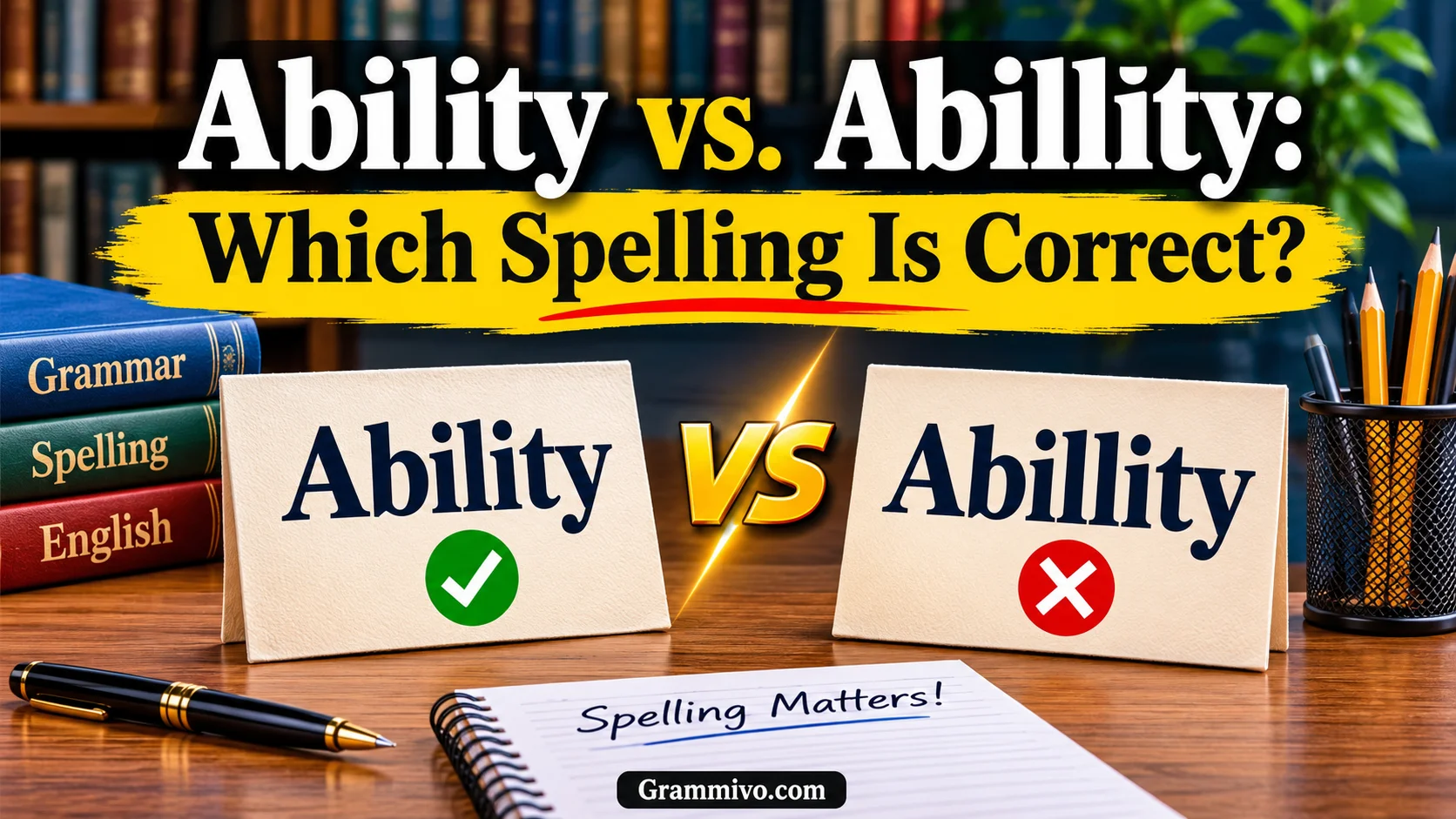
Have you ever wondered whether the correct spelling is ability or abillity? You’re not alone. Many English writers accidentally add an extra L when typing this common word. Although both versions look similar, only one follows standard English spelling rules.
The confusion often happens because English contains many words with double consonants, such as skill, brilliant, and excellent. As a result, writers sometimes assume that ability follows the same pattern. However, it doesn’t.
The correct spelling is ability, with only one L. The spelling abillity is incorrect and doesn’t have a recognized meaning in standard English.
Understanding this small spelling difference can help you write more confidently. Whether you’re preparing an email, completing an assignment, writing a professional document, or improving your vocabulary, knowing the correct form matters.
This guide explains the difference between ability and abillity, their meanings, spelling patterns, grammatical uses, common mistakes, and practical sentence examples.
Quick Answer
Ability is the correct spelling, while abillity is a misspelling.
The word ability contains one L and refers to someone’s skill, talent, power, or capacity to perform an action.
For example:
- Correct: She has the ability to solve difficult problems.
- Incorrect: She has the abillity to solve difficult problems.
Remember this spelling: A-B-I-L-I-T-Y.
Whenever you write this word, use one L instead of two.
Comparison Overview
Although ability and abillity look almost identical, they don’t have the same spelling status. One is a standard English word, while the other is simply a spelling error.
| Feature | Ability | Abillity |
| Spelling | Correct | Incorrect |
| Number of Ls | One | Two |
| Meaning | Skill, talent, or capacity | No recognized standard meaning |
| Part of speech | Noun | Not a standard English word |
| Pronunciation | /əˈbɪləti/ | No standard pronunciation |
| Usage | Accepted in English | Not accepted in standard writing |
| Example | She has great ability. | Incorrect spelling |
The important distinction is straightforward: ability is the word you should use in everyday and professional writing.
Main Differences Between Ability vs. Abillity
The biggest difference between these spellings concerns their correctness. However, understanding the word’s meaning and grammatical function makes the distinction easier to remember.
Is Ability or Abillity Correct?
Ability is the correct spelling in American English and other standard varieties of English.
It describes someone’s power, skill, talent, or capacity to accomplish something. You can use it when discussing physical performance, intellectual skills, communication, education, or professional experience.
For example:
- Her ability to communicate clearly makes her an excellent teacher.
- The athlete demonstrated exceptional physical ability.
- His problem-solving ability impressed the entire team.
- Learning a new language requires patience and dedication.
In each sentence, ability describes a particular skill or capacity.
On the other hand, abillity contains an unnecessary second L. English dictionaries don’t recognize it as a standard alternative spelling.
You might encounter this version in social media posts, informal messages, school assignments, or online comments. However, its appearance doesn’t make it correct.
Remember: Always write ability with one L.
What Does Ability Mean?
The noun ability refers to the power, skill, or capacity to perform a particular action.
It can describe something you’re naturally good at or something you’ve developed through practice and experience.
For example, a child might have a natural ability to recognize musical patterns. Meanwhile, an adult might develop the ability to manage a business through years of professional experience.
The word has several related meanings.
Skill or talent: Ability can describe someone’s competence in a particular activity.
- She has an excellent ability to draw realistic portraits.
- His musical ability became apparent at an early age.
Capacity to perform an action: It can also describe whether someone can complete a task or handle a situation.
- The new software improves our ability to manage information.
- She has the ability to work under pressure.
Mental or physical capability: Ability can refer to someone’s intellectual or physical potential.
- Regular exercise can improve your physical ability.
- Reading helps children develop their language abilities.
Potential for achievement: Sometimes, ability describes someone’s capacity to develop or accomplish something in the future.
- The young player has the ability to become a professional athlete.
- Her leadership ability makes her a strong candidate for promotion.
In simple terms, ability describes what someone can do or is capable of doing.
What Does Abillity Mean?
Abillity is an incorrect spelling of ability. It doesn’t have an established definition in standard English dictionaries.
People usually make this mistake because they accidentally insert an additional L while typing or remembering the word.
For example:
- Incorrect: He has the abillity to lead a large team.
- Correct: He has the ability to lead a large team.
Another example:
- Incorrect: Her abillity to learn quickly is impressive.
- Correct: Her ability to learn quickly is impressive.
The mistake doesn’t change the intended meaning. Readers can usually understand what someone means from the surrounding sentence.
However, using the wrong spelling can make academic assignments, business documents, and professional communication appear less polished.
If you see abillity in a document, replace it with ability.
Why Is Ability Spelled With One L?
English spelling can sometimes feel unpredictable. However, the spelling of ability becomes easier to understand when you examine its structure and history.
The word comes through Middle English from Old French abilité, ultimately deriving from Latin habilitas, meaning fitness, aptitude, or capability.
Its modern spelling developed with one L before the ending -ity.
The word’s structure also provides a useful clue:
Ability = Abil + ity
The ending -ity commonly turns an adjective into a noun describing a quality, condition, or state.
Consider these examples:
| Adjective | Noun |
| Able | Ability |
| Possible | Possibility |
| Responsible | Responsibility |
| Flexible | Flexibility |
| Capable | Capability |
| Available | Availability |
Notice that able changes to abil- before adding -ity.
This spelling pattern explains why ability doesn’t contain two Ls.
Why Do People Add an Extra L?
Several factors can contribute to this spelling mistake.
Confusion with double-L words: English contains many familiar words with two Ls, including brilliant, excellent, and skill. Writers may mistakenly apply the same pattern to ability.
Typing mistakes: When typing quickly, people sometimes press a key twice without noticing. This can happen even when they know the correct spelling.
Incorrect visual memory: If you’ve repeatedly encountered a misspelled version, you might begin remembering it incorrectly.
Uncertainty about word formation: Some writers assume that adding -ity requires doubling the final consonant. However, that isn’t how ability is formed.
Understanding these causes makes the correction easier. You don’t need to memorize complicated spelling rules. Simply remember that ability has one L.
Read More: Abscess vs. Abcess: Which Spelling Is Correct?
How to Use Ability in a Sentence
The word ability functions as a noun. It commonly appears when discussing someone’s skills, personal qualities, professional strengths, or capacity to complete an activity.
Understanding its grammatical use will help you write more naturally.
Ability as a Noun
A noun identifies a person, place, thing, quality, or idea. In this case, ability names a particular skill or capacity.
For example:
- Her ability to communicate makes her a valuable employee.
- The teacher recognized his ability in mathematics.
- Good leaders have the ability to inspire others.
- Physical ability can change with age and experience.
The word can function as a subject or an object in a sentence.
As a subject:
- Her ability to solve problems impressed the manager.
- His natural ability helped him succeed in sports.
As an object:
- The company values creativity and ability.
- Practice can improve your writing ability.
After a preposition:
- She has confidence in her ability to succeed.
- The position requires an ability to work independently.
These examples show how naturally the word fits into different sentence structures.
Common Expressions With Ability
English speakers frequently combine ability with other words to describe specific skills or qualities.
Here are some useful expressions and their meanings.
| Expression | Meaning | Example |
| Ability to learn | Capacity to gain knowledge | Children have an impressive ability to learn. |
| Natural ability | Skill someone seems naturally gifted in | She has a natural ability to sing. |
| Learning ability | Capacity to understand new information | His learning ability improves with practice. |
| Problem-solving ability | Skill in finding solutions | Employers value strong problem-solving ability. |
| Communication ability | Capacity to exchange information effectively | Good communication ability helps teams succeed. |
| Physical ability | Capacity to perform physical activities | Swimming requires physical ability. |
| Mental ability | Intellectual capacity | The test measures different mental abilities. |
| Leadership ability | Skill in guiding others | Her leadership ability inspires confidence. |
| Creative ability | Capacity to produce original ideas | The project encourages creative ability. |
| Technical ability | Skill in using tools or technology | The position requires technical ability. |
These expressions work in conversations, academic writing, workplace communication, and professional documents.
Ability in Different Contexts
The meaning of ability remains consistent across different situations. However, the particular skill or capacity changes depending on the context.
In everyday conversations
People use ability to discuss ordinary skills and personal strengths.
- I admire your ability to stay calm.
- His ability to remember names is remarkable.
- She has an amazing ability to make people laugh.
In education and learning
Teachers and students use the word when discussing academic performance and learning potential.
- Every student has a different ability to understand complex subjects.
- Reading regularly can strengthen your language ability.
- The teacher assessed each student’s mathematical ability.
In the workplace
Employers often use ability when describing job requirements and professional strengths.
- The position requires the ability to manage multiple projects.
- Her ability to communicate with clients makes her an excellent candidate.
- We appreciate your ability to meet tight deadlines.
In sports and physical activities
The word can describe athletic performance, coordination, strength, and physical capacity.
- His running ability improved after months of training.
- The coach recognized her ability to perform under pressure.
- Flexibility can improve your physical abilities.
In personal development
People also use ability when discussing growth, confidence, and self-improvement.
- Developing the ability to manage stress takes practice.
- She believes in her ability to achieve her goals.
- Experience strengthened his ability to make difficult decisions.
Ability vs. Skill vs. Capability
Although ability, skill, and capability share similar meanings, they’re not always interchangeable.
Understanding their differences helps you choose the most accurate word.
| Word | Meaning | Example |
| Ability | General power or capacity to do something | She has the ability to solve complex problems. |
| Skill | Competence developed through learning or practice | She has excellent computer skills. |
| Capability | Overall capacity or potential to perform something | The machine has the capability to process large amounts of data. |
When Should You Use Ability?
Use ability when discussing someone’s general capacity, talent, or competence.
For example:
- He has the ability to understand complicated ideas.
- Her ability to lead a team is impressive.
The word works well for both natural talents and developed strengths.
When Should You Use Skill?
Use skill when referring to a particular competence that someone develops through training, education, or practice.
For example:
- Writing is an important professional skill.
- She developed excellent negotiation skills through experience.
A skill usually involves some degree of learning or practice.
When Should You Use Capability?
Use capability when emphasizing the capacity or potential to perform a task, handle responsibility, or achieve something.
For example:
- The organization has the capability to expand internationally.
- This device has advanced processing capabilities.
A simple way to remember the difference: Ability describes what you can do, skill describes what you’ve learned to do well, and capability emphasizes what you’re equipped or prepared to accomplish.
Common Misspellings of Ability
Even familiar English words can cause spelling problems. Ability is no exception.
The following mistakes often occur when people type quickly or confuse the word’s letter pattern.
| Incorrect spelling | Correct spelling |
| Abillity | Ability |
| Abilty | Ability |
| Abililty | Ability |
| Abiltiy | Ability |
| Abillities | Abilities |
Some mistakes involve adding an extra letter. Others happen when writers accidentally leave out or rearrange letters.
Here are a few examples:
- Incorrect: Her abilty to communicate is excellent.
- Correct: Her ability to communicate is excellent.
- Incorrect: He has the abililty to manage difficult situations.
- Correct: He has the ability to manage difficult situations.
- Incorrect: The employee’s abillity impressed everyone.
- Correct: The employee’s ability impressed everyone.
One important distinction concerns the plural form. Abilities is a correct English word, not a misspelling.
For example:
- She has several useful abilities.
- The course helps students develop practical abilities.
Frequently Asked Questions
Is Abillity a Real Word?
No. Abillity isn’t a recognized standard English word. It’s a common misspelling of ability, which means the skill, talent, or capacity to do something.
Is Ability Spelled With One L or Two?
Ability is spelled with one L. The correct letter sequence is A-B-I-L-I-T-Y. Writing it with two Ls creates the incorrect spelling abillity.
What Is the Plural of Ability?
The plural form is abilities. To form it, replace the final Y with I and add ES.
For example: “The students demonstrated different abilities during the competition.”
What Is the Difference Between Ability and Skill?
Ability refers to someone’s general capacity or talent for doing something. Skill usually describes competence developed through practice, training, or experience.
For example, someone might have a natural ability to draw but develop professional drawing skills through years of practice.
Why Do People Misspell Ability as Abillity?
People often add an extra L because they confuse ability with familiar double-L words such as brilliant or excellent. Fast typing and incorrect visual memory can also contribute to this mistake.
Conclusion:
When choosing between ability vs. abillity, the correct spelling is always ability in standard English. The word contains one L and describes someone’s skill, talent, power, or capacity to accomplish something. In contrast, abillity is simply a spelling mistake with no recognized standard meaning. Whether you’re writing an academic assignment, preparing a professional email, or improving your everyday vocabulary, using the correct spelling helps make your writing clearer and more polished.
