
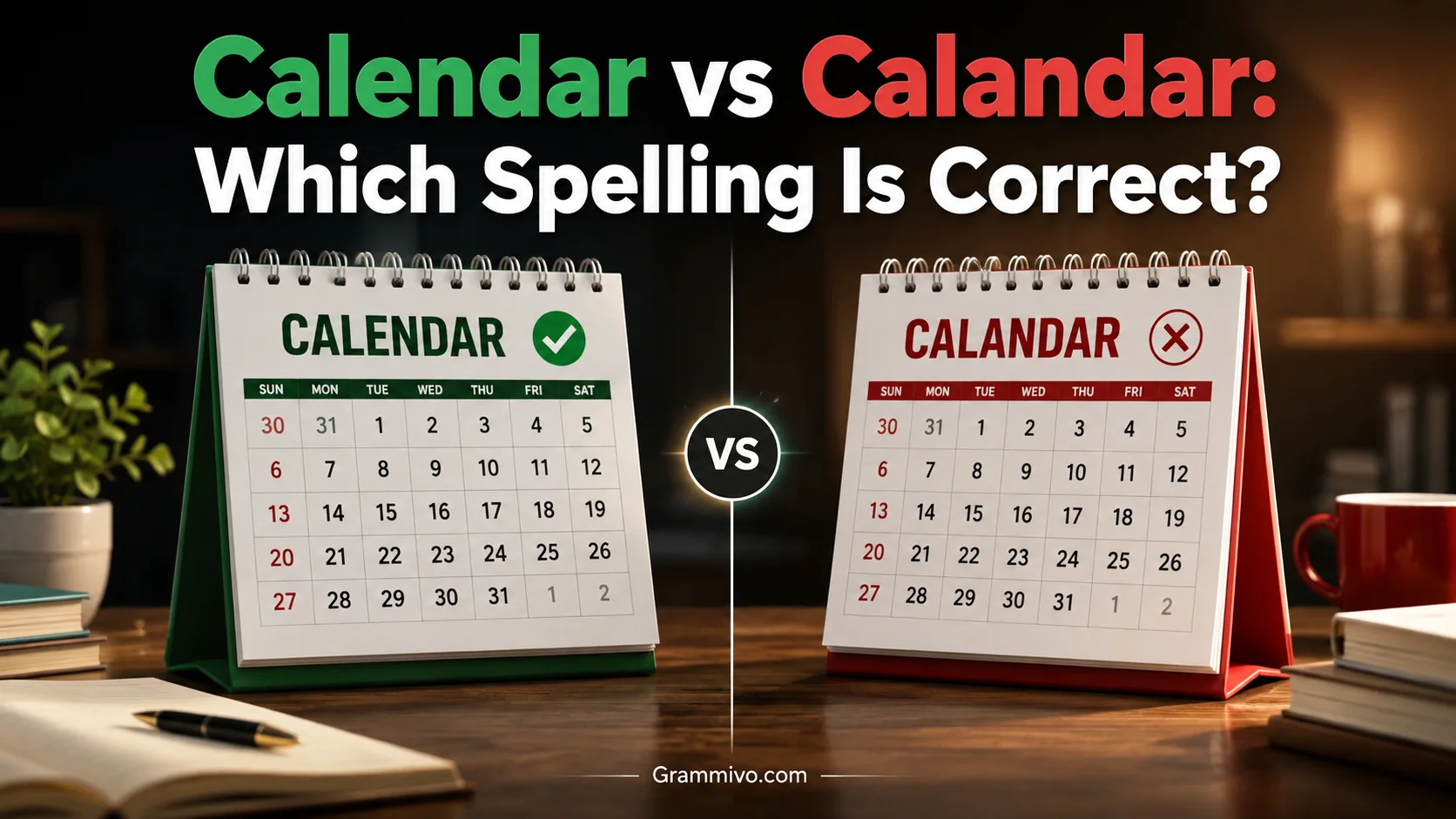
If you’ve ever hesitated between calendar vs calandar, you’re not alone. The two spellings look remarkably similar, and the difference is only one vowel. Yet that single letter matters. Calendar is the correct spelling in standard English, while calandar is a misspelling.
You’ll see calendar everywhere: on phones, computers, office walls, school schedules, appointment apps, and printed planners. The word can refer to a physical or digital tool for organizing dates, a system for measuring time, or a period such as a calendar year. Because people often pronounce the middle of the word quickly, however, some writers hear an “a” and write calandar.
This guide explains the difference between calendar and calandar, why the mistake happens, how to remember the correct spelling, and how to use calendar naturally in American English.
Quick Answer:
Calendar is the correct spelling.
Calandar is a misspelling and isn’t a standard alternative spelling in American or British English.
| Spelling | Correct? | Meaning |
| Calendar | Yes | A system or tool for organizing dates and time |
| Calandar | No | A common misspelling of calendar |
For example:
Please put the doctor’s appointment on my calendar.
Not:
Please put the doctor’s appointment on my calandar.
The easiest way to remember the spelling is to notice the middle of the word:
CAL + EN + DAR = CALENDAR
A useful memory trick is cal-END-ar. The word calendar contains the letters end in sequence: cal-END-ar.
Major English dictionaries recognize calendar as the standard spelling. Cambridge Dictionary, for example, defines calendar as a system showing days, weeks, and months and also lists its scheduling-related uses.
What Does Calendar Mean?
The word calendar has several closely related meanings, all connected to organizing or measuring time.
Most commonly, a calendar is a chart, book, application, or other system that shows the days, weeks, and months of a year. A wall calendar might display one month per page, while a smartphone calendar can show appointments by day, week, month, or year.
For example:
I checked my calendar before accepting the invitation.
Here, calendar means a tool used to keep track of scheduled events.
The word can also describe an organized system for dividing the year. The Gregorian calendar, for instance, is the civil calendar used in most countries today. It divides the year into 12 months and normally contains 365 days, with a leap year containing 366.
Calendar can also appear in expressions involving specific periods.
- Calendar year: January 1 through December 31.
- Calendar month: A named month such as January or February.
- Calendar day: A particular day on the calendar.
- Academic calendar: A schedule showing the dates and periods of a school or university year.
- Fiscal calendar: A system used by an organization to organize financial periods.
The word has even developed a verb use, particularly in American English. To calendar something can mean to schedule it for a particular date.
For example:
The court calendared the hearing for September.
That usage is more specialized than the everyday noun, but it demonstrates how flexible the word has become.
Calendar vs Calandar: What’s the Difference?
The difference between calendar and calandar is straightforward: one is correct and the other isn’t.
Calendar is the established English spelling. Calandar doesn’t represent a separate meaning, dialect, or regional spelling. It is simply a spelling error.
| Point of comparison | Calendar | Calandar |
| Standard English spelling | Yes | No |
| Standard US English | Yes | No |
| Standard British English | Yes | No |
| Appears in major English dictionaries | Yes | No as the standard word |
| Can be used in formal writing | Yes | No |
| Can refer to a schedule | Yes | No |
| Can refer to a timekeeping system | Yes | No |
This distinction matters because some spelling differences between American and British English are legitimate. For example, color and colour are both accepted regional spellings. Calendar and calandar aren’t comparable.
If you’re writing an email, school assignment, article, report, résumé, or business document, choose calendar.
Why Is Calendar Correct and Calandar Wrong?
The spelling calendar comes from a long linguistic history rather than a modern spelling rule created to confuse English learners.
The English word ultimately traces back through French to Latin calendarium, which referred to an account book or register associated with the calendae, the first day of a Roman month. The Latin word calendae is also the source of the English word calends, an old term for the first day of a month.
Over centuries, the word developed into calendar in English.
The important point for modern writers is simpler: English standardizes the word as calendar, with an e in the middle.
The incorrect spelling calandar likely feels natural because pronunciation can obscure that vowel. In ordinary speech, people don’t carefully pronounce every letter. The middle syllables can sound reduced, making it easy for a listener to imagine an “a” rather than an “e.”
That’s a classic example of why English spelling and English pronunciation don’t always line up perfectly.
Consider these words:
- calendar
- separate
- definitely
- restaurant
- Wednesday
In each case, pronunciation alone doesn’t always tell you exactly which letters to write.
Why Do People Spell Calendar as Calandar?
The error usually comes from phonetic spelling. In other words, someone writes the word according to how they think it sounds.
When people say calendar quickly, the unstressed middle vowel isn’t pronounced as strongly as the first vowel. In American English, the word is commonly pronounced approximately like:
KAL-uhn-der
The spelling, however, is:
CAL-en-dar
That difference can create a mental trap.
Someone may hear:
KAL-uhn-dar
and unconsciously write:
calandar
The problem becomes even more likely when someone encounters the incorrect spelling repeatedly online. Once a misspelling looks familiar, the brain may stop flagging it as unusual.
This happens with many English words. Familiarity isn’t proof of correctness.
For example, people frequently confuse:
- definitely with definately
- separate with seperate
- receive with recieve
- necessary with neccessary
- calendar with calandar
The lesson is useful beyond this single word: if a spelling depends entirely on pronunciation, double-check it when the word contains an unstressed vowel.
How to Spell Calendar Correctly
The spelling becomes easier when you break the word into manageable parts:
CAL + EN + DAR
Put those pieces together:
CALENDAR
The full sequence is:
C-A-L-E-N-D-A-R
The letter that causes the problem is the e after cal.
A practical memory trick is:
Cal-END-ar
The middle of calendar contains end:
CAL + END + AR
This isn’t the actual pronunciation of the word. It’s simply a spelling aid. Think of the word as hiding END inside it.
You can also remember the contrast this way:
- Correct: calendar
- Incorrect: calandar
Only one letter changes, but only one spelling is standard.
How Do You Pronounce Calendar?
In American English, calendar is commonly pronounced approximately KAL-uhn-der.
The pronunciation explains part of the spelling problem. The first syllable receives the strongest stress:
CAL-en-dar
The middle vowel is weaker. When a vowel occurs in an unstressed syllable, speakers often reduce it in natural speech. That reduction can make spelling less obvious.
This creates an important distinction:
Pronunciation: KAL-uhn-der
Spelling: C-A-L-E-N-D-A-R
Don’t try to spell every English word purely by sound. English has too many historical spellings for that strategy to work consistently.
Calendar in American English
In American English, calendar is the standard spelling and is used in everyday, professional, academic, and technological contexts.
You’ll encounter the word in phrases such as:
- Google Calendar
- calendar app
- calendar invite
- work calendar
- school calendar
- calendar year
- calendar reminder
- calendar event
- calendar appointment
- shared calendar
Modern technology has made the word even more common. Instead of hanging a paper calendar on the wall, you might manage hundreds of appointments through a phone or computer.
For example:
I’ll check my calendar and get back to you.
Or:
The meeting is already on my calendar.
The spelling doesn’t change just because the calendar is digital.
A paper calendar and a smartphone calendar perform different practical functions, but both use the same word.
Calendar in British English
British English also uses calendar.
There is no standard British spelling calandar. If you’re writing for a British audience, you still write:
calendar
The pronunciation may differ somewhat between British and American speakers, but the spelling remains the same.
This is worth remembering because English learners sometimes assume every spelling difference follows the American-versus-British pattern. That’s not how it works.
Some words genuinely have regional spelling differences:
- color / colour
- center / centre
- organize / organise in many British contexts
- traveling / travelling
But:
- calendar / calendar
There is no corresponding standard calandar version.
Examples of Calendar in Sentences
Seeing the correct spelling in context makes it easier to remember.
Everyday Examples
I marked the dentist appointment on my calendar.
My calendar is packed this week.
What does your calendar look like tomorrow?
She bought a new wall calendar.
Check the calendar before choosing a date.
These examples use calendar as a tool for managing dates and appointments.
Workplace Examples
The meeting has been added to everyone’s calendar.
Please send a calendar invite to the project team.
I have three deadlines on my calendar this week.
Our shared work calendar shows the team’s upcoming events.
Digital scheduling has made expressions such as calendar invite common in modern workplace English.
School Examples
The university published its academic calendar.
According to the school calendar, classes end in May.
Parents can find holidays on the school calendar.
Here, calendar refers to an organized schedule rather than simply a physical sheet of dates.
Historical and Cultural Examples
The Gregorian calendar is widely used for civil dates around the world.
Ancient civilizations developed different systems for tracking time.
The lunar calendar determines dates according to cycles of the Moon.
These examples show that calendar can refer to a broader system of organizing time.
Common Phrases With Calendar
The word calendar appears in many fixed expressions. Learning these phrases can help you recognize the correct spelling naturally.
| Phrase | Meaning | Example |
| Calendar year | January 1 through December 31 | The report covers the entire calendar year. |
| Calendar month | One named month | Payment is due within the calendar month. |
| Calendar day | A specific day counted on a calendar | The notice takes effect after five calendar days. |
| Academic calendar | Schedule for an educational institution | Check the academic calendar for holidays. |
| School calendar | Schedule of school dates | The school calendar lists the winter break. |
| Work calendar | Schedule of professional events | The meeting is on my work calendar. |
| Calendar invite | A digital invitation to an event | I sent you a calendar invite. |
| Calendar year | A January-to-December period | Sales increased during the calendar year. |
| Gregorian calendar | A widely used civil calendar | Most international business uses Gregorian dates. |
| Lunar calendar | A calendar based partly or primarily on lunar cycles | Some holidays follow a lunar calendar. |
One phrase deserves special attention: calendar year.
A calendar year runs from January 1 through December 31. It differs from a fiscal year when an organization uses a financial year that begins or ends on different dates.
For instance, a company could have a fiscal year running from July 1 through June 30 while still using the standard calendar year for ordinary dates.
Read More: Buoy vs Bouy: Which Spelling Is Correct?
Calendar vs Schedule: Are They the Same?
Calendar and schedule overlap, but they aren’t always interchangeable.
A calendar commonly organizes dates and events visually or chronologically. A schedule usually focuses more directly on planned activities and their timing.
Compare these examples:
Check my calendar to see when I’m free.
Check my schedule to see when I’m free.
Both sentences work.
However:
The wall calendar shows every day of the month.
A schedule doesn’t naturally replace calendar here.
Likewise:
The train schedule lists departure times.
A calendar isn’t the normal word for that document.
Understanding this distinction helps you use calendar naturally rather than simply memorizing its spelling.
Calendar vs Diary in American and British English
Another interesting distinction involves diary.
In American English, a diary often means a personal journal where someone records thoughts, experiences, or daily events.
In British English, diary can also mean a book or system used to record appointments and plans.
For example, a British speaker might say:
I’ll put it in my diary.
An American speaker is more likely to say:
I’ll put it on my calendar.
The important point is that neither usage changes the spelling of calendar.
Calendar vs Calandar in Formal Writing
If you’re writing anything formal, always use calendar.
This includes:
- Academic assignments
- Business emails
- Reports
- Résumés
- Articles
- Websites
- Legal documents
- School announcements
- Professional correspondence
- Marketing materials
A spelling mistake can distract readers even when the intended meaning remains obvious.
Consider:
Please check the calendar for the updated deadline.
This looks polished and standard.
Now compare:
Please check the calandar for the updated deadline.
Most readers will understand the sentence, but the misspelling immediately undermines its appearance.
The fix is tiny. Replace the a with e.
Common Misspelling: Calandar
Calandar is one of the most recognizable misspellings of calendar.
It follows a predictable pattern: the writer substitutes a for the correct e.
The error can be summarized like this:
Incorrect: calandar
Correct: calendar
Don’t treat calandar as an informal spelling. It isn’t like slang, texting shorthand, or a regional variant. In standard English writing, it’s simply incorrect.
If your word processor flags calandar, accept the correction to calendar unless you have an unusual proper name or specialized context that genuinely requires something else.
FAQs:
Is “calandar” ever correct?
No. Calandar isn’t a standard spelling of the English word calendar. In ordinary English writing, use calendar.
Is calendar spelled with an E?
Yes. The correct spelling is calendar, which contains an e after cal.
The word can be remembered as:
CAL + END + AR
Is calandar an American spelling?
No. Calandar isn’t a standard American English spelling.
American English uses calendar.
Is calandar a British spelling?
No. British English also uses calendar.
The pronunciation can vary between British and American speakers, but the spelling remains calendar.
Why is calendar so easy to misspell?
The unstressed middle syllable can make the vowel difficult to identify by sound. People may hear an “a” and reproduce it in writing, creating calandar.
Conclusion:
When choosing between calendar vs calandar, there’s no real contest. Calendar is the correct spelling, while calandar is a misspelling. The mistake usually happens because the middle vowel isn’t strongly pronounced in everyday speech. That can make calendar sound different from the way it’s written. Still, the standard spelling stays the same in both American and British English.
