
If you’ve ever hesitated between buoy vs bouy, you’re not alone. The word buoy has an unusual spelling that doesn’t always match what your ears expect to hear. That makes it an easy word to misspell, especially when you’re writing quickly.
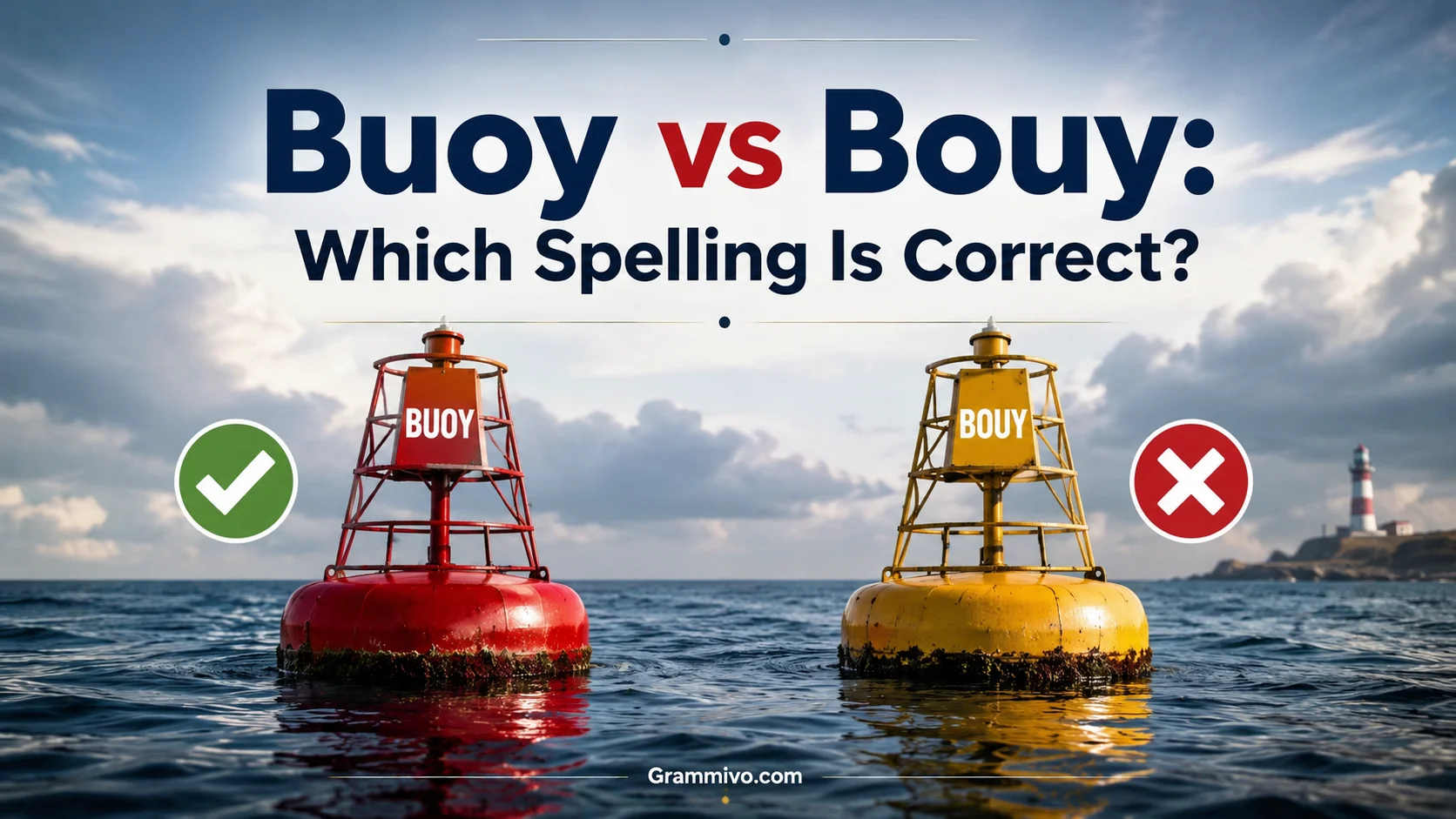
The correct spelling is buoy. The spelling bouy is a common misspelling, not a standard alternative form. A buoy can refer to a floating marker used on water, but the word also works as a verb meaning to keep something afloat or to give someone encouragement and support.
The spelling becomes easier once you understand the word’s meanings, pronunciation, related forms, and a simple way to remember the letter order. This guide covers all of them with practical examples.
Quick Answer:
Buoy is the correct spelling. Bouy is a misspelling.
The standard spelling is:
B-U-O-Y = buoy
A buoy is commonly a floating object placed in water to mark something such as a channel, hazard, location, or boundary. As a verb, buoy can mean to keep something afloat or to lift someone’s spirits.
| Spelling | Correct? | Meaning |
| Buoy | Yes | A floating marker; to support, lift, or keep afloat |
| Bouy | No | Common misspelling of buoy |
For example:
- Correct: The sailor steered toward the red buoy.
- Incorrect: The sailor steered toward the red bouy.
The confusion usually comes from the unusual vowel order. English readers may instinctively write bouy because that sequence feels more familiar. However, standard English uses buoy, with U before O.
What Does Buoy Mean?
The word buoy has both literal and figurative meanings. Its most familiar meaning refers to a floating object used in water.
As a noun, a buoy is a floating marker that serves a particular purpose. Depending on its location and design, it can identify a navigation route, warn boats about an underwater hazard, mark a boundary, or identify a specific area.
For example:
The captain watched the buoy as the boat entered the channel.
The word also works as a verb. In its literal sense, to buoy can mean to keep something afloat or help it remain above the water.
Its figurative meaning is more abstract. If something buoys you, it encourages you, raises your spirits, or gives you renewed confidence.
For example:
Her friends’ support buoyed her after the disappointing result.
Here, nobody is physically floating. The support gives her emotional strength.
The same figurative idea appears in business and economics:
Strong holiday sales buoyed the company’s earnings.
In this sentence, strong sales helped support or strengthen the company’s financial position.
The Two Main Uses of Buoy
You can think of the word as having two broad ideas:
- Physical: something stays afloat or gets support.
- Figurative: someone receives encouragement or confidence.
That connection makes the different meanings easier to understand. A floating buoy supports something physically, while figurative buoying provides emotional or practical support.
Why Is Buoy Spelled “Buoy” Instead of “Bouy”?
The spelling buoy looks unusual because English doesn’t always arrange vowels in ways that feel intuitive to modern readers.
When people hear the word, they often try to reconstruct the spelling from its pronunciation. That can lead to bouy, especially because the letters o-u occur in many familiar English words.
However, pronunciation isn’t a reliable spelling guide for this word.
The standard form is firmly established as buoy. The letters appear in this order:
B → U → O → Y
Not:
B → O → U → Y
This is a useful distinction because the error doesn’t usually involve misunderstanding the word’s meaning. Someone writing bouy generally knows exactly what they mean. They simply reverse the two middle vowels.
English has plenty of words where spelling requires memorization rather than straightforward sound-to-letter conversion. Buoy belongs to that group.
Buoy vs. Bouy: What’s the Difference?
There isn’t a meaningful difference in definition between buoy and bouy because they aren’t two standard spellings of the same English word.
Instead, the distinction is straightforward:
Buoy is the accepted spelling.
Bouy is generally a spelling error.
| Feature | Buoy | Bouy |
| Standard spelling | Yes | No |
| Standard dictionary entry | Yes | No |
| Common intended meaning | Floating marker or support | Usually intended as buoy |
| Used in formal writing | Yes | No |
| Used as noun | Yes | No |
| Used as verb | Yes | No |
| Correct spelling for English learners | Yes | No |
If you’re writing an essay, email, report, article, school assignment, or professional document, choose buoy.
Why Do People Write “Bouy”?
The mistake has a simple explanation: the spelling looks more intuitive when the vowels are reversed.
A writer may remember that the word contains B, O, U, and Y but forget the exact order. Because bouy looks plausible at first glance, the mistake can slip past a quick review.
Pronunciation adds another layer of difficulty. Depending on the speaker and variety of English, buoy may not sound the way its letters suggest.
That combination creates the perfect recipe for a spelling mistake:
- unusual vowel order
- pronunciation that isn’t obvious from the spelling
- infrequent everyday use for some speakers
- a visually plausible misspelling
The solution is simple: memorize BUOY as a single spelling rather than trying to spell it phonetically.
How Do You Pronounce Buoy?
The pronunciation of buoy varies across English-speaking regions.
Cambridge Dictionary lists American English pronunciations including /ˈbuː.i/ and /bɔɪ/. In simple terms, some speakers pronounce it roughly like “BOO-ee,” while others use a pronunciation closer to “boy.”
This regional variation matters because pronunciation can influence how people attempt to spell the word.
If someone pronounces buoy like “boy,” the spelling bouy might seem even less obvious. If someone says “BOO-ee,” the unusual vowel sequence becomes easier to recognize but still isn’t completely predictable.
For spelling purposes, don’t rely on pronunciation.
Remember:
BUOY = B-U-O-Y
The pronunciation may vary. The standard spelling doesn’t.
American Pronunciation and Regional Variation
English isn’t a single uniform sound system. Words can develop different pronunciations across regions while retaining the same spelling.
That’s why two speakers can pronounce buoy differently without either person necessarily using an incorrect form.
For an English learner, this distinction is especially useful. Pronunciation variation doesn’t automatically create spelling variation.
In this case, the standard written form remains buoy.
What Does Buoy Mean as a Noun?
As a noun, a buoy is a floating object placed in a body of water for a specific purpose.
You may encounter buoys in:
- oceans
- bays
- rivers
- lakes
- harbors
- marinas
- shipping channels
- recreational swimming areas
A buoy can provide information to people operating boats or using the water.
For example, it might mark the edge of a navigable channel or identify a hazard. Some buoys can also provide information about a particular location or serve specialized scientific, environmental, or maritime functions.
The important point is that a buoy isn’t simply an object that happens to float. It normally has a deliberate purpose.
Example Sentences With Buoy as a Noun
- The fishing boat passed the yellow buoy.
- A red buoy marked the edge of the channel.
- The swimmers stayed inside the area marked by the buoys.
- The crew spotted a navigation buoy ahead.
- The storm pushed the buoy away from its usual position.
Each sentence uses buoy as a physical object.
What Does Buoy Mean as a Verb?
As a verb, buoy has a literal and a figurative sense.
The literal sense relates to floating or keeping something afloat. The figurative sense involves support, encouragement, confidence, or improvement.
For example:
The flotation device buoyed the swimmer in the water.
Here, buoyed describes physical support.
Now consider:
The unexpected compliment buoyed her confidence.
This sentence uses the figurative meaning. The compliment didn’t physically lift her into the air. Instead, it gave her confidence.
That distinction is important because the verb appears frequently in journalism and business writing.
Buoy in Figurative Language
When writers say that something buoys someone’s spirits, they mean it makes that person feel more hopeful, cheerful, confident, or encouraged.
Common expressions include:
- buoy someone’s spirits
- buoy someone’s confidence
- be buoyed by support
- be buoyed by good news
- be buoyed by success
For example:
The team’s first victory buoyed its confidence before the championship.
The victory gave the team a psychological lift.
What Does “Buoyed By” Mean?
Buoyed by is one of the most common forms of the verb.
It means encouraged, supported, strengthened, or made more confident because of something.
Consider this sentence:
Buoyed by strong customer demand, the company expanded production.
The company didn’t literally float. Strong customer demand gave it a form of support and encouraged expansion.
Another example:
Buoyed by positive reviews, the restaurant opened a second location.
The positive reviews helped create confidence and momentum.
You can use the expression with emotional, social, financial, or practical support.
| Example | Meaning of “buoyed by” |
| Buoyed by her family’s support | Encouraged by support |
| Buoyed by good news | Made more hopeful |
| Buoyed by strong sales | Financially strengthened |
| Buoyed by the victory | Made more confident |
| Buoyed by positive feedback | Encouraged to continue |
Buoy, Buoyant, and Buoyancy
The spelling becomes easier to remember when you connect buoy with related words such as buoyant and buoyancy.
These words share the same underlying idea of floating or being supported.
| Word | Part of Speech | Basic Meaning |
| Buoy | Noun/verb | A floating marker; to support or encourage |
| Buoyant | Adjective | Able to float; cheerful, confident, or strong |
| Buoyancy | Noun | The ability to float; figuratively, resilience or positive energy |
What Does Buoyant Mean?
Buoyant can describe something that floats easily in water.
It can also describe a person who remains cheerful, optimistic, or resilient.
For example:
Despite the setback, she remained buoyant.
In economics, buoyant can describe a strong or healthy condition:
Consumer spending remained buoyant throughout the quarter.
So buoyant carries the same broad idea of rising, floating, or maintaining strength.
What Does Buoyancy Mean?
Buoyancy refers to the tendency or ability of something to float.
In physics, buoyancy relates to the upward force a fluid exerts on an immersed object. That scientific concept explains why some objects float while others sink.
The word also has a figurative use:
His natural buoyancy helped him recover quickly from the disappointment.
Here, buoyancy means emotional resilience or an upbeat quality.
Examples of Buoy in a Sentence
Seeing the word in different contexts makes its meaning much easier to recognize.
Navigation
The sailor used the buoy as a reference point.
Here, buoy is a floating navigational marker.
Water Safety
The swimmers stayed within the area marked by the buoys.
The buoys establish or identify a particular area.
Physical Support
The flotation device helped buoy the injured swimmer.
The verb refers to physical support in water.
Emotional Support
Her family’s encouragement buoyed her spirits.
The word means that the encouragement lifted her emotionally.
Business
Strong demand buoyed the company’s quarterly results.
The verb means that demand supported or strengthened the results.
Confidence
The early victory buoyed the team’s confidence.
The victory gave the team greater confidence.
Read More: Bellwether vs Bellweather: Which Spelling Is Correct?
Common Mistakes With Buoy
The most obvious error is bouy, but several other mistakes can occur.
Writing “Bouy” Instead of “Buoy”
This is the classic spelling error.
Incorrect:
The boat passed the bouy.
Correct:
The boat passed the buoy.
The fix is simply to remember that U comes before O.
Assuming Buoy Has Only a Nautical Meaning
Many people first learn buoy as a water-related noun and overlook its verb forms.
However, you’ll frequently see buoyed in news articles, business reports, and general writing.
For example:
The positive announcement buoyed investor confidence.
There isn’t necessarily a physical buoy involved.
Confusing Pronunciation With Spelling
Because buoy can have different pronunciations, trying to spell it from sound can create problems.
The safer strategy is to remember the written form independently:
BUOY
Forgetting the Final Y
Some writers may remember buo but hesitate over the ending. The standard spelling contains four letters:
B-U-O-Y
The final Y is essential.
How to Remember the Spelling of Buoy
The easiest memory trick is surprisingly simple:
BUOY has U before O.
Think of the word as four fixed pieces:
B + U + O + Y
Don’t rearrange the vowels.
Another useful trick is to associate the word with the thing it describes. Imagine a floating marker with the word BUOY printed across it. The visual connection can make the spelling easier to retrieve later.
A Simple Spelling Test
Cover the word and try to write it from memory:
B _ _ _
Then fill in:
B-U-O-Y
If you instinctively write B-O-U-Y, stop and remember:
The U floats before the O.
That little image can help anchor the correct sequence.
Is “Bouy” Ever Correct?
For standard English writing, bouy is not the correct spelling of the word.
If you see bouy online, the writer may simply have made a spelling mistake. Internet usage doesn’t automatically establish a spelling as standard English.
There can always be exceptions involving usernames, business names, fictional names, product names, or intentionally altered spellings. A person or organization can choose almost any spelling for a proper name.
That doesn’t make bouy a standard spelling of the English word buoy.
For ordinary writing, use buoy.
Buoy vs. Bouy in Formal Writing
Spelling accuracy matters more in formal writing because readers often judge credibility through small details.
A single typo won’t necessarily ruin an article or report. Still, unusual spelling errors can distract readers because they interrupt the flow of a sentence.
Using bouy in a professional document can also make the writer appear uncertain about a basic term, especially when the word appears in a technical or maritime context.
Use buoy in:
- school assignments
- college papers
- professional emails
- business reports
- technical documents
- journalism
- website content
- formal correspondence
- resumes and application materials
FAQs:
Is “bouy” a word?
Bouy is generally a misspelling of buoy, the standard English word. For normal English writing, use buoy.
Is “buoy” the correct spelling?
Yes. Buoy is the correct standard spelling.
The letters are:
B-U-O-Y
How do you spell buoy?
Spell it B-U-O-Y.
The most common mistake is switching the positions of U and O to create bouy.
How do you pronounce buoy?
Pronunciation varies among English speakers. Cambridge Dictionary lists American pronunciations including /ˈbuː.i/ and /bɔɪ/.
In everyday terms, it may sound roughly like “BOO-ee” or “boy,” depending on the speaker and region.
What does buoy mean?
As a noun, a buoy is a floating marker or object used in water.
As a verb, buoy can mean to keep something afloat or to encourage, support, or strengthen someone or something.
Conclusion:
When choosing between buoy vs bouy, there isn’t much mystery once the spelling is clear. A buoy can be a floating marker in water. The word can also function as a verb meaning to keep something afloat or provide support, encouragement, or strength.
You’ll encounter the word in nautical contexts, everyday descriptions, emotional writing, journalism, business reporting, and economics. Forms such as buoys, buoyed, buoying, buoyant, and buoyancy all build on the same core idea of floating, support, or uplift.
