
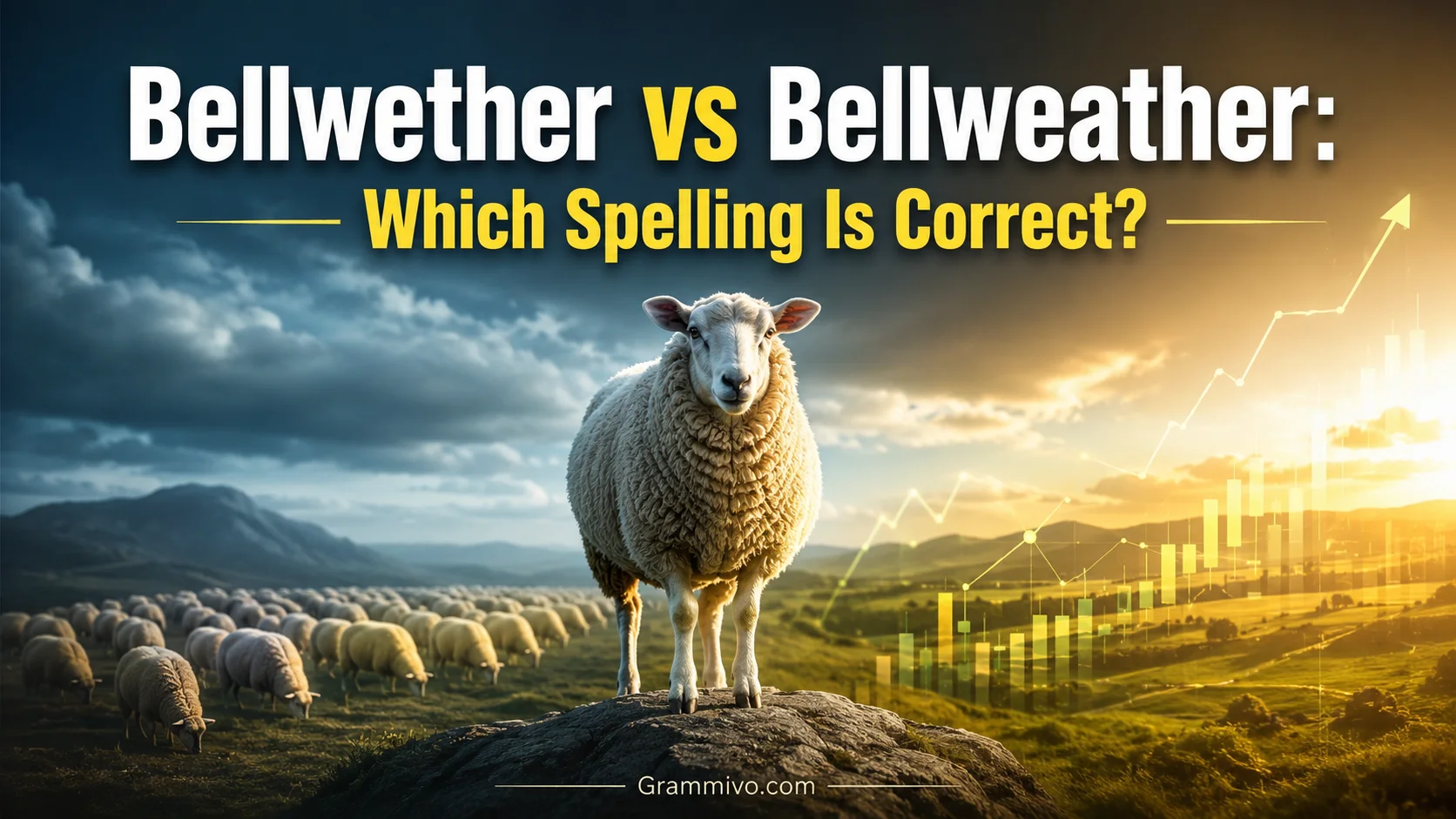
If you’ve ever written bellweather instead of bellwether, you’re not alone. The two spellings look almost identical, and the familiar word weather makes the incorrect version feel perfectly reasonable. However, when you mean a person, place, company, event, or other thing that leads a trend or signals what may happen next, bellwether is the correct spelling.
The confusion becomes easier to understand once you know where the word came from. Bellwether combines bell with the older word wether, which means a castrated male sheep. Historically, a bell could be placed around the neck of a leading sheep so the rest of the flock could follow it. Over time, that literal image developed into the modern figurative meaning of a leader or indicator.
Quick Answer:
Bellwether is the correct spelling. Bellweather is generally a misspelling when you mean a leader, trendsetter, or indicator of future developments.
The word bellwether can describe something that provides a useful signal about a larger situation. For example:
“The company is considered a bellwether for the technology industry.”
Here, bellwether means the company’s performance may provide clues about where the wider technology industry is heading.
You’ll see the word in several common expressions, including:
- bellwether state
- bellwether company
- bellwether stock
- bellwether industry
- bellwether indicator
- bellwether of change
- bellwether for consumer trends
The incorrect spelling bellweather probably arises because weather is a familiar English word. The meaning of bellwether also involves predicting or indicating trends, which can make the weather spelling seem even more logical.
But the history tells a different story.
Bellwether vs Bellweather: The Key Difference
The simplest way to distinguish the two forms is to look at the middle of the word.
| Spelling | Correct standard form? | Meaning |
| bellwether | Yes | A leader or indicator of a broader trend |
| bellweather | No, for this meaning | Common misspelling of bellwether |
| bell weather | No | Not the standard spelling of the word |
Bellwether is the established dictionary spelling.
Bellweather replaces wether with the much more familiar weather. That substitution changes the spelling without creating a standard alternative form of the word.
For example:
- Incorrect: “The state is a bellweather in national elections.”
- Correct: “The state is a bellwether in national elections.”
Another example:
- Incorrect: “The company has become a bellweather for the industry.”
- Correct: “The company has become a bellwether for the industry.”
The correct spelling may look unusual at first. Once you understand its origin, however, it becomes much easier to remember.
What Does Bellwether Mean?
Bellwether is a noun with two closely connected meanings.
First, it can refer to a leader or trendsetter. Second, it can describe something that serves as an indicator of a broader trend or future development.
The second meaning appears frequently in modern journalism, politics, economics, finance, and business writing.
Consider this sentence:
“The retailer’s holiday sales are a bellwether for consumer confidence.”
The retailer isn’t literally leading consumers around like a sheep. Instead, its sales figures may reveal something about the spending habits of consumers more broadly.
Similarly:
“The county has long been viewed as a political bellwether.”
That means election results in the county have historically been viewed as a useful indication of wider political sentiment.
The word therefore carries the basic idea of following a leader or using one thing as a signal of what comes next.
Why Is Bellwether Spelled With Wether?
The spelling makes much more sense when you know what wether means.
A wether is an older English term for a castrated male sheep. The word isn’t related to atmospheric weather.
Historically, a shepherd could place a bell around the neck of a sheep that led or moved prominently within a flock. The sound of the bell helped others identify and follow that animal.
That produced the literal compound bellwether:
bell + wether = bellwether
Eventually, the image of a bell-wearing lead sheep became a metaphor for a person or thing that leads others.
The modern meaning expanded further. Today, a bellwether doesn’t have to lead directly. It can simply signal a larger movement.
That semantic shift explains why the word works so naturally in phrases such as “bellwether stock” and “bellwether state.”
Bellwether Has Nothing to Do With Weather
This is the biggest spelling trap.
The words wether and weather look and sound similar, but they have completely different meanings.
| Word | Meaning |
| wether | A castrated male sheep |
| weather | Atmospheric conditions such as rain, wind, heat, or snow |
| whether | Used when expressing alternatives or uncertainty |
That distinction matters because English contains several words that sound alike or nearly alike but have unrelated histories.
For example:
- “The weather is unusually warm today.”
- “The shepherd watched the wether.”
- “I don’t know whether she’ll attend.”
- “The company is an industry bellwether.”
The last sentence uses wether because the word comes from the sheep-related term.
A useful memory trick is simple:
A bellwether has a bell and a wether. It doesn’t predict the weather.
The Origin and History of Bellwether
The history of bellwether reaches back to Middle English.
Merriam-Webster traces the word to Middle English bellewether. Its original literal sense involved a sheep carrying a bell. The figurative idea of a leader developed from that physical image.
The historical concept is straightforward. A flock needs to move together, and a bell makes one animal easier to identify. Once the bell becomes associated with the animal at the front or with a particularly influential animal, the metaphor of leadership becomes natural.
Language often develops this way. A concrete object becomes an image, and the image eventually becomes an abstract idea.
The same pattern appears in many English expressions. Someone can be called a pacesetter because they set the pace for others. A trailblazer metaphorically creates a path for people to follow. A bellwether similarly evokes a leader whose movement helps indicate where others may go.
The modern word retains that old leadership image even though most people who use it aren’t thinking about sheep.
How to Pronounce Bellwether
In standard US English, bellwether is commonly pronounced approximately:
BEL-weth-er
The first part sounds like bell. The middle comes from wether, not weather.
You don’t need to pronounce it as three strongly separated words. In ordinary speech, it flows naturally:
“BEL-weth-er”
For English learners, the unusual spelling can make pronunciation seem harder than it is. Once you connect wether with the older sheep-related word, the pronunciation becomes easier to remember.
How to Use Bellwether in a Sentence
The word usually appears as a noun. It often follows a, the, or another determiner.
Several patterns are especially common.
Bellwether for
Use bellwether for when something indicates a broader development.
“Housing prices can be a bellwether for consumer confidence.”
“The company’s earnings became a bellwether for the retail sector.”
This construction emphasizes the thing being measured or predicted.
Bellwether of
Use bellwether of when you want to describe something as an indication or sign of a broader condition.
“The election was seen as a bellwether of changing public attitudes.”
“The product became a bellwether of a new consumer trend.”
The choice between for and of often depends on sentence structure and emphasis. Both constructions are established in modern English.
Bellwether state
A bellwether state is a state whose political results are considered potentially indicative of broader national voting patterns.
The term appears frequently during US elections.
For example:
“Analysts watched the state closely because it was considered a political bellwether.”
Importantly, bellwether doesn’t mean the state will always predict the national result. It means observers regard its behavior or outcome as a potentially useful signal.
That distinction prevents the word from being misunderstood as a guarantee.
Bellwether company
A bellwether company is a business whose performance can provide clues about a larger industry or market.
Suppose a major retailer reports unusually strong consumer spending. Analysts might describe the company as a bellwether for retail if its results provide useful information about broader consumer behavior.
The company’s size, market position, customer base, or economic importance can make its performance particularly informative.
Bellwether in Politics
Politics provides one of the most recognizable modern uses of bellwether.
A bellwether state, county, or district is one that observers consider representative of broader electoral trends.
The term appears because election results can sometimes reveal shifts in voter preferences before those shifts become obvious elsewhere.
However, political bellwethers can change over time. A region that accurately reflected national voting patterns in one period may become less representative later as demographics, party coalitions, economic conditions, and political identities change.
That makes bellwether more precise than simply calling a place “important.”
A bellwether is important because its behavior may signal something larger.
Bellwether in Business and Finance
Business writing uses bellwether in much the same way.
A company can become a bellwether when investors or analysts treat its performance as evidence about a wider market.
For instance, a major semiconductor manufacturer might be described as a bellwether for technology demand. Its orders and revenue could provide clues about demand across several related sectors.
Likewise, a large retailer may act as a bellwether for consumer spending.
The word doesn’t necessarily mean that the company controls the entire market. Instead, it suggests that the company’s performance has diagnostic value.
In finance, you’ll also encounter bellwether stock. This describes a stock that investors view as an indicator of broader market or industry conditions.
That makes bellwether different from largest. A company can be the largest business in a sector without necessarily serving as a reliable indicator of where the entire sector is heading.
Read More: Believe vs. Belive: Which Spelling Is Correct?
Bellwether in Technology
Technology provides another useful setting for the word.
A product can become a bellwether for consumer adoption if its sales or popularity reveal a larger shift in behavior.
For example:
“The rapid adoption of the device became a bellwether for the growing demand for wearable technology.”
Here, the device isn’t necessarily responsible for the entire trend. Its success serves as evidence that the trend exists and may continue.
The same idea applies to software, artificial intelligence, cybersecurity, cloud computing, smartphones, and other rapidly changing fields.
When an industry moves quickly, analysts often look for signals. A bellwether provides one.
Bellwether in Fashion and Culture
The word also works outside economics and politics.
A fashion brand might become a bellwether for changing consumer tastes. A popular music genre could serve as a bellwether for a cultural shift. A new entertainment platform might become a bellwether for changing viewing habits.
For example:
“The rapid popularity of short-form video became a bellwether for changing online media habits.”
The important idea is broader than popularity.
Something isn’t automatically a bellwether just because lots of people like it. It becomes a bellwether when its behavior helps indicate a wider pattern.
That’s an important distinction.
Bellwether vs. Similar Words
Several English words overlap with bellwether, but they aren’t perfect substitutes.
| Word | Main idea | How it differs from bellwether |
| Bellwether | Leader or broader trend indicator | Can signal where a larger group or market is heading |
| Trendsetter | Someone or something that starts a trend | Focuses more on creating a trend |
| Leader | Person or thing that leads | Broader and less specific |
| Indicator | Something that provides information | Doesn’t necessarily imply leadership |
| Barometer | Something that reflects conditions | Often emphasizes measurement or current conditions |
| Predictor | Something that helps forecast an outcome | More directly focused on prediction |
| Pacesetter | Someone or something that establishes a pace or standard | Stronger emphasis on setting the standard |
| Forerunner | A person or thing that comes before another | Emphasizes precedence rather than measurement |
This comparison shows why bellwether has a useful niche.
A trendsetter may cause a trend. A bellwether may reveal that a trend is developing.
A predictor may forecast an outcome through a model or known relationship. A bellwether is often a real-world person, place, company, event, or result that observers use as a practical signal.
Common Mistakes With Bellwether
The most common mistake is straightforward:
bellweather instead of bellwether.
But several related errors can also cause confusion.
Mistake 1: Writing Bellweather
“The retailer is a bellweather for consumer spending.”
“The retailer is a bellwether for consumer spending.”
The incorrect form probably comes from the familiar word weather. Standard English uses bellwether for this meaning.
Mistake 2: Thinking Bellwether Means Weather Predictor
The word may appear in discussions about prediction, but it doesn’t refer specifically to atmospheric conditions.
A bellwether can indicate a trend. A weather-related term concerns atmospheric conditions.
Mistake 3: Assuming Bellwether Means Trendsetter
The two concepts overlap, but they aren’t identical.
A trendsetter helps establish a new direction. A bellwether can simply indicate that the direction is emerging.
Mistake 4: Treating Bellwether as a Guarantee
Calling something a bellwether doesn’t mean it predicts the future with certainty.
A bellwether is better understood as a signal, not a crystal ball.
Is Bellweather Ever Correct?
For the standard noun meaning “a leader or indicator of a trend,” bellweather is not the standard spelling. The established spelling is bellwether.
However, there’s an important distinction when you encounter Bellweather as a name.
Businesses, organizations, products, publications, and other entities can intentionally choose unusual spellings for branding. If Bellweather appears as a proper name, its spelling may be deliberate.
That doesn’t make bellweather an accepted alternative spelling of the ordinary English word bellwether.
In other words:
- bellwether = standard English word
- bellweather = generally a misspelling in ordinary usage
- Bellweather as a brand or proper name = potentially intentional
Context matters.
FAQs:
Is bellwether or bellweather correct?
Bellwether is correct. Bellweather is generally a misspelling when you mean a leader or indicator of a broader trend.
What does bellwether mean?
A bellwether is a person or thing that leads others or serves as an indicator of a broader trend. Modern usage often focuses on the second meaning.
Why is bellwether spelled with “wether”?
The word comes from the older term wether, meaning a castrated male sheep. Historically, a bell-wearing sheep could lead a flock, which inspired the modern figurative meaning.
Is bellweather a word?
Bellweather is not the standard spelling of the noun bellwether. You may encounter Bellweather as an intentional proper name or brand name, but ordinary English uses bellwether.
Does bellwether have anything to do with weather?
No. Bellwether and weather have different origins and meanings. Wether refers to a male sheep, while weather refers to atmospheric conditions.
Conclusion:
When comparing bellwether vs bellweather, the answer is clear: bellwether is the correct standard spelling when you mean a leader, trendsetter, or indicator of broader developments. The unusual spelling isn’t random. It comes from bell + wether, with wether referring to a castrated male sheep. The historical image of a bell-wearing sheep helped create the modern metaphor for something that leads or signals where others may be headed.
