
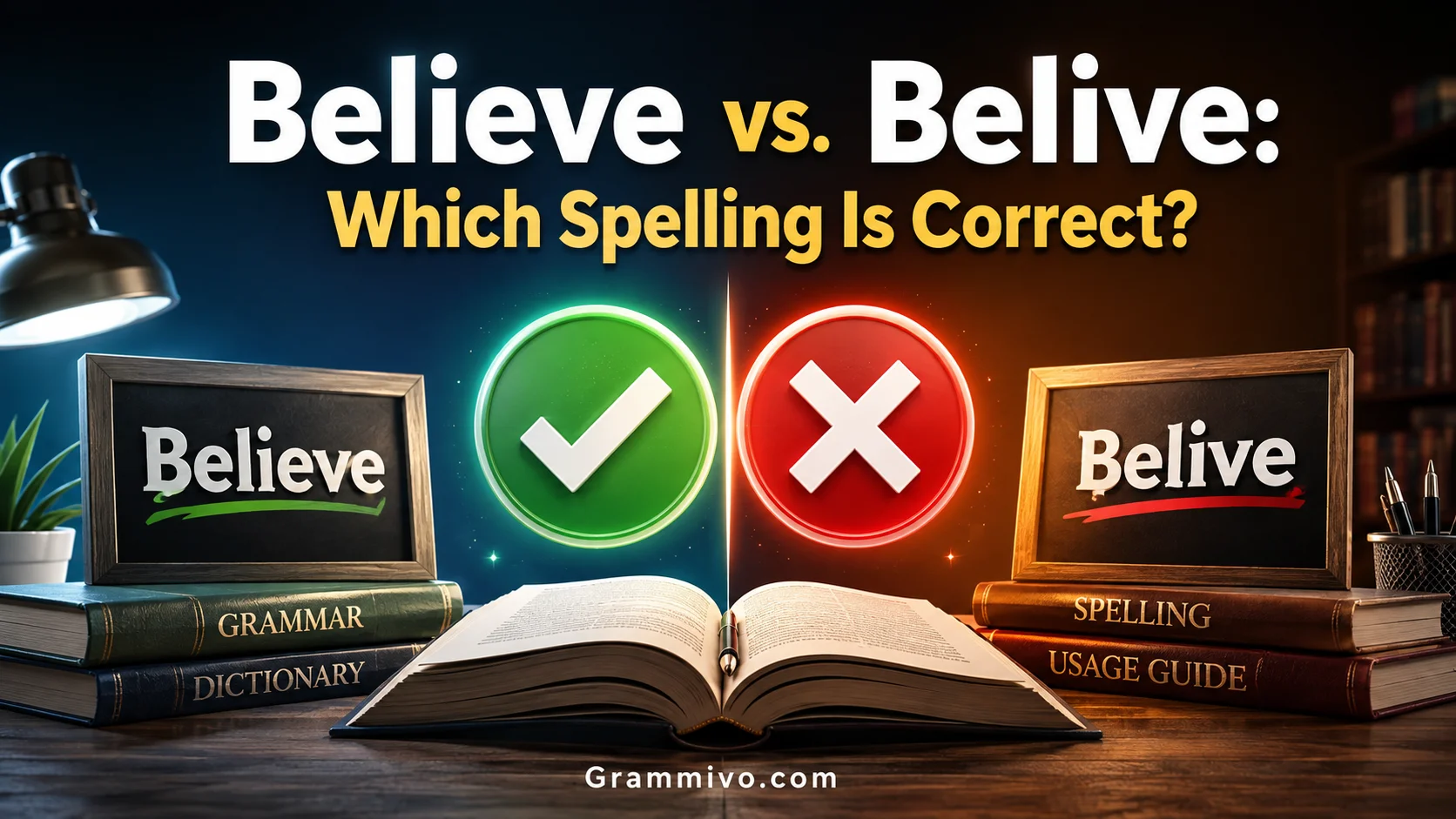
Have you ever typed “belive” and wondered whether you were missing something? You’re not alone. Believe is one of those English words whose spelling looks simple until you have to write it from memory. The pronunciation doesn’t clearly reveal every letter, and the familiar -ieve pattern can easily trip up even experienced writers.
The good news is that the answer is straightforward: believe is the correct spelling when you mean “to accept something as true,” “to think something is true,” or “to have confidence in someone or something.” Belive is normally a misspelling in this context. There is, however, a rare Scottish word belive with a completely different meaning, which explains why the spelling can occasionally appear in dictionaries.
Quick Answer:
Believe is the correct spelling in standard modern American English when you mean “to accept something as true” or “to have confidence or faith.”
- Correct: I believe you.
- Incorrect: I belive you.
- Incorrect: I beleive you.
- Correct: She believes the story.
- Correct: We believed him.
- Correct: They are believing in themselves.
The spelling is B-E-L-I-E-V-E.
The form belive does exist as a rare Scottish adverb meaning roughly “in due time” or “by and by.” That unusual word has nothing to do with the everyday verb believe used in American English.
| Spelling | Standard use | Meaning |
| believe | Correct | To accept as true, trust, think, or have faith |
| belive | Usually incorrect | Normally a misspelling of believe; also a rare Scottish adverb |
| beleive | Incorrect | Common misspelling of believe |
So, if you’re writing an email, essay, text message, report, or social media post, choose believe.
Believe vs. Belive: What’s the Difference?
The difference between believe and belive usually comes down to one missing letter.
Believe is the standard English verb. It has several closely related meanings, including accepting something as true, holding an opinion, trusting someone, or having faith in something.
Belive, when someone writes it in an ordinary sentence such as “I belive you,” is almost certainly a spelling error.
For example:
I believe everything you told me.
Here, believe means that the speaker accepts the other person’s statements as truthful.
Compare that with:
I belive everything you told me.
The meaning is understandable, but the spelling is incorrect in standard American English.
There’s one interesting exception. Dictionaries record belive as a rare Scottish adverb. In that historical or dialectal use, it can mean something like “soon,” “in due time,” or “by and by.” It isn’t an alternative spelling of the common verb believe.
That distinction matters because seeing belive in an old Scottish text doesn’t necessarily mean the writer made a spelling mistake.
What Does Believe Mean?
The verb believe describes a mental state in which you accept something as true, regard something as likely or factual, or place trust or confidence in someone or something.
Merriam-Webster defines believe in several related ways, including accepting something as true, holding an opinion, and having a firm or trusting faith.
The exact meaning depends on the construction.
Believe Something Is True
You can use believe when you accept a statement, explanation, or claim as true.
Examples:
- I believe your story.
- She believes the information is accurate.
- They believed his explanation.
- Do you believe what he said?
- We believe the results are reliable.
Here, the word focuses on acceptance of information.
Believe in Someone or Something
The phrase believe in has a slightly different sense.
It can express confidence, trust, faith, or acceptance of the value or existence of something.
For example:
- I believe in you.
- She believes in hard work.
- They believe in equality.
- Do you believe in ghosts?
“I believe you” and “I believe in you” aren’t interchangeable.
I believe you means:
I accept what you’re telling me as true.
I believe in you means:
I have confidence in your abilities or potential.
That small preposition changes the relationship between the speaker and the idea being expressed.
How Do You Spell Believe?
The correct spelling is:
B-E-L-I-E-V-E
A useful way to visualize it is:
be + lie + ve = believe
The middle of the word contains the sequence lie:
be-lie-ve
This isn’t a formal spelling rule, but it can work as a memory aid.
Another useful phrase is:
I believe I can achieve.
Both believe and achieve contain the -ieve sequence. Linking the two words can make the spelling easier to remember.
Believe vs. Belive Spelling
Look closely at the difference:
| Correct | Incorrect |
| believe | belive |
| believed | belived |
| believing | — |
| believes | belives |
The most common mistake involves dropping the e that appears before the final v-e sequence.
The correct word has three consecutive vowel letters across its middle and ending pattern:
b-e-l-i-e-v-e
That spelling can feel unintuitive because English pronunciation doesn’t always tell you exactly which vowels belong in a word.
Why Is Belive Usually Incorrect?
Belive is usually incorrect because the standard English verb is spelled believe.
The missing e creates the problem.
English spelling often preserves historical patterns that aren’t obvious from pronunciation. Believe is a good example. When you hear the word aloud, you don’t hear every individual letter. You hear something closer to buh-LEEV in ordinary American pronunciation.
That creates a gap between sound and spelling.
A learner might reasonably think:
“If it sounds like ‘beliv,’ why shouldn’t I spell it that way?”
That’s exactly where English spelling gets tricky. Pronunciation can guide spelling, but it can’t always determine it.
Consider these related words:
- believe
- belief
- believable
- believer
- unbelief
- unbelievable
Once you recognize the spelling family, believe becomes easier to remember.
Believe vs. Beleive vs. Belive
Three spellings frequently get mixed up:
- believe — correct
- belive — normally incorrect
- beleive — incorrect
The third version, beleive, is especially common because writers sometimes place the e before the i.
The correct sequence is:
belie…
not:
belei…
So remember:
believe
not:
beleive
and not:
belive
Why Is Beleive Wrong?
Beleive isn’t the standard spelling of the English verb.
It looks plausible because English contains many words with different vowel arrangements. For example:
- receive
- perceive
- deceive
- conceive
Those words can make spelling patterns feel inconsistent. However, believe follows its own established spelling.
The safest approach isn’t to force every English word into one spelling rule. Instead, learn the word’s established form and recognize its related words.
A Simple Trick to Remember Believe
Spelling tricks work best when they give your memory something concrete to grab.
One useful phrase is:
I believe I can achieve.
Both believe and achieve use the -ieve pattern.
Another memory device focuses on the middle:
be-LIE-ve
The word lie appears inside believe.
That gives you:
BE + LIE + VE
It’s not a grammatical rule. It’s simply a visual cue.
The “I Before E” Rule and Believe
You may have learned:
“I before E except after C.”
That familiar rhyme can sometimes help with believe, but don’t treat it as an absolute rule.
English has plenty of exceptions. The spelling system developed from multiple historical sources, so a single rhyme can’t accurately predict every word.
For believe, the useful part is simply recognizing the ie sequence:
believe
The word doesn’t contain cei or ei in the position that causes confusion.
Believe in a Sentence: Correct Examples
Seeing the word in context is one of the quickest ways to understand its spelling and meaning.
Examples With Believe
- I believe you.
- We believe the evidence supports the claim.
- She believes that the plan will work.
- I can’t believe how quickly the year passed.
- Do you believe his explanation?
- They believed the warning was genuine.
- He doesn’t believe the rumor.
- I believe this is the best option.
- Many people believe the tradition dates back centuries.
- She wants to believe that everything will improve.
Notice that believe can appear before a person, a noun phrase, or a clause.
For example:
I believe you.
I believe the story.
I believe that she is telling the truth.
The grammatical structure changes, but the spelling stays the same.
Read More: Becoming vs. Becomeing: Which Spelling Is Correct and Why?
Believe vs. Believe In
This distinction deserves special attention because learners often understand the spelling but still use the verb incorrectly.
“I Believe You”
When you say:
I believe you.
You’re saying that you accept the person’s statement as truthful.
Imagine a friend tells you:
“I didn’t take your book.”
You respond:
“I believe you.”
You’re expressing confidence that the person’s statement is true.
“I Believe in You”
Now consider:
I believe in you.
This usually expresses confidence in someone’s ability, character, or future success.
A coach might tell an athlete:
“You’re ready for this. I believe in you.”
The coach isn’t simply saying the athlete’s statement is true. The coach is expressing confidence in the athlete.
This distinction becomes especially important in emotional and professional communication.
| Expression | Typical meaning | Example |
| believe someone | Accept what someone says as true | I believe you. |
| believe something | Accept something as true | I believe the report. |
| believe in someone | Have confidence in someone | I believe in you. |
| believe in something | Have faith in or accept the value/existence of something | She believes in fairness. |
Common Mistakes With Believe
Spelling believe correctly becomes easier once you know which mistakes to watch for.
Belive
I belive you.
I believe you.
The incorrect version drops an e.
Beleive
I beleive this is true.
I believe this is true.
Here, the letters i and e appear in the wrong order.
Belived
They belived him.
They believed him.
The past tense retains the ie sequence before adding d.
Belives
She belives everything.
She believes everything.
The third-person singular form is believes, not belives.
Believing
The present participle is:
believing
For example:
She is believing in herself again.
The spelling changes because English generally drops the final silent e before adding -ing.
This gives you a useful word family:
| Form | Correct spelling |
| Base form | believe |
| Third-person singular | believes |
| Past tense | believed |
| Present participle | believing |
| Noun | belief |
| Person | believer |
| Adjective | believable |
Believe vs. Belief: Don’t Mix Them Up
Believe and belief come from the same word family, but they perform different grammatical jobs.
Believe is a verb.
I believe you.
Belief is a noun.
Her belief in the project never disappeared.
You can think of the distinction this way:
Believe = the action or mental state.
Belief = the idea or conviction itself.
Compare these examples:
- I believe the story.
- My belief in the story is strong.
- They believe in the principle.
- Their belief in the principle is sincere.
The spelling changes because the words serve different grammatical functions.
Believe and Belief Spelling
The contrast is worth memorizing:
believe → belief
The final e changes position in the related noun.
That can confuse learners because both words sound similar.
However, once you’ve seen the pair repeatedly, the distinction becomes much easier to recognize.
Believe Word Forms and Related Words
Understanding the larger word family can reinforce the correct spelling.
| Word | Part of speech | Meaning |
| believe | Verb | Accept as true or have confidence |
| believes | Verb | Third-person singular form |
| believed | Verb | Past tense or past participle |
| believing | Verb/adjective | Present participle or describing someone who believes |
| belief | Noun | A conviction or accepted idea |
| believer | Noun | Someone who believes |
| believable | Adjective | Capable of being accepted as true |
| unbelievable | Adjective | Difficult or impossible to believe |
| unbelief | Noun | Lack of belief |
For example:
The explanation was believable, so I believed it.
And:
Her belief in the team’s ability made her a committed believer in the project.
Learning related forms gives you more than a spelling trick. It helps you understand how English builds words from a common base.
FAQs:
Is “belive” a correct spelling?
Not when you’re using the ordinary English verb meaning “to accept as true” or “to have confidence in.” The correct spelling is believe.
Belive does appear as a rare Scottish adverb, but that is a different word with a different meaning.
Is it believe or belive?
Believe is correct.
For example:
I believe you.
Not:
I belive you.
Is beleive a word?
Beleive is not the standard spelling of the English verb. It’s a common misspelling of believe.
Why do people spell believe as belive?
The word is easy to mistype because its pronunciation doesn’t clearly reveal every letter. The -ieve pattern also makes the spelling harder to recall.
The correct spelling is:
b-e-l-i-e-v-e
How can you remember the spelling of believe?
Try:
I believe I can achieve.
Both words use the -ieve pattern.
You can also visualize the word as:
be-LIE-ve
Conclusion:
When you’re choosing between believe and belive in ordinary American English, the answer is clear: Use it when you mean to accept something as true, think something is true, trust a statement, or have confidence or faith. The spelling belive is normally a mistake in this context. Although dictionaries record belive as a rare Scottish adverb, that historical or regional usage isn’t an alternative spelling of the everyday verb.
